
by John Allen Paulos
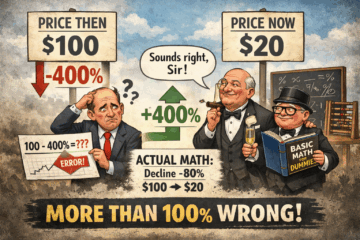 Oy. Where to start? Let me begin with a recent abuse involving percentages. Trump’s absurd claims about price declines of more than 100% have elicited a lot of well-deserved derision. How could someone with an undergraduate degree in business from Wharton make these mathematically impossible claims?
And why would the billionaire Commerce Secretary Howard Lutnick attempt to show that Trump’s claims might be made to look rational. That’s an easier question. Toadyism.
Lutnick’s effort is a laughable, but perhaps superficially appealing “explanation” for claims about percentage declines of more than 100%
Here’s a cleaned up account of the mistake: Say an item sells for $100 at a given point, but for whatever reason after some time it sells for $20. Consumers at the later time, would be right to note that for the $20 price to rise to its earlier price of $100 it would have to rise by 400%.
Now an innumerate politician who might be supported by a rich yes man would be quite wrong to claim that at the later time the price had declined by 400%. That, of course, remains nonsensical (it declined by 80%), but it is perhaps a compelling conclusion for those whose knowledge of basic math is on a par with their fluency in Kazakh.
The Trump-Ludnick story is related to a surprisingly common misunderstanding about percentages. To illustrate it, tell people that a 50% decline in the price of an item followed by a 50% increase in its price will restore the price of the item. Many people, perhaps most, will believe you. Giving in to my professorial tendencies, I’ll mention here another very common misunderstanding, and that is the distinction between rising by x% and rising by x percentage points. If, for example, the diagnosis rate of some childhood disease rose from 1% two years ago to 4% last year, the rate rose 3 percentage points during that time, but it can also be rightly said that the rate rose 300%. Which equivalent characterization here and elsewhere politicians use is often determined by which one seems more consistent with their policy goals.
Of course, the attempts by Lutnick and others to simply ignore or rationalize Trump’s many fallacious claims would likely fall on Trump’s deaf ears as would simple discussions like those above; they’re probably beyond Trump’s toddler-level numeracy, as even fractions appear to be since he invariably ignores the denominator when discussing the fraction of immigrants committing crimes.
More generally he misuses percentages and other basic notions to self-aggrandize, wield power, and exact revenge via obfuscation, lies, and, especially, hyperbolically hyperbolic hyperbole. Sadly, Lutnick and others who should know better back him up like trained seals. Attorney General Bondi claimed, for example, that military efforts to limit fentanyl have saved 258 million American lives or about three-quarters of the American population. She proudly stressed the claim seemingly oblivious to its absurdity and to the distinction between lives and dosages. Trump and even others in his administration seem to treat numbers generally as providing decoration, not information.
Trump’s unthinking response to so many issues is an unholy combination of mendacity, cruelty, and innumeracy – the climate (it’s a hoax), tariffs (have brought in 18 trillion dollars in new investment), elections (rigged, almost by definition, if he loses), and healthcare (the ending of medicaid and vaccine denialism). Just one more dreadful example related to the latter is the draconian closing down of USAID (the US Agency for International Development) and its depressingly deadly consequences. Many Trump supporters believed him when he said that the US is spending much too much money on foreign aid and that we should eliminate it. But USAID constituted less than 3 tenths of 1 % of GDP, a figure some benighted souls might read as 31%.
In my 1989 book Innumeracy I noted that one million seconds is about 11 ½ days, a billion seconds about 32 years, and a trillion seconds about 32,000 years. Over time with more exposure to large numbers I would have thought this elementary equivalence would have become commonplace. Unfortunately it’s not commonplace enough to have reached Trump and many of his supporters.
This listing of just a very few of Trump’s numerical abuses suggests to me an obvious question: why don’t politicians and journalists demur when Trump says something arithmetically ludicrous? “Sir, isn’t that percentage impossible,” or “Mr. President, what is the evidence for that enormous number.” Would they mutely accept it if he insisted that 2+2 equals 22
Were Trump in my class, I would give him a grade 600% below passing. Perhaps Wharton might even consider revoking his degree.
***
John Allen Paulos is an emeritus Professor of Mathematics at Temple University and the author of Innumeracy and A Mathematician Reads the Newspaper. These and his other books are available here (https://johnallenpaulos.com/booksandreviews.html).
Enjoying the content on 3QD? Help keep us going by donating now.