
Marleen Rozemond at Notre Dame Philosophical Reviews:
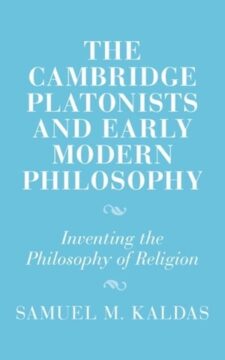 Samuel Kaldas’s book is an extremely welcome addition to the growing literature on the Cambridge Platonists. These philosophers have suffered from significant neglect by historians of philosophy, but as a result of the recent interest in lesser known early modern thinkers, this has been changing. Two questions are central to Kaldas’s book: (1) Is the term “Cambridge Platonists” an apt label for the philosophers in question? And (2) What is their significance in the history of philosophy? Contrary to some scholars (19-20), Kaldas convincingly argues that the label is warranted for Henry More, Ralph Cudworth, and the less well-known John Smith and Benjamin Whichcote. They shared a significant commitment to various Platonist ideas, and their contemporary critics sometimes accused them of inappropriately Platonizing tendencies. For Kaldas, their main importance lies in their contribution to the history of the philosophy of religion. He compellingly documents their significance in that context, but as I will explain later, they also have a lot to offer in other areas of philosophy.
Their contribution to the philosophy of religion, Kaldas argues, consists in participation in an intense and prominent debate about the Doctrine of Double Predestination (DDP), a central doctrine in Calvinism in mid-17th century England. DDP holds that no human beings deserve salvation due to our intrinsically defective nature, the doctrine of “total depravity”.
more here.
Enjoying the content on 3QD? Help keep us going by donating now.