
by Mary Hrovat
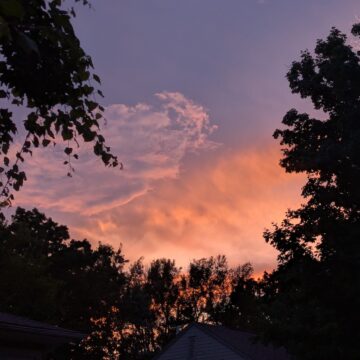
I’ve come to believe that any aspect of nature, large or small, will reward patient, open-ended attention. I’ve been photographing the sky for three years. Here I describe some of the things that I’ve come to appreciate about it.
The sky is full of color and light. It’s blue, of course, and children drawing the sky tend to leave it at that. When you look closely, though, you can see so many shades of blue, so many variations in the light. I could write at great length about the incredible colors of sunrise and sunset, or the marvels of light and shadow in the golden hour, or the varieties of lightning. But even in a clear sky at midday, the color varies across the sky. Twilight has its own shades of blue.
Clouds have innumerable colors, ranging from pure white through many subtle grays to almost black. They sometimes cast shadows on each other or on the sky. Water droplets and ice crystals in the sky can cause colorful or even startling effects such as rainbows, sun dogs, and sun pillars. And at night, in addition to the moon, there are planets, comets, meteors—less brilliant, more subtle, and infinitely engaging.
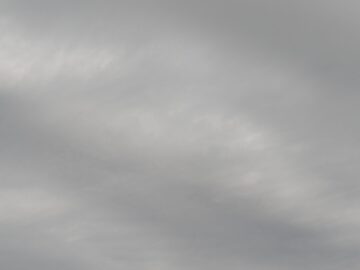
The sky is always in motion. One of the first things I noticed when I began to photograph the sky daily was that it changes hour by hour, if not moment by moment. I’ve known for a long time that clouds move, of course; I remember being thrilled by that fact as a child. But it wasn’t until I began photographing the sky daily that I finally began to notice how variable it is. If I see clouds that I’d like to photograph, I need to do it right now. On a stormy day, clouds may race through the sky. When the moon is above the horizon, it can be especially easy to see clouds as they alternately reveal and conceal the moon.
Certainly there are sunny days with few clouds. On other days, especially in winter, the clouds can seem like a heavy featureless blanket from dawn to dusk. Even then, in both cases, the sky’s appearance often shifts subtly throughout the day.
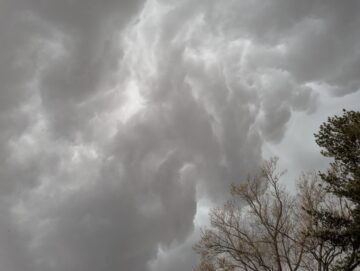
The sky is wordless, and yet we read it. The presence or absence of clouds, and their types, can tell us what kind of weather might lie ahead. In daylight hours, we can usually spot a storm coming. Under cloudy but calm skies, we may be able to estimate the likelihood of rain. It’s possible, over time, to form a felt sense of the likely weather in a location based on current conditions, including the appearance of the sky. These days, you can broaden that sense by learning about, for example, the conditions required for various types of clouds to form.
For most of humanity’s existence, all we had was a collective felt sense of weather based on experience. Old weather lore (for example, “Red sky at night, sailor’s delight; red sky at morning, sailors take warning”) represents vestiges of this shared knowledge.
The sky also tells us where we are in time. We can generally estimate the time of day from the position of the sun or the level of light. On the shortest, cloudiest days of winter, it may be impossible to tell noon from tea time, but by and large, the sky gives us a reliable indication of how much daylight is left and when the sun is going to rise or set. The position of the sun, or the constellations visible in the night sky, can often tell you at least broadly where you are in the year.
“There is no clock on Earth that gives the correct time,” according to Kevin Birth; he was making a point about how the time told by clocks is always an approximation that we calculate. The sky doesn’t give us the kind of approximation that enables us to precisely coordinate our interactions with other people. Rather, it gives us a felt sense of where we are in the flow of days and seasons. Again, for a long time that was all we had, or all that most of us had. That felt sense can be quite satisfying, even comforting, despite its imprecision.
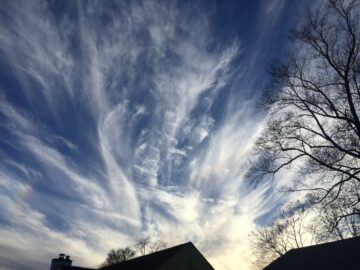
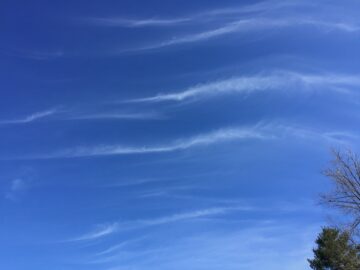
The sky offers countless metaphors. The sky has been described as a roof or a vault, and clouds in particular are often described as resembling something else. A mackerel sky, for example, contains wavy rows of close-packed clouds that are thought to resemble fish scales. Cirrus uncinus clouds, which are thin and streaky, are also called mare’s tails.
Skies may also seem to express moods or emotions. To human eyes, it can appear that the sky smiles or threatens. It’s typically wintry and stormy skies that are considered to be ominous, bitter, or gloomy (Nathaniel Hawthorne described a sky as “gloomy as an author’s prospects,” oh dear). But on a hot day with little wind, a cloudless sky can seem pitiless, the light glaring and unfriendly.
A sky may look and even feel leaden—having not only the dark gray color of lead, but also an appearance that suggests heaviness or foreboding. By contrast, some skies feel lively: streamers of cloud in a blue sky may appear to be dancing.
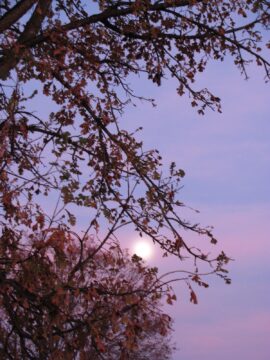
Other skies are serene. There’s a moment after sunset, even or maybe especially in the absence of strong red and orange colors, where the sky is almost colorless near the horizon, and the entire world goes still. It feels as if the sky has paused for a moment to rest quietly on the threshold of darkness.
A sky, or a single cloud, may even strike an observer as rather goofy. The sky can seem enigmatic. My mind sometimes sees lines of clouds as lines of writing, and imagines the trees craning upward to read them. Really, the range and nuance of feelings seen in the sky seem infinite. Sometimes the sky seems to represent moods more fully and subtly than words can.
The sky is unassuming. It’s not trying to get my attention. It doesn’t do anything for show. It responds to temperature, air pressure, the presence of aerosols, the land below it. When cumulus clouds tower into a summer sky, I may see cloud castles, or I might get a sense of expansiveness and ascent, possibly of turbulence. The sky is just being itself, and my perceptions are not always directly related to what’s happening up there. But, as the sky is skying, I am responding with human perceptions and emotions.
The sky seems as near as my eyes, my window, my camera screen; as close as my memories and emotions. I try to tell you about it, in pictures and words; I seem to be making a net that holds it still for you to see. But I know that the sky is much too vast to ever be caught and held. Maybe the only truly valuable thing I can say is, “Look! Oh, look!”
∞
All of the photos are mine. You can see more of my writing at MaryHrovat.com. I post sky photos most days on Bluesky. Prints of some of my photos are available at my Etsy shop, SlowQuietImages.
Enjoying the content on 3QD? Help keep us going by donating now.