
by Steve Szilagyi

The suburban lawn. It’s as loaded with symbolism as it is with chemicals. That perfect green expanse stands for everything people hate about people like me: the smug squire in his tony ranch house.
I wasn’t always this way. Back in the 1980s, I was an Upper West Sider who laughed with the outrageous comedian Sam Kinison, as he screamed what I considered the last word on yard care:
“Once my life was so boring, I actually worried about my yard. Hey, do me a favor—if you see me outside painting the house, working in the yard… kill me! Shoot me in the head, run me over with the car—I live in hell, I live in hell, AUUUGH!”
Today, I live happily in Sam Kinison’s inferno. Okay, not exactly. I pay a guy to paint and do yard work. But even if I don’t personally care for my lawn, I do care about it. So do my neighbors.
We all observe the unwritten rules of lawn care to reassure ourselves—and each other—that we’re not the kind of people we moved here to get away from. Few things in suburbia are scrutinized more narrowly than a neighbor’s lawn gone to seed. And few souls are more pitied than the damned fool who thinks he can escape a lifetime of mowing by replacing his grass with gravel, stones, and ornamental grasses. His efforts to evade his responsibilities are contemptible and he knows it.
Drive down our long and lovely street and you’ll see near-total consensus on the basics of suburban land management: lawns mowed, shrubs trimmed, mulch refreshed annually. But this tidy uniformity covers a caldera of hot contention—a profound disagreement that threatens to shred the very sod beneath our feet.
The issue? Roundup.
A discovery on a par with penicillin. Developed by Monsanto Corporation and now owned by Bayer AG, Roundup is a ruthlessly efficient weed killer. When it was first introduced in the early 1970s, its chief ingredient was hailed by the USDA as the “virtually ideal” herbicide. As recently as 2010, weed scientist Stephen Powles called it “a one-in-a-100-year discovery that is as important for reliable global food production as penicillin is for battling disease.”
But for many modern suburbanites, Roundup is nothing more or less than the distillation of pure evil.
I found out how controversial it is at a recent backyard cookout hosted by a near relative. Baked by the sun and bored to near-insanity by the conversation, I searched my mind for a topic that might stir things up—something lively but not political. “Gee,” I ventured, “I was at Home Depot the other day, and wow, they sure sell a lot of Roundup…”
At the mere mention of the word, the complacent little gathering split into warring camps. Half the guests hailed Roundup as God’s gift to lawns and flower beds; the others condemned it as basically radioactive. Within moments, voices were raised. Fists flew. The picnic table was overturned. Guests started spraying lighter fluid and combatants were engulfed in flames…
I wish. But it was striking how quickly the mood turned.
Creeping charlie. Having ignited the debate, I stepped back, having no emotional investment in the topic. After years of fruitless weed-pulling, I’ve adopted a live-and-let-live approach to chickweed, creeping Charlie, and crabgrass. I’ll even admit, through gritted teeth, that a hillside covered with bright dandelions on a May afternoon can have a certain beauty.
My wife, on the other hand, is an avid gardener and thoroughly theological on the subject. God may or may not exist, but the Devil is real—and it is weeds. Holding a sprayer in one hand and a jug of Roundup in the other, she goes after weeds the way Jonathan Edwards went after sin. Sometimes I think it’s not enough for her to simply kill the weeds. She wants to hear them scream as she pours the poison down their throats.
She is, in her small way, a farmer—and farmers as a class are among the least sentimental people on earth. They’re also the world’s biggest users of Roundup products. Anyone hoping to curb its use discovers how hard it is to dissuade someone from a liquid charm that—with a mere squirt—solves the biggest problem in their life.
Of course, the accusations against Roundup aren’t trivial. They amount, in short, to this: Roundup is destroying the world, beginning with you.
Hamburgers and IPAs. The ingredient it has been most condemned for is a chemical called glyphosate. Glyphosate has been linked to a host of serious health risks—chief among them, cancer.
A 2015 study by the International Agency for Research on Cancer (IARC) determined that glyphosate was “probably carcinogenic to humans.” That is to say, in lab settings, glyphosate is known to cause oxidative stress and DNA damage in animals. So it’s a decent bet it will do the same to human animals.
The IARC categorizes possible carcinogens by levels of risk. Interestingly, they don’t put glyphosate in their most severe risk category, but in a secondary tier that also includes fearsome phenomena such as red meat, hot beverages, and shift work. Alcohol is in their highest risk category – more dangerous than Roundup.
If you go to enough suburban cookouts, you will very quickly run across someone who fulminates against Roundup while shoving hamburgers into their mouths and guzzling IPAs. But then, very few people outside the field of statistics are good at assessing risk.

He liveth. There’s every reason on earth to be suspicious of killer chemicals like glyphosate. And by all precedent, Roundup should have gone the way of DDT and asbestos back in 2014, when a landscaper named Dewayne Johnson developed a rash that turned out to be non-Hodgkin lymphoma. Johnson was a regular sprayer of Roundup on the job, and his lawyers went to work convincing a San Francisco jury that it was the herbicide that caused his cancer. The jury agreed that Monsanto had failed to provide adequate warning to users and awarded Johnson $289 million—a sum later reduced to around $20 million.
Some might envy a wheelbarrow of cash like that. But of what use was it to Johnson? He had a terminal diagnosis. The man was going to die.
As the philosopher René Girard might tell you, “We desire what others desire because we imitate their desires.” Once Dewayne Johnson collected his award, some 175,000 Roundup users—and their lawyers—went into full-blown mimetic frenzy, raining lawsuits on Monsanto that eventually cost the company billions.
Meanwhile, it’s been over a decade since Johnson received his terminal diagnosis and—God be praised—he appears to be doing fine. (Johnson is the subject of the 2022 documentary “Into the Weeds”, which takes a serious look at Roundup products.)
Don’t forget Nosferatu. Poor old Monsanto never had a chance once the case went before a jury. The very name Monsanto probably inspired prejudice, echoing as it does the villainous syllables of monsters, Sauron, and Satan.
But in the months leading up to the trial, Monsanto was purchased by Bayer AG, a German company whose name has a white, antiseptic glow (if you ignore its World War II associations). Bayer paid off Johnson et al. and hurled the Monsanto name into Mount Doom, where it was consumed by righteous fire.
Lawsuit or no lawsuit, Roundup was still an incredibly valuable brand. Ordinarily, a product taking a publicity hit like Roundup would be relaunched as something like EarthFlower, with a well-publicized sliver of earnings going to some toothless environmental nonprofit. But Bayer was not about to greenwash the goose that laid the golden egg.
Bayer went on the commercial offensive, reformulated Roundup and swarming the marketplace with a million variations—sprays, gels, concentrates, with glyphosate, without glyphosate, fast-acting, root-killing, lawn-friendly, driveway-safe.
Instant justice. For instance, some users found glyphosate killed too slowly. It poisoned plants from the bottom up. You had to wait a couple of days to see the enemy browned and frozen in its final death agony. To meet the demand for instant justice, Bayer added a chemical called diquat—which begins killing as soon as it hits the leaves and dispatches its victims with more satisfying speed.
This reformulation strategy allowed Bayer to preserve the Roundup name—popular around the world—while hedging its legal and financial risk. Though glyphosate remains a core component of Roundup’s agricultural products, Bayer’s diversification into diquat and other alternatives gives it the flexibility to deal with whatever legal and environmental challenges might arise.
This is not to say that there are a whole lot of challenges out there for Roundup—at least in the U.S. Although the mere mention of its name may trigger squabbles on suburban patios, on the whole, Roundup seems to have quenched its opposition as easily as Gulliver put out the fire in the Lilliputian royal palace.
Diquat vs. gut bacteria. A 2025 Guardian article called diquat “quite a bit nastier than glyphosate,” citing a Chinese study that found it kills beneficial gut bacteria and causes intestinal inflammation in mammals. The study’s authors hope their findings might lead to protective treatments—but for now, the poison is doing its thing. While the U.K., EU, and China have banned diquat, the EPA hasn’t even scheduled a review. Even nonprofits that exist to fight such chemicals seem overwhelmed. They’ve already maxed out battling paraquat, chlorpyrifos, and other botanical napalms we’ve unleashed on enemy plant life.
But it’s a relief to note that although Roundup has been plausibly linked to everything but the Lindbergh kidnapping, most respectable studies exonerate its ingredients from the kind of neurotoxicity that might cause Parkinson’s.
When I brought up Roundup at my relative’s backyard cookout, I was trying to cause trouble—not take sides. Because when you step back from The Guardian and the environmental scientists and their studies, the world looks like a different place. If you’re aware of all the gloom about Roundup and similar products, it can be a real shock to walk into a Lowe’s or Home Depot and be greeted—right by the door—by row upon row of Roundup products, glistening cheerily in their white or silver plastic containers. These poisons aren’t hidden away in a back room, cringing in shame at decent people’s disapproval. Their boxes even boast, “This stuff works!”
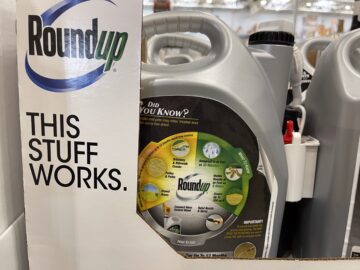
Feeding hungry children. If the EPA seems cool with Roundup, that’s because as recently as 2020 it concluded that glyphosate poses no health risks when used as directed. The European Food Safety Authority and Germany’s Federal Institute for Risk Assessment have both found that glyphosate is “unlikely to pose a carcinogenic hazard to humans” when used properly. If you look around, all sorts of studies show that glyphosate and diquat are okay—as long as you don’t actually drink them out of the bottle. And compared to a lot of other herbicides, they are, on the whole, beneficial to humanity: allowing farmers worldwide to grow more crops on less land, conserving soil, and feeding hungry children.
If you ask any suburbanite whose identity includes environmental awareness what they think of Roundup, they will condemn it out of hand. But the nation’s revealed preference says otherwise, as Americans pour more than 50 to 80 million gallons of Roundup-style products a year onto their lawns and gardens. And those millions of gallons are a mere eyedrop compared to the 200 to 300 times more glyphosate used in agricultural settings worldwide. Ladies and gentlemen, we are pouring tons and tons of this juice into the ground every year to poison the plants we don’t like in favor of those we love. There’s no question it’s working its way into our bodies—and not helping things there.
On the other hand, the nutritious foods Roundup makes possible to grow in cheap and abundant quantities are also making their way into our bodies. And there’s no question that food is a good thing. Try living without it for a while and you’ll see.

Why do people hate it so much? I have to admit I’m puzzled by the strong anti-Roundup feelings I’ve casually encountered in the world of people in my class. What is it about Roundup that makes someone condemn it publicly while spraying it privately to protect their peonies? Why was the jury that made Dewayne Johnson a multi-millionaire so eager to punish the monstrous Monsanto?
My first guess was that there’s kind of mass psychology at work—some intimate anxiety, like fear of blood (red dye no. 2), nervousness about touching bottoms (Johnson & Johnson baby powder), or traditional gender expectations around cooking (Teflon). Could it be guilt? Guilt that we, as suburban homeowners, devote so much wealth and resources to our lawns and flower beds while [pick your resource crisis] is happening elsewhere?
Then it suddenly occurred to me: the problem was the name. Roundup. That name conjures images of cowboys, movie westerns, Stetsons, shootouts—and by gun association, pickup trucks with shotgun racks and rednecks. Not to mention random incarceration (“Round up the usual suspects”).
Roundup suggests a whole catalog of things people like us already hate. And so I ask: Would Roundup by a different name be less controversial? If so, you’d think there would be a terrific commercial opportunity for a weed killer with a name that didn’t swagger around the backyard in holsters.
Home now & garden hard guys. To check my theory, I went online and visited a couple of home and garden stores to check out the names of other products in the Roundup space. Boy, was I surprised. Roundup, it turns out, is a comparative milquetoast. Rivals are christened with lethal names like Killzall, Avenger, and Big ’n’ Tuff, and when they don’t sound like out-and-out murderers and bullies, they still have he-man names like Touchdown and Ranger. Then, in a dark class all its own, is a brand I’m sure to avoid: Finale.
So maybe I was wrong about the name.
And the more I look into it, the clearer it becomes that the disapproval of environmental nonprofits, The Guardian, and the best arguments of the backyard barbecue pontificators are mere pipsqueak annoyances in the face of the commercial juggernaut led by glyphosate- and diquat-containing products. Roundup (which is, of course, not radioactive) is by far the best-selling household and agricultural herbicide in the world, generating about $2.8 billion a year for Bayer AG.
Bayer, for its part, claims that it only breaks even on the product, owing to ongoing legal expenses. But sales figures tell the real story: Roundup buyers don’t give a good gol’ dang what the courts, The Guardian, or anybody else has to say about the herbicide in the friendly jug.
They are like my wife.
They want to kill weeds.
Enjoying the content on 3QD? Help keep us going by donating now.