By Maniza Naqvi
 Would she, the question was put to her discreetly, add a small personnel issue to her tasks on this particular field visit? Could she perhaps get a reality check on McMullen? In response, she had raised an eyebrow, conveying that she was intrigued by the request but non committal to an affirmative. It had been about Stan. Stanley McMullen. The Stanley McMullen. Legend extraordinaire in these corridors this side of the Potomac and that side of the Potahar Plateau. Could she look in on Stan and find out what was going on? Might she, probe into why there had been the sudden change of heart? She had agreed at once with a surge of patriotism and curiosity. And of course, because saying no to a superior, was never a good idea or even an option. However, being “seasoned” as was the parlance—she knew that it was always a good idea, to point out how she was over worked and would have to go out of her way to fit in this extra line item on her mission statement, this was after all adding on to her already demanding work agenda and the extra work load, given all the existing stress, would come at a huge cost to herself and her work life balance. This she duly communicated and it was as such noted. Perhaps on her way back she could consider a stop over in Rome or the Dalmatian coast or Istanbul, up to her—on the house so to speak, A little R & R for being the team player and the trooper that she was.
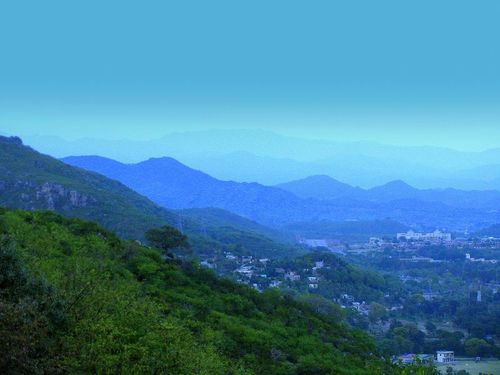
Now here she was in an over air conditioned coffee shop with large picture windows, clay tiled floors and elegant ceiling fans, sitting across from Stan who was going on about the view surrounding them:
Soft purple haze against those hills—like someone took a paint brush and dabbed it in–just look at it. I can never remember the name of those trees—
Jacaranda. Quite the artistic sentiment there, Stan.
Yeah! I'm dabbling in water colors—got someone coming in to give me lessons—a pretty famous guy, a celebrity around here. In the art circles. Those are the perks! You get yourself coaches and tutors who are Olympians or internationally acclaimed just because well the dollar goes the distance here. It really is value for money. Just look at those beautiful purple jacaranda blossoms out there-against the backdrop of those hills—amethyst and emerald. What a sight huh? Love it! Love it! What a location! Should've named this place Cafe Amethyst and Emerald. Damn! Did you hear the thunder last night—the lightning—the storm rolling in over the Margalla hills? Must've been two in the morning—spectacular. Nothing beats that.
Uh Huh. It woke me up too. I thought perhaps your much advertised arrival of the Taliban was upon us!
He laughed—ah yes—the 70 miles from Islamabad hullaballoo—How the idea has grown! It almost makes me blush. Is it three million people we've managed to make homeless and hungry because of our campaign of screaming that Pakistan was a mortal threat to the world? Threatening them, that if they didn't do something about it, we would! Holbrooke, Clinton, Obama, Petraeus, Mullen! What a team! And boy, if they didn't hate us before—they sure do now! And you're here to show our deep humanitarian concern and to figure out how to feed them and cloth them are you? Don't look at me that way!
Is this remorse, I'm hearing from you? Guilt? Stan, come, come, is this contrition I detect writ across your face? Is that the reason for the request for early retirement?
Just told you—it's time to turn the page—do something different. It wasn't a request, by the way, it was a notification of retirement. It's time for me to notice stuff like the thunder and lightning and call it by its name: a storm. Just that: a storm. Nature's noise and drama. Count that as one of the reasons why I'm going to stay. I love the seasons here.
Love for the seasons? Uh huh.
Do you think the English took to talking so much about the weather after feeling an unbearable burden of unspeakable imperial distortions?
No. They have weather. They talk about it. I suspect they did it before they took to the high seas and took over the planet.
Nah! I suspect I'm right. They used weather to fill in the awkward pauses between why the news of a massacre in some shit hole in Africa or South Asia matched Daddy's sudden wealth in said shit hole. But, you can be funny, Eileen. I liked that about you. I liked that a lot. And just for old time's sake, you know—I'll share my latest secret with you—
Really! A secret! Do tell. I'm always up for a good secret divulged! And one from you Stanley should be just the thing.
Well no, not quite in the magnitude you might be expecting dear girl sorry to disappoint. It is not quite the geo-political seismological nature you might be expecting but rather agronomical in nature. You see I'm going to grow a hybrid new strain of coffee around here something between an Arabica and a Robusta variety. I think we've got the climate here—the high altitude—just enough rain and shine. I'm looking into it.
Uh huh. Coffee. You're going to grow it, here? And you have the know-how by surfing the internet?
Yup. In fact I was doing that before you walked in with your pretty face and got me all distracted again. That's my new project! The Pothar plateau coffee bean! I've been reading up on the internet about it—That is, when I'm not reading up on the news that we've been churning out which the free press of the free world is happily lapping up. Our stuff, is all the rage now: all our imagined goblins and monsters who threaten America—never mind that they are in reality bare foot, unwashed, frightened and hungry.
Coffee to sworn and steady tea drinkers? Your brief stint in Bogota surfacing suddenly?
I see you're not falling for the bait. Not the way you used to anyway. I can see I'm going to have to try harder. Fine.
I'm ignoring your attempts to try to provoke me Stan. So you've put down your stakes here? Is that final or are you sulking?
Yes.
Yes, what?
Yes, ma'am?
No! Which is it—final or making a point?
Yes—it's final. I'm here till they bury me in Murree next to my old, great-grand-uncle Colonel McMullen himself.
And till then it's this coffee thing?
Yup. It's time to change their tastes around here—Change of empire change of beverage of choice for the natives. That's what I think. Hey maybe —Come to think of it I'll look into buying some of the slopes in Swat valley they may be going cheap, now that we've got our minions clearing out the land for us. I could grow coffee there. Maybe—I'll come along with you when you head out for your humanitarian visit tomorrow? Have a look see myself, do a little reccy for real estate. Root around for property. What d'ya say? Yes?
No. So you're calling it quits?
You bet. After buying as many rugs as I possibly could lay out, fold, roll up, stack, give away—and after becoming an expert in kilims—and tribal carpets—and after filing reports, networking —showing around the umpteenth visiting Stateside big wig on his fact finding mission—After making up stories, to fit their needs, I should say our needs and strong arming the big muckimucks around here—after all that and then some—well then—it came time to go.
To do what? To where?
Just told ya. This is the place I've helped make into what it is—this is the place that I'm someone in. I count here, I've grown accustom to it and it to me. I've been here, now how long?
Twenty nine years—
Exactly! Give or take the mismatch in the Andes. Yeah. Wow. That long huh? Half of this country's existence almost: as Pakistan. I've gotten pretty used to people asking me to save them. Please Mr. Stanley save us! Getting that from pretty important people is heady stuff, let me tell you—Generals—Presidents—Prime Ministers! Well I felt responsible. Heck, I still do! Yeah it gives me a high—a buzz a real upper in the morning. It's my daily fix. And I decided to stay.
I know what you mean.
Fact finding missions—god those are the worst—aren't they? Ridiculous—comedy if they weren't so dangerous. Everything one of those fact finders sees becomes a defining fact—every person he meets becomes an important resource person, no matter who, no matter how briefly met, no matter how stupid, nope that person becomes important, providing important data points—to be magnified and extrapolated to whole populations—everything noticed no matter how trivial becomes a feature of the country—They'll sit in their bullet proof cars—yammering on about their gardens in DC, their hotel rooms, the airport business and first class lounges and their upgrades—until they are interrupted by “another fact” which catches their attention as it flashes by along the roadside— which they file away immediately to generalize and extrapolate onto the whole country in their fact finding report. Spending exactly forty-eight hours in bleary jetlag in three spots close to Islamabad usually all three in luxury hotels and perhaps another as a photo op with the natives—makes them an expert on the country.
Now don't be so harsh. You've been quite the fact maker yourself.
Yes.
And now these new facts about yourself…..
Who would have thought that this dead town would grow on me? Look at them those hills—aren't they the loveliest sight. The jacaranda in bloom all purple on Ataturk avenue—against those emerald green hills—
Yes, we've established that Stan. Purple, green, amethyst, emerald, ruby, diamond. They are lovely, but not enough reason to stay.
Cricket in the parks—-In the early mornings –a walk—I go right up the hill nearest to my house—mist—wild monkeys—parrots—its bliss. And late at night—like it was last night — the rain comes in to keep me company with thunder and lightning over the hills—it is spectacular. I love it here. The view. For a guy like me, who's spent his life observing—a view is important, you know. You can say “I've grown accustomed to her face”.
Her?
Islamabad. Pakistan. Margalla Hills.
So I am to conclude that the hills have conspired to keep you here? I think you've lost the plot.
Believe and think what you will, Eileen. It's all plausible, if I say so isn't it? It used to be that way. The hills have conspired? Yes! Conspiracies—Well this is the town for them. And nothing like a café to hear them or hatch them don't you agree? Three just this week I've overheard that will be doing the rounds if they aren't already. You will hear them—Obama is the brainchild of Wolfowitz—then there's the one that Cheney killed Benazir—And of course Hoodbouy and Ahmed Rashid are working for the US Military—writing articles about the Taliban threat. Even though it is a non-existent Taliban threat.
She shrugged. The door opened and several women walked in. They stood chatting noisily, fussing about which table to sit at until a waiter ushered them to one.
It's a little morning coffee party—we arrange those here. Very popular with the housewives!
Ah! She said, as though searching amongst the group for another reason for Stan's decision. She twisted her body, and turned to take a sweeping glance at the group of women. None, not one of them, would fit Stan's taste for the very fit, young things.
He said: The late evenings are more stimulating. The clientele more erudite. If we made a list, we could fill this café with all the intellectual hoi polloi in this town—in this country—all of whom, by the way have been my willing story tellers—collaborators—willingly expanding on our myths—I call them our list of coffee drinkers—our plot makers. I throw them a sentence and they run with it. Very talented. Most remarkable.
She watched him wipe the surface of the marble topped round table between them–removing the traces of moisture left from the condensation of their tumblers of iced water.
A habit of erasing one's tracks. He said grinning at her.
She managed to smile back uncomfortable that the twist of her mouth felt more like an expression of pitiful contempt then one that played as affectionate indulgence.
As he turned to motion to the waiter behind the counter to come over and take her order, she noticed how Stan's hair had thinned-a bald patch had begun on his pate. And there was quite the beer bulge around the waist. He held the glass with an outstretched arm—his other arm thrown over the back of his chair—legs splayed—still the master of his domain. His fingers grasping the glass, too pale, almost reptilian she thought, pudgy. Had he always been this way–it had only been a few years since she had last seen him. Was lust's inevitable fate loathing? She couldn't remember what she had found so attractive, those many years ago in Islamabad. Must be power she thought. She was a visiting novice—brought in as a USAID consultant for a couple of weeks—and he was the political advisor at the Embassy. The inevitable cocktail party in the big lawn on a sultry summer evening. Just like in the movies—she in something flowing bought that day with a colleague at the bazaar—he in a linen suit. Now, a cafe owner, gone native, wearing a white kurta-shalwar, an image immaculate enough—with a two day bristle on his chin, but simply no contest to the dazzling spy master. Back then she had talked about conspiracies—he had made fun of her. She had sipped on some third rate white wine and he had tossed back whiskey shots one after the next steadily through the evening. Now she said macchiato and he said double espresso. He spoke to the waiter in Urdu. The waiter nodded and moved away.
Nice, she said, jerking her head in the direction of the surroundings around her: You've done a great job going native. A company of your own. No pun intended! A coffee shop, exactly what Islamabad needed, Stan. Why call it The Little Margalla Cafe. Why not Coffee is Stan—or Café Stan? Or apostrophe ‘stan's Cafe?
Very funny. And not to mention that one—stan–is an over-used pun —no jab left in it any more.
Or the Little Coffee Company? Or The Red Zone. You should've stayed within the secure diplomatic zone—-The Green Zone in Baghdad, the Red Zone here, what's the color in Kabul? I mean you have seen the graffiti across the street I presume? It's hard to miss!
You mean the “Go America Go!?”
Yup.
Ah shucks I'm a dumb American I thought they were cheering me on! That's what Holbrooke seems to think! Someone needs to clue in the protesters— —Go means: Yes! OK! The Red Zone—now that has a certain kick to it. If they'd zoned it as amethyst or emerald then I would have gone for it! No, I'm sold on calling my little sanctuary Little Margalla Café. A place in which to be transformed. I sell conversation, ideas injected with caffeine.
Ah yes—staying within your competencies. How should I put it, for transformative information.
And I import coffee—that was one of the perks of my position—I managed to wrangle a little import license. And I'm looking into buying a little land in the hills—like I said, new project. I'm going to try my hand at a little coffee growing. The Generals were quite taken with the idea that I wanted to stay back. Touched —really. They wanted to gift me a piece of property—for my services rendered here. A plot in Chuk Shezad—prime land around here is all called Chuk-this and Chuk-that in this lovely little vipers' nest called Islamabad. Yeah, chuck the poor powerless bastards out of their ancestral villages to make way for villas is more like it! At least two dozen villages leveled, bulldozed to make way for these orderly pretty neighborhoods of gentility—and the Generals so called farm houses and ranch houses. But I resisted giving in to their generosity. Then the hills knocked some sense into me. I wanted to stay. So I insisted on paying for my plot. I asked them to set a price tag and they did.
The offer of land by the Generals at a throw away price was too good to pass up?
At market rate, Eileen, top dollar, market dictates.
Yes. As you know the Internal Corruption Investigation Unit –the ICIU is looking into your little purchase.
Well good for them. Eye See I You. How droll! They'll find nothing. All the papers are in order. Fair and square. They sold, I bought. Market economy, baby. These hills yes these hills are a sight of heaven itself aren't they with that incredible clear sky? Personally give me the view of the hills any day to a view of the sea. Others, including the Generals themselves of course choose to retire on the Mediterranean—Marbella —But not me! I'll take Margalla any day. And I have. So I said yes—give me a couple of acres—of destroyed ancestral homes, a hamlet and village. Ah come off it, don't look at me that way— what's the good of such strict standards, such high morals, Eileen? All you are left with is a list of regrets.
Mmmm.
Every man has a dream and mine is to switch the loyalties of the Pakistani palates to caffeine. I plan to sell them coffee, addict them to double espressos—three times a day all from my little Margalla café—on Ataturk avenue.
Well it's the choice you've made. But we haven't decided if you can. If we let you, then you can stay.
Let me? If I can? I have news for you, doll. I did! My choice.
Don't tell me Stan that you are so naïve. You choose? You choose nothing. It is decided for you pal—you only get to acquiesce. And the day you do not, then that's the day you will have chosen, and will, most definitely, my friend feel a bullet go through the base of your skull.
A reference to Benazir?
No. But it could apply,
I decided to open a coffee shop—at the foot of the foothills—
Sure, Stan. You decided. We haven't made up our mind yet, about your choice. We haven't decided, you see. And that's what matters.
The coffees arrived. She stirred the liquid in the tall glass. He rocked his cup back and forth on its saucer and contemplated her. You know the offer still stands. Come live with me. Retire here with me. Make this choice. You know you would enjoy it here.
At the Conspiracy café? What would I do? Eavesdrop on your customers and send memos out about possible threats?
Yup.
Hmmm.
I heard a great one the other day. Should have sent in a memo. Someone sitting right over here at that table was talking about having read somewhere that Paul Wolfowitz's wife Clare Selgin is an anthropologist specializing on Indonesia. Worked for USAID projects there?
Ex-wife. So?
So this guy says Obama's mom, she was an anthropologist specializing on Indonesia—lived there—worked on USAID projects—there and here, in Pakistan.
Uh-huh.
Paul Wolfowitz was an Ambassador there, to Indonesia—His wife and Ann Durham—Obama's mom well they were friends, had to be friends you see—like everyone in Islamabad always is? The Ambassador had at the very least barbeques for compatriots on fourth of July, and so on, and that, you see is when he met Ann's amazing and wonderful boy? So you see, as the story would have it, Paul discovered our young shining new talent!
Ahhh. Plausible. Makes perfect sense.
Doesn't it? I'm telling you, this is my perfect treasure trove, my perfect listening post.
I thought you set it up for hours of languid discussion on art and existentialism.
That too—But after I retired from let's call it the enterprise—and had decided to stay, since everyone knew I had gone native anyway, I decided to open this little café. I thought our sleepy little town in the shade of the lovely Margalla hills could use some espresso and latte. Too bad I can't dissuade the clientele from calling it expresso coffee. But really, this little café is for people like you visiting Islamabad—with too many time zones under their belt—in need of the real deal. And of course, conversations about the latest fiction and discussions on existentialism.
Existentialism. When you sent your final memo saying that you were retiring to set up a cafe in the hope of bringing intellectual discourse Parisian style with cafe charm to Islamabad—I sent out an email to everyone in the office with the subject line: Stan our man in Pakistan: Threatens Existentialism. Do you think I started something?
He laughed. So that's where that idea took off about an Existentialist threat. And we're bombing the hell out of ‘em now. Clearing the land so to speak for prosperity and our way of life! Someday we'll replace Tomahawk missiles, Black Hawks, Chinnoks, and Cherokee helicopters with names of other tribes that they will have destroyed—there will be the Achakzai fighter jet—the Dawoodkhel missile….the Yousafzai drone….
Ah c'mon Stan! Don't you get bored with your predictable outrage—considering that you contributed so much to it? You bore me.
Really? I didn't used to. I thought this was the feisty me that you found attractive. Besides I seem to remember your outrage. I thought it charming.
It's old now. Fifteen years ago—perhaps it was instructive then, now it's just old.
Instructive when you were reading my memos on the Taliban? And when you were a junior to me? Under me and come to think of it over me—most enjoyable back then. Thank you for your service!
Yes, then. Every which way. But now that's done and the game is on and you my friend are old. And so am I. And yes, I have been your boss for quite a while now—longer then I care to remember.
Hard to believe that my one liners about the threat of the Taliban—the threat of madrassas was turned into a strategy for invasion and occupation. Dear God, madrassas: Those negligible numbers of students and religious schools, completely inconsequential! But we didn't present them that way, did we?
You didn't present it that way, you mean. I seem to remember a rather clever one liner from you as a way of defending one of your obscure data points of the day—pandemics begin with a single sneeze. Yes—those not to be sneezed at data blipswere very useful. But it is what it is—if you write well, you create the facts on the ground. And sooner or later someone pulls out the wealth of information you've provided over the years and turns it into something meaningful. The art of brewing I guess. You picked the perfect retirement business. –Anymore conspiracy theories overheard?
Uh huh. They're trying to connect the dots–SARS cropped up just before the Iraq invasion–the Swine flu–just before the Swat valley operation. Keeping the world marinated in fear and therefore, malleable and unquestioning. But hell we don't want to depress everyone too much or have them out on the streets protesting, overturning–raging—
Don't worry about that! They're all too busy pouring their rage into Facebook and Twitter—it's only a cyber- virtual mob, a virtual outrage–not even that. We're safe.
And then there is the injecting of a little hope to keep their minds off of war, recessions and the arrests of innocent guys –so give them a Scottish plump spinster a little off in the head–who sings like an angel. Ah, something to make us all relate to—see the silver lining–feel that this is a just and good world! Everyone can be a star!
Now is that what people coming in here are talking about Stan? Or is that just Stan-speak.
It's the conversations I hear Eileen. And here's another one the guy who swam across the lake to Ang San Su Kyi's home— John Yettaw word around the latte tables is that he went there to warn her that she was going to be assassinated. He was an ex-military guy—what if he knew something about this —about how they killed Benazir? General Stanley McChrystal presided over the assassination of Benazir Bhutto. And now he's heading the show across the border.
Well that one, that rumor was started on our side—Seymour Hersh in search of another go at stardom. Anything else?
Yup–Asif Zardari helped General McChyrstal and got rewarded. He had his innocent child call her mother on the cellphone right after the speech to tell her that she was watching her live on TV in Dubai and to ask mama to wave to her. So then just as Benazir was leaving the grounds after the rally, safely tucked away in her SUV—ring–ring–“Mom–stick your head out of the car and wave to me!” The kid apparently has gone crazy. That's the talk in this cafe.
Uhuh. That's pretty sick.
Yup. Sick are us. Hey here's an idea. Don't scowl like that—I'm making a proposal! You could finally get on with it. Like you've always wanted to do. Here's your chance for getting more than just carpets on this trip. It's a bonanza out there. Go get a kid—a baby—get a dozen for Godssake if you want to. Let's go to the refugee camps tomorrow pick a few. I'd be happy to raise them with you. We could play Mom and Dad. Give some lucky kids a lucky break—The American dream. What do you say? We could be like the Negropontes. I heard he adopted four kids from Honduras.
Lovely! No.
Not buying that? Not interested in saving me? C'mon Eileen—save me. Okay. I'll let it percolate in your head. The idea may grow on you, it has happened before. I've managed to pollinate that fertile brain of yours before with my words.
Pollinate or pollute—poison?
A sudden burst of laughter from the party of women on the other side of the café made her turn to look at them again—chewing the inside of her lower lip as she surveyed the group with a calculating contemplative gaze. The women had grown in numbers—a dozen or so—milling around the buffet table near the far wall. An impression of expensive handbags; glamorous hair; stunning jewelry and yards of pretty, delicate colorful scarves over elegant tunics and pants.
She turned her attention back to Stan as he said: Pollinate! It's a beautiful concept—us using words to make a thousand flowers bloom!
She looked back again and her gaze focused on a slender figure who had her back to them—she must've just come in. A pale peach colored dupatta covered the length of her, undulating over the curves of her shoulder blades and hips, like a chaddar—There seemed to be altogether, too much perfume in the air, she thought.
God what a gaggling bunch they are—Stan continued—as she turned her attention back to him. Look at them those women over there–the wives of grade 21-22 officers, attacking the buffet. I mean they've come to a café but they're laying into the food.
Well you're serving it—why do you have a buffet in a café?
They wouldn't come otherwise!
Then don't complain! The customer knows best.
Just look at them—fat—corpulent, thunder thighs every last one of them, like great big pigs at a trough. Oh excuse my cultural insensitivity—cows.
Not all of them Stan.
They are the real problem in this country—if you want to save this country from the great big burden of its own rot and corruption it is not the mullahs or the military or the civil officers that you need to get rid of, its these wives of the bureaucrats with their endless demands and greed—bigger cars, bigger villas—more silk cloth to wrap their bulging bodies into. I say line ‘em up, every last ill tempered heaving bitch and shoot ‘em between those scowling cold eyes.
Really? Come now, that much resentment Stan? Too much expensive perfume in the air——Can we open a window? Air out your air-conditioned café?
Air it out, all you want, He said rising to his feet suddenly. I'm off and I'm staying put. Make of it all what you will Eileen.
Yes, thank you. I will.
(To be continued, maybe.)




 Where legitimate grievance has erupted in armed conflict, as in Congo, Rwanda and Sudan, the Church has been neither neutral nor salutary. In Rwanda and Congo, the Church actively fomented ethnic divisions (Hutu/Tutsi, Hema/Lendu), ultimately facilitating ethnic cleansing campaigns in both countries. During Southern Sudan’s famines in the 1990s, the Church leveraged its food distributions to starving animist populations against Bible study and conversion.