For his birthday, my father asks me to hypnotize him.
“Just tell my body to tell itself to heal me,” he says.
This sounds too complex a method to be undertaken by someone like me. I imagine that when I tell his body to heal itself, Dad’s insides will play a game of telephone, his brain passing instruction to his bones, bones to blood, blood to cells, and so on, and so anatomically forth, until the original message garbles and wends its way stomach-ward, where it beds down beside the remains of my father’s most recent meal. I’m bad with telephones. This isn’t a call I want to make.
But for nearly a year now, my father’s been dealing with a condition that doctors will classify one day as morbidly urgent, and as a simple but mysterious allergy the next. All we know, all we see, is that his skin is overwhelmed by sores of parable proportions, and if he’s allergic, then he’s allergic to the world, because touching just about anything sets his skin to shudder and flash with heat. In response, he restricts his diet, handles dyed objects with gloves, and institutes a uniform of billowy white clothing. I can never decide if he looks like he’s about to go on safari, or be baptized, but this indecision hardly matters, as I’m not certain either would be of any use.
—-
I’m not a good candidate for a hypnotist, as inopportune laughter is a specialty of my personality, and while the practice no longer ranks as a pseudoscience, I’m still uncomfortable with being placed in a position of authority over Dad’s brain, and given the opportunity to do so, would prefer to take him for a dip in the Dead Sea, or a skeptic’s tour of Lourdes.
We wouldn’t go to the faith healer I once saw on a painful whim of an experiment, with a woman willing to be paid for her services in exchange for the tutoring session of her son. Beyond the cold I came down with soon after my visit, this experience was notable only for two items:
1. Outside the home, there was a garden with a statue, and a dog affectionately licking its stone hand, obviously convinced of realities unobservable to myself.
2. In tutoring the healer's son, I assisted in the writing of a paper that demanded the use of many synonyms for fakery. False. Forgery. Ersatz.
—-
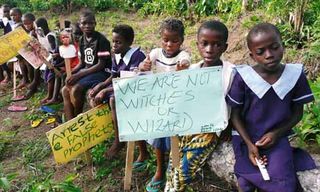 I'm still not sure how to feel about that particular waste of time. I never expected to benefit, and some would say that this was precisely the problem. But that lack of expectation, truthfully, is something of an effort, as I’m vulnerable to the guilty pleasures of superstition and the colorful terrain of the paranormal, and have to occasionally remind myself of the dangers that come with believing too much. So while reading reports about financial experts flocking to psychics in record numbers, and avoiding the magical thinking that often slips in with the New Year, I also have to note just a few elements that usually accompany such preoccupations: hysteria, distraction, a willingness to exploit the exploitable. Better than to note might be to watch the British documentary, Dispatches: Saving Africa's Witch Children.
Tell-tale signs of a dark servant under the age of two, according to a popular book in Nigeria written by supposed prophetess Helen Ukapbio of Liberty Gospel Church, are high fevers, declining health, and disrupted sleep. She herself is a mother of three, and her own offspring have unsurprisingly avoided this diagnosis.
Read more »