by Bryant Urstadt
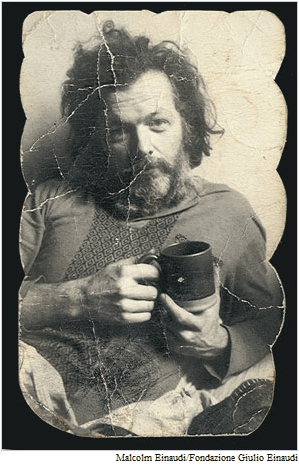
He appeared at James Jones’ funeral in 1978, with a boulder in the back of his station wagon, which required three men to unload. Jones was the author of From Here to Eternity, just the kind of bright literary lamp Humes would introduce himself to when he was alive. The boulder is still on the lawn in Bridgehampton. Fine, but… Humes had never met Jones.
He showed up at Random House in the mid-Fifties with a stellar novel, just moved in with his manuscript and his toothbrush and his motorcycle, which he wheeled into the lobby of the office of founder Bennett Cerf, when Random was located in the more motorcycle-friendly Villard Mansion, just behind St. Patrick’s Cathedral on Madison Avenue.
“You didn’t just meet Humes,” remembers Random House editor Bob Loomis, who edited Humes’ second novel, Men Die.
*
Loomis, now 80, is the embodiment of the legend of Random, having worked with everyone from William Styron to Toni Morrison, and he lobbied hard within Random to allow for last springs’ reissue of Men Die and Humes’ longer, better novel The Underground City. “He kind of entered your life. He used to sleep in our offices. He helped me move. He just became part of your day.”
Humes swept into the cafes of Paris in the late forties and early fifties, inserting himself into a crowd that included Irwin Shaw, James Baldwin, and everyone else, it sometimes seemed, who would otherwise have been living in Greenwich Village. Humes was at Le Dome in Paris one night in 1951, probably wearing the black velvet cape and carrying the silver-handled cane for which he became known in those days, tapping a 24-year-old Peter Matthiessen on the shoulder and introducing himself, and soon after teaming up with him to start Paris Review.
And now Humes, dead for 16 years, crashes 2008, his books up for reevaluation after forty years in the cooler of history; the subject of Doc, the documentary by daughter Immy Humes; and shedding awkward news about Matthiessen, who used Humes and their Paris Review as a front for his work with the CIA. (It was deeper than that, of course; in a way, it can be argued that Matthiessen was using the CIA as a front for living as a novelist in Paris.) Humes now is a weird Banquo pounding the literary table, asking us to listen, listen, to the story of his life, his work, and the birth of one of the country’s most important literary magazines.










 It's Christmastime, Solstice-time, that annual ritual of family and SADness. But whenever I get depressed, I remember that poets frequently intuit the nature of the world long before psychologists, physicists, biologists, mathematicians or theorists are able to parcel out their pieces into numbers, formulae, and systems. I remember, for example, how the German and British Romantic poets grasped an understanding of complexity, relativity, and organic growth that was largely alien to Enlightenment science and the Industrial Revolution – understandings we now take for granted in the scientific conceptions of Relativity Theory and Chaos Theory, which were devised, respectively, nearly 100 and 200 years later.