by Vivek Menezes
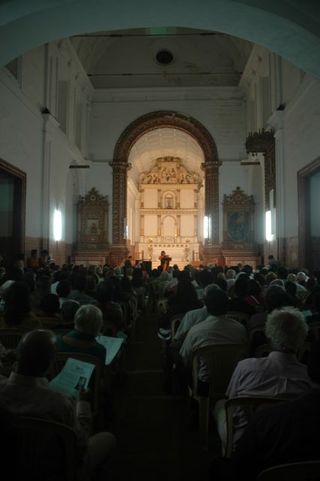 This Saturday night, I attended one of the best concerts in my life.
I’m trying to avoid all hyperbole here, honest. Also it’s not like I haven’t been around – my 3-decade concert resume includes Jobim in Rio, Springsteen in New Jersey, Aida in Luxor, and – some of you might recall – Lou Majaw in his hometown Shillong.
But this Saturday night on a rugged hillside overlooking the Mandovi River in Old Goa was the equal of all those experiences.
The marvelous soprano Patricia Rozario sang Bach, Mozart and Mendelssohn in the lovely 500-year-old Capela do Monte, packed in tight with a hushed, intent audience. The sari-clad singer dazzled throughout, but it is when she sang in Konkani – hymns from Goa’s centuries-old tradition – that a palpable atmosphere of catharsis arrived for Rozario and her now-emotional audience.
The formidably talented and experienced singer suddenly had tears visibly welling in her eyes. All around me audience members were crying, the silver-haired lady next to me buried her face in her grandson's shoulder and sobbed quietly. My own face was wet now, we each had suddenly realized it had taken all of us – setting, singer, repertoire and audience too – five full centuries to get to this electric moment of coming together. It was inexpressably moving to be there. But we all knew it never should have taken this long.
For at least two decades, I’ve fairly diligently (but informally) surveyed scholars, musicians and music fans about “western” music in India.
In all that time, I’ve encountered barely a handful of non-professional musicologists who realize that – for example – the violin’s presence in India far predates the sitar or tabla, or even what is now called “Hindustani classical music.” It is common for boneheads to tout the credentials of this music, that emerged from post-Mughal North India, as somehow more ‘Indian’ than, say, a cello concerto. But that is totally ahistorical, and like every single North-India-generated generalization about “Indianness”, willfully ignores the history and culture of India’s Western coastline.
Read more »