by Peter Unger
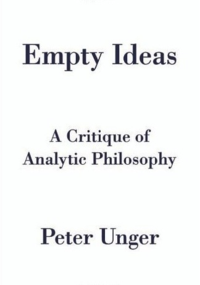 On June 16th, an interview of me appeared on this site that, initially, was supposed to be largely concerned with what’s in my brand new book, Empty Ideas, to be published officially, by the Oxford University Press, on July 14th. Well, as actually happened, most of the discussion ended up being about other things, providing little idea as to what’s actually in the book itself, and what it might mean for the importance of – or the unimportance of – a very great deal of mainstream analytic philosophy. In this brief piece, I’d like to do something to help rectify that.
First off, I should tell readers that Amazon.com has done a pretty good job with the first swatches of the book: there, you can see what looks to be more than 40 of the book’s first 56 pages. In just a few moments, the relevance of that will be made quite striking.
A central thesis of the book, perhaps its most central thesis, is this: Contrary to what has been supposed by Anglophone academic philosophers, during the last five decades, there has been offered hardly any new thoughts whose truth, or whose untruth, makes or means any difference as to how anything ever is as concern concrete reality, except for ever so many perfectly parochial thoughts, ideas about nothing much more than which words are used by which people, and how various of these people use these words of theirs — and nothing any deeper than that. (And, if it be required that the newly offered non-parochial thoughts be credible idea – at least more credible than their negations, or their denials, then what’s been relevantly placed on offer, in all these years, goes from hardly anything to nothing at all.) Rather, even while brilliant thinkers have offered thoughts meant to cut lots of concrete mustard, what’s been newly placed on offer, with any credibility, are just so many thoughts empty of import for concrete reality, that is, just so many concretely empty ideas. And, each of these concretely empty ideas owes its emptiness to its being analytic, in a useful sense of that term, so, what’s more, each of the offered thoughts are thoughts that, at least when correct, are just so many analytically empty ideas, each on a par with, in that way, the thought that someone can remember her old college days only if she went to college.
All that is spelled out, at least pretty well, I think, in pages of the book that Amazon offers for your free inspection, especially in the freely available pages comprising almost all of chapter 1.
(And, should those pages leave you a little shy of a firm grasp of what I mean to convey, your grasp should be pretty firm, indeed, if you also read the next pages Amazon provides freely, pages comprising most of chapter 2 of Empty Ideas. For good measure, on Amazon you’ll also get, for free, a good running start on what’s in chapter 3 of the book.) As is my hope, many of those reading these words, will jump over there – right now – and get a good look at that material, doing that before proceeding with any more of this present short piece.
In line with all that material, and at all events, in the rest of this brief piece, I’ll aim to add just a bit more, providing some central material from the next chapter in the book, chapter 4. While this won’t do anything even remotely close to giving an adequate idea of all that goes on in Empty Ideas, a book comprising 9 dense chapters, it may well, I think, convey the flavor of what goes on in about half the book.
Read more »