Looking Through Glass

by Madhu Kaza

In the borrowed apartment where I'm living for a while, on the top floor of a brownstone, a stone Buddha sits on a low table in front of a center window. The crowns of trees some thirty feet away float in the window; they belong to the park across the street. Many of these trees are rooted near the street below, and the park slopes up behind them, so that through the canopy I sometimes catch flashes of figures moving inside the park at the top of the hill. Through my window I hear the squeaking of swings, and though I don't see them, I hear the squawking of children throughout the afternoon.

One afternoon this summer – it had been dark and humid all morning—I was sitting at my desk working, when suddenly I heard a boom of thunder, immediately followed by the shrieks of children. I looked out the window at the swaying branches of the trees and imagined the scared and thrilled children leaping out of the swings and scattering home before the rain came down. I watched the trees long after the voices emptied out of the park and the rain began tapping the leaves.

I love looking out of windows. I have spent whole afternoons watching the light change inside a room and watching the movements of the world outside. I lived for nearly fifteen years in a studio apartment in Manhattan, where ninety percent of my waking hours at home were spent sitting in a chair by the window, where I worked, ate, read, talked on the phone and idled. I think of the years racked up looking through glass, listening to the muted sounds of the city.

Looking through a window has always felt akin to looking at art. Painters have long made the connections between the canvas and the window. In his 1435 essay, “On Painting,” the Renaissance artist Leon Battista Alberti wrote, “Let me tell you what I do when I am painting. First of all, on the surface on which I am going to paint, I draw a rectangle of whatever size I want, which I regard as an open window through which the subject to 870px-Open_Window,_Colliourebe painted is seen.” In more recent paintings of the 19th and 20th century the window has become a prominent motif, one that can organize or frame the subject of the painting. In Matisse's Open Window, Collioure, for instance, very little (and no detail) of the domestic interior is shown. The painting itself becomes a view from a window.
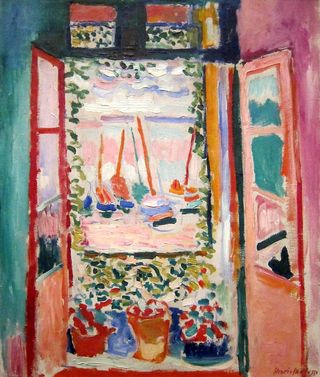
Even if paintings sometimes open up views onto the world, I recognize that it doesn't necessarily follow that looking out a window is like looking at art. Features that brings these two experiences together for me, however loosely, include the frame and the distance– my position apart from the action. When gazing out a window I am more still in my looking than when I am out in the world. I find myself slightly abstracted from my body and in the position of a spectator. It's great if a window looks out onto a street or a meadow where horses roam, but the view needn't be spectacular or even beautiful. It certainly helps if the view is not of a grim shaftway, if instead it's of a dynamic space where people or animals or clouds come and go, where vegetation comes into leaf, flowers, and dies – anywhere where you can watch things change throughout the day. Through a fixed frame viewed over time the scene becomes cinematic.

Read more »

Monday, September 8, 2014

Speech, Civility and the Salaita Case

by Gerald Dworkin

In a talk given some years ago at the University of Illinois Urbana (UIUC), which is the object of a boycott protesting the Salaita decision, I described myself as a “first amendment fanatic.” Having grown up in the era of McCarthyism as the child of a member of the Communist Party, having endured a mild amount of FBI scrutiny of my travel and organizational affiliations, surely contributed to this bias in favor of freedom of speech. The text I most enjoyed teaching by the philosopher I admire most, John Stuart Mill, is his defense of freedom of speech in On Liberty.

I have always been suspicious of bans on “hate speech” and thought a bit about how it might or might not differ from crimes which created additional punishments for particular victims of assaults. I was inclined to favor such additional sanctions for, say, the elderly who were more likely to be seriously injured by such assaults, and to be more fearful of using the streets. But I was inclined to oppose such increases for those attacked because of their race or sexual orientation. It smacked too much of punishing not just the acts but hateful thoughts as well.

This is where I stood when considering the question of whether to sign on to a petition to the Chancellor of the University UIUC condemning her action of de-hiring, or not appointing, or firing –depending on arcane views about the nature of contract law — Steven Salaita. I assume that many of the readers of this blog are aware of the wide-spread controversy, and proposed boycott–refusing to speak at the campus– of UIUC, by the academic community. Philosophers have been particularly prominent in this effort. For those who are new to this issue, here is some basic information, a critique of the decision, and a defense of it:

  1. https://www.insidehighered.com/news/2014/08/25/u-illinois-officials-defend-decision-deny-job-scholar-documents-show-lobbying
  2. https://www.insidehighered.com/views/2014/08/08/essay-criticizing-u-illinois-blocking-controversial-faculty-hire
  3. https://www.insidehighered.com/views/2014/08/08/essay-defends-university-illinois-decision-not-hire-steven-salaita

The issue is, as a matter of law, very complicated. Experts in contract law–does he have a valid contract before the Board of Trustees approves the appointment?– are divided on the matter. The constitutional issue seems clearer. The First Amendment has been long interpreted as forbidding state agencies–including public universities– from punishing employees for the expression of political viewpoints. But this is consistent with such agencies being able to ensure they can discharge their legitimate functions. So there is room–given various empirical assumptions–for the decision being upheld. But, absent any evidence that Salaita has made his classroom a hostile one by his tweets, it is likely that he is protected by the First Amendment.

However, I think that there are moral, political and institutional issues that arise in this case , and which are invoked by the protesters and the defenders, that need to be discussed in isolation from the purely legal issues. These are my focus in this blog post.

Read more »

“Never Forget”—And How I Can’t Help But Remember 9/11

by Debra Morris

Best South Tower photoAlong with thousands of others that day, I emerged from the South Tower of the World Trade Center with a crippling fatigue in my knees. Of the walk down, in my case from the 61st floor, certain things stand out: the speed with which one can descend a flight of stairs and smoothly pivot on the ball of the left foot, to begin again; a few stray remarks from strangers (“I think something hit the North Tower.” “They're saying the building's safe and we can go back up.”); our slowing pace as we continued downward, to make room for those entering the stairwell at each floor. And this, of course: at a standstill, just outside the 18th floor; a pause no more than a half minute but time enough for the second jet to slam through floors 78–84 above us, with a sound like a freight train, jolting us against the handrail and blurring the stairs at our feet. Seconds more, waiting—unaware, mercifully, that we were waiting—for the unmistakable sound of a building's slow, groaning collapse. Then someone saying quietly, “It's OK; let's go,” and we began the descent again, our steps suddenly desperate and clumsy.

And now, certain disclaimers, which are always on my mind on the rare occasion I relate any of the above. I, and thousands of others that day, emerged from the South Tower with no obvious wounds—no burns, no cuts, no eyes bloodied by pulverized glass and concrete. Because my floor was below the plane's point of impact, I always had hope of making it to safety, and hope is an especially precious and bounteous thing under certain circumstances. It's remarkable, too, how quickly a person can get down even 61 floors when she has been told to do so—meaning that I was outside and away from the tower with time to spare. Enough time to wonder: how different, really, was my experience from that of the millions traumatized by the televised accounts of the day?

Perhaps I recount it now with the hope that you will tell me where you were at that same moment—and confess: did the world blur before your eyes, too?

Read more »

Poetry in Translation

GABRIEL AND SATAN

after Iqbal

Gabriel
All right, mate. Dish out the dirt.

Satan
Suffering, seeking, yearning, burning
I have the strength of hopelessness

Gabriel
Heavens! Will you ever return?

Satan
No bazaars, Jaguars, rouge et noir—
Bestow these gated lawns on the pious

Gabriel
Angels are bright still, after all.

Satan
From my despair: Gods’ fire.
I am the warp of wisdom’s robe.

by Rafiq Kathwari, the present winner of the Patrick Kavanagh Poetry Award.

Imran Khan’s Misstep

by Ahmed Humayun

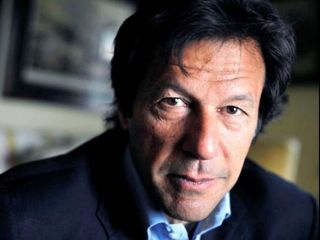
Imran-khan-niazi1The 2013 elections in Pakistan gained the Pakistan Tehrik-e-Insaf (PTI) the government in Khyber-Pakhtunkhwa province as well as the third most prominent position in parliament. This striking success was a vindication of Imran Khan, PTI's leader, who had struggled for many years to break into a sclerotic system dominated by autocratic political parties organized around familial and financial interests.

But the results were a crushing disappointment for Khan and many of his supporters who became convinced that the elections had been rigged against them. Over the last several weeks, the country has become embroiled in a severe political crisis in which Khan and some of his followers are staging protests in Islamabad against last year's election results and the current government of Prime Minister Nawaz Sharif, the head of the Pakistan Muslim League (PML-N).

Some of Khan's arguments deserve to be taken seriously. There are undoubtedly deep flaws in an electoral system that is still nascent. Last year was the first time, after all, that one elected regime transferred power to another in Pakistan's history. To the extent that the PTI has elevated the issue of improving electoral accountability in the country's national debate, it deserves credit. Yet Khan has advanced a series of improbable, evidence-free conspiracy theories that have muddied rather than clarified the debate. Worse, by intriguing to overthrow Sharif's regime, he has damaged Pakistan's fragile democracy.

Khan's allegation that ‘rigging' took place is almost certainly true, but the assertion that a host of Pakistani institutions connived to rig elections in Sharif's favor is almost certainly false. Here are just a few reasons to be skeptical of Khan's sweeping claims. First, while claims about a stolen election have been asserted with great certitude, no evidence for a vast conspiracy has been provided. Khan has leveled highly specific allegations, incriminating the Chief Justice, the head of the election commission, and various others, without any proof. Second, consider the sheer improbability that some 70,000 polling stations, where perhaps 600,000 people worked, under the direction of a cabal consisting of the election commission, the superior judiciary, and Nawaz Sharif, worked in unison to deliver a result adverse to Khan. Third, at the time of the elections, the Pakistan People's Party (PPP) was in power and oversaw the holding of the elections. If such a vast conspiracy is possible, then why did the PPP suffer a drubbing, and why did it allow its political nemesis, the PML-N, to triumph? Fourth, why is only PTI and not the other political parties—who presumably would be equally suspicious of the adverse election results—protesting? Instead, while happy to see the Sharif government flounder, the parties have stood by the government. Fifth, if the election was stolen by the PML-N in order to prevent PTI's victory, it was done in a rather half-hearted manner – awarding the PTI rule in a province, and making it into the third largest party in the national assembly.

All independent observers, including international monitors, concede the flaws in the 2013 elections but aver that, nonetheless, these were the freest and fairest elections in Pakistani history. This is not a high bar to cross, but it suggests why all of Pakistan's parties accepted the results when they were announced and formed the government.

Read more »

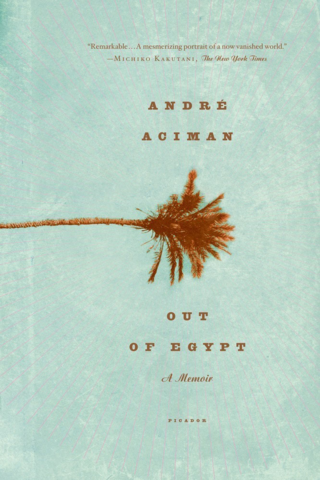
Out of Egypt

by Ruchira Paul

And suddenly I knew, as I touched the damp, grainy surface of the seawall, that I would always remember this night, that in years to come I would remember sitting here, swept with confused longing as I listened to the water lapping the giant boulders beneath the promenade … I wanted to come back tomorrow night, and the night after, and the one after that as well, sensing that what made leaving so fiercely painful was the knowledge that there would never be another night like this… not this year or any other year… I had caught myself longing for a city I never knew I loved.

Out of Egypt

The city was Alexandria, Egypt, the year 1964 and the person thinking the thoughts, a thirteen year old boy whose family was about to depart from the city the next day – for ever. André Aciman’s Out of Egypt is an enchanting memoir that draws from history, childhood memories and probably a bit from the author’s imagination. I recently re-read the book after a gap of more than a decade and found it just as absorbing as it had been the first time.

Out of Egypt recounts the story of the author’s extended family, Sephardic Jews with their footprints in many parts of Europe and the Middle East – Italy, France, Germany, Syria, Turkey and finally, Egypt. The large, loud, colorful clan was polyglot (Aciman’s two grandmothers spoke to each other in six different languages), contentious, sharp of tongue and at times snobbish. Even after three generations in Egypt, they hadn’t learnt to speak Arabic well except to communicate with the baker, the butcher and the domestic help in a pidgin version. They considered themselves French, Italian and German although most arrived in Alexandria via Constantinople. Used to seeing their fortunes wax and wane, Aciman's great uncles were forever ambitious and optimistic that the next financial scheme was bound to strike gold. To that end they tirelessly utilized their social and political connections, a bit of chicanery and if the target was a family member with means, arm twisting. Their sisters and the women they married were by turn shrewd, neurotic, theatrical, acid tongued and in times of crises, generous and supportive. In the midst of many near disasters and real catastrophes, the whole family rallied to help each other. By the time the book ends, several older family members had died and others were scattered through Europe and America. The events after WWII and the burgeoning nationalistic fervor made Egypt an inhospitable place for its non-Muslim residents.

Read more »

Spaghetti with a Dash of Dostoyevsky

by Lisa Lieberman

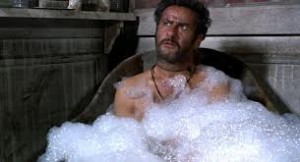
Wallach-in-bathtub-GoodBadUgly-300x162My favorite line from The Good, the Bad, and the Ugly (1966), spoken by the late, great Eli Wallach, captures the essence of the Spaghetti Western. Here's Tuco, the Mexican bandit played by Wallach, taking a bubble bath in some half-destroyed hotel room, when a one-armed bad guy barges in, holding a loaded revolver in his left hand. The last time we saw this guy, Tuco had left him for dead after a shoot-out. He's been thirsting for revenge ever since, he says, and in the time it's taken him to find Tuco, he's learned to shoot left-handed. Blam! Wallach's character blows him away. “When you have to shoot, shoot. Don't talk.”

Sergio Leone loved Westerns and the image of America they conveyed. You see this in his craftsmanship, the careful attention to detail, the gorgeous panoramas reminiscent of John Ford's best work. Even when Leone undercuts the conventions of the genre (as in the scene with Tuco and the one-armed bad guy), he pays them tribute, substituting his own, more nuanced myths for the old cowboy clichés. “Fairy tales for grown-ups,” he called them in an interview with Christopher Frayling.

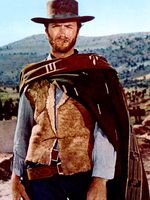
ClintOf course, Europeans are the grown-ups: worldly, cynical, not prudish about sex, more concerned with surface style, it must be said, than with the moral underpinnings of their heroes. Who is “Blondie,” Clint Eastwood's character in the film? We never learn his real name, where he came from, who his daddy was. A man of few words, he's unconcerned with social niceties, having no interest in women, good or otherwise, no long-range plans, dreams, or ambitions. He dresses well, however.

Clothes Make the Man

The trademark hat with tooled leather hat band. The poncho. In his later masterpiece, Once Upon a Time in the West (1968), Leone put all of his actors in dusters like the one Blondie wears when Tuco is forcing him across the desert, kicking off a fad for the long, fawn-colored coats among trendy Parisians. But those dusters are really dusty. Compare the nice, clean hero of an American Western to his sweaty counterpart in one of Leone's films. At the end of a hard day's ride in The Searchers (1956), John Wayne's horse is pretty sweaty, but apart from needing a shave, Wayne himself is fresh as a daisy.

Read more »

Wow

Ayasofiya2by Maniza Naqvi DSC01672

Just Wow! At every turn, and corner in Istanbul—you are bound to say—Wow.

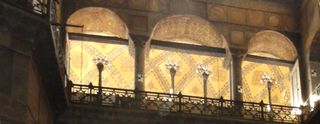
The obvious example is, of course, at the Basilica of Aya Sofiya—built by Emperor Justinian in 537 AD. Legend has it, that Justinian wanted this magnificent Eastern Orthodox Church, in its beauty and scale to rival Solomon's great Temple. So that even Solomon would have been Wowed. Whether, Solomon would have been Wowed, or not, subsequent emperors, certainly were—And in 1204, the Aya Sofiya, was converted to a Roman Catholic Church, and then in 1453 the Ottoman Emperor was certainly wowed, because he appropriated the Basilica, and converted it into a mosque,—which it remained till 1935, when it was turned into a museum, for a Basilica and a church and a mosque, by the State of Turkey. The histories of Roman, Byzantine and Ottoman empires, were now showcased, and encapsulated in one space. Istanbul, is afterall, just that kind of an ‘and-and' place. The word Aya, in Greek means holy, and Sofiya means wisdom. Aya Sofiya: Holy Wisdom.

Ayasofiya1

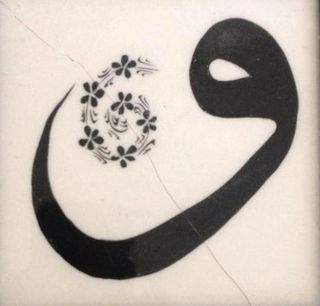
When I visited, the Museum of Aya Sofiya, again this Spring, I moved away from the hordes of tourists, to a quieter corner, and found there a small display of calligraphy. Here, I saw depicted, in a single stroke of ink, the Arabic letter pronounced as wow. Letters of the Arabic alphabet are used as symbols in Sufism, to signify a greater meaning of perfection.

WowletterThe letter Wow, shaped like a bowed head, like a tadpole—like an embryo like a germinating seed, like the sun's millions of warm smiles on the waves of the water, takes just one stroke to create: one stroke, in a swirl like a strand of honey, dripping or a whirl—like a whirling dervish. It caught my eye, and reminded me of itself, in the thriving, pulsating streets, and cafes and mosques and later even on a friend's posting on facebook. Wow, wow, wow.

This letter Wow, has the numerical value of six, which also symoblizes perfection and resembles the number six as written in English. The Arabic word Wadood which begins with the letter Wow means love and is—one of the attributes of God. Thus, the letter Wow is shorthand for aspects of loving, in Sufi Orders. It symbolizes the sense of being spiritually elevated. And, the letter Wow is the first letter of how the word ‘and' is spelt in Arabic—Wa. Several verses of the Quran extolling love begin with words starting with the letter Wow. And so many of the verses begin with the word Wa meaning and. For example in the Chapter Al Buruj ‘And He is the Forgiving, the Loving, Lord of the Throne of Glory, Doer of what He wills.

Read more »

Monday, September 1, 2014

Deep Surface

by Brooks Riley

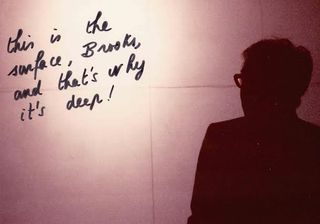
ScreenHunter_782 Sep. 01 11.58Jean-Luc Godard once inscribed a picture to me with these words: “This is the surface, Brooks, and that’s why it’s deep.” At the time, I was skimming the surface, darting from one life experience to another without stopping to sink down or dive deeper—or give his jeu de mots much thought. While I always relished his love of word play in both English and French, this time I was suspicious of what sounded to me like a facile paradox.

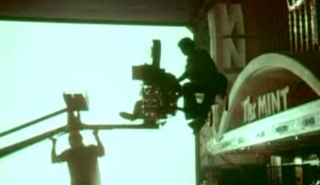
As a man of cinema, Godard must first have thought of that great cinematic paradox, the flat screen and the depth of field that miraculously occurs when a film is projected onto it. In the photograph, he stands in front of a blank wall, very like the blank screen he would soon use for a shadow play to the opening bars of Mozart’s Requiem Mass in D Minor, defying the double-entendre of flatness and cinematic depth with a chiaroscuro ballet in front of the screen—a crane operator and his crane moving the camera and cameraman slowly up, over and then down again, a graceful pas de deux silhouetted against the flat white surface—a two-dimensional triumph.

ScreenHunter_781 Sep. 01 11.40How appropriate that this holy moment was filmed in the soundstage where the glitzy streets of Las Vegas had been built for Francis Ford Coppola’s One from the Heart. The crew, borrowed for a Saturday from that bigger film, consisted of Italians—Vittorio Storaro and his Italian crew—and the hardboiled Hollywood mainstream pros who had seen it all—or thought they had. As Godard piped Mozart over the loudspeakers, and the camera rolled, a cathedral hush permeated the vast interior of the soundstage as the middle-aged, elegant crane operator began to move in front of the screen with the assurance of a dancer, or a man who knows his job. When the music faded out at the end, the hush prevailed. No one, not the crew, not the visitors, not the cast, had ever seen anything like it. It was surface magic, deep beyond words. Now I knew that his inscription made sense.

(As a 9-year-old with not enough movie experience I could easily have retorted, ‘This is the surface, Jean-Luc, and it’s a grande illusion,’ as I waited in vain for Marlon Brando to emerge from the back door of my local movie theatre after a showing of Desiree.)

Too often surface is a euphemism for superficial. But living on the surface makes it easier to be ubiquitous. The assumption that one has to dig or dive for treasures is not necessarily reliable. Analogies can also be arrived at by moving far afield over a surface, like the gerridae, those bugs who walk on water, always finding what they need on top, not deep down. Knowledge is like that body of water: You can dive down into it, but to see clearly, you have to rise to the surface.

Read more »

Monday Poem

Parallel Universe

everything unknown returns to life
upon awakening in my bed supine in light
sun bequeathed day ignites a fire beneath
my blankets burn mind’s the filament of a lamp
upon awakening stupidity tumbles down a sheer of chance
small thoughts plunge they start an avalanche
the ground gives way beneath my feet
upon awakening where am I?
light ricochets from every wall
blind see deaf hear motion stills
minutiae interlock upon awakening
east and west do not collide they mesh
upon awakening bias stands upon its head
draining deadliness, its river Cocytus circles a sewer
upon awakening states recede decline abjure
the babble of all the varied words of god unite
upon awakening they steep in a cauldron of love
the clock’s a joke upon awakening
doors swing wide though no one knocks
upon awakening each ajar as each unlocks
windows blast from jambs upon awakening
lions lie with lambs every noise becomes a note
upon awakening every weight begins to float
even cacophony sings upon awakening
nothing is ever learned again by rote
upon awakening everything becomes
the final sacrificial goat

by JIm Culleny
8/31/14

A personal ethics of clicking

by Charlie Huenemann

ClickNow that every click we make is watched, archived, and meta-data-fied, it is time to start thinking seriously about a personal ethics of internet consumption. This goes beyond mere paranoia and worry over what others might think of what you're taking interest in. Each click is in fact a tiny vote, proclaiming to content providers that you support this sort of thing, and hope to see more of it in the future. And – as always! – we should vote responsibly.

It's too bad, really. Gone are the days where, with the adjustment of a couple of browser settings (“Privacy – on!”), no one could ever know that we were clicking away at all sorts of embarrassments, from naked people to celebrity gossip to stuff that might accurately be labeled as very nasty. It was a seemingly harmless way to let that little id go crazy and graze its fill. Content providers happily supplied the forbidden fruits and we gobbled them up.

Now the jig is up. Privacy settings are as effective as the dark vs. light lever on a toaster. But more significant than any embarrassment we may feel is the fact that our clicking is factored into incredibly effective algorithms which help to steer more of the same our way. And as more of us click on crap, more and more similar crap is generated for consumption, and the internet gradually expands into wall-to-wall crap.

Immanuel Kant's perspective on ethics might suggest to us a Categorical Internet Imperative: Click only on those links that you can at the same time will all your fellow citizens to click on. I don't know about you, but many times I feel that if everybody were just clicking on what I'm clicking on, our culture would be racing toward – well, to pretty much where we are these days, I guess: a few reliable sources of insight and information doing their best to compete with freak shows, bear-baitings, and adorable kittens attacking paper bags.

Not to say we have to be Prussian prudes, of course. Insight and information can come from surprising places, and we surely need clowns to tip us off balance and question ourselves. And there's nothing wrong with just plain old fun (as if anyone needs to be told that). But once we begin seeing our clicks as tiny votes, we begin to think about what sort of sustenance we are channeling into our own minds, and what sort of diet we are recommending to our neighbors. Let us dream a little: if all the clickers out there aimed more consistently toward “good stuff”, content providers would be competing to produce more and more of that stuff. Gradually, one hopes, we would witness the ebbing of the crap, and the waxing of a gloriously informed and inspired culture.

(Okay, that's crazy talk. But even a small shift in that direction would be to the good.)

Read more »

Why I don’t like tipping

by Emrys Westacott

Images

I dislike tipping. That is, I dislike the whole tipping system. As a card-carrying tightwad I can't honestly say I enjoy leaving tips, but that's not my point. My point is about the general practice, the social institution.

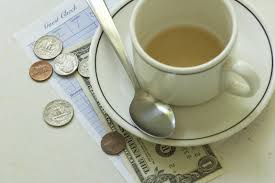
What set me thinking about this was a slightly unpleasant experience I had recently in a café in Quebec City. My wife and I had finished breakfast and after quite a long delay the waitress brought the bill. In Canada these days, as in Europe, it's normal for customers to pay using a portable credit card reader that is brought to the table. These reportedly reduce credit card fraud by eliminating the opportunity for dishonest wait staff to “skim” the credit card information while out of sight of the card owner. The bill is displayed on a screen along with various tipping options. These vary according to the machine, but a typical range of options is: 10%, 15%, 20%, custom tip, no tip. Usually I tip 15%, but on this occasion, partly because of the long delay in getting the bill, and partly because I felt the waitress had from first to last been unpleasantly condescending, I tapped the 10% button. She was looking over my shoulder (another thing I had against her), and immediately asked me if I was dissatisfied in any way with the service. Being taken by surprise, and also being a wimp, I answered “No.” She then told me that in Quebec it was normal to tip at least 15%. I said, “Oh, I didn't know,” and left the tip at 10%. If I'd been less of a wimp I would have explained my dissatisfaction and complained about her looking over my shoulder. Then again, if I'd been even wimpier I would have adjusted the tip according to her recommendation.

Tipping is a peculiar institution. Whether you leave a tip is optional, and there are many circumstances where you would suffer no adverse consequences (other than possible feelings of guilt) should you not tip: for instance, when you check out of a hotel, alight from a taxi, or eat at a restaurant you are unlikely to revisit. If we were nothing but little carbon-based bundles of rational self-interest, as some economists prone to abstraction have at times assumed, tipping would be much less common and might even never have become an established custom. In some places—Japan, Finland, South Korea, for instance–it isn't. And even in places like the US, where tipping is widespread, the conventions aren't especially consistent. Many people leave a tip for the person who cleans up their hotel room, but not for the person at the reception desk who checks them in and out. They add a tip for their hairdresser, but not for their dental hygienist.

Read more »

Inconsistent Mathematics, Reutersvärd, and Buddhism: An Interview with Chris Mortensen

by Michael Lopresto

IA_23_Bike Rack with Shadows

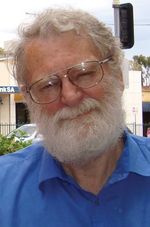
Chris Mortensen is Emeritus Professor of Philosophy at the University of Adelaide. He thinks that the inconsistent hasn't been taken seriously enough in Western philosophy, that the masterpieces of Reutersvärd rub our noses in the inconsistent, and that Western philosophy and Buddhism are complementary. He's the author of Inconsistent Mathematics (1995) and Inconsistent Geometry (2010).

Firstly, what made you get into philosophy?

I think I was always interested in it, really—since high school, anyway. I was diverted for while into maths and physics during my first couple of years at university, before coming back to philosophy. I realised that if what you want to do is what you like doing, then philosophy is the thing to do. I still kept up with the maths subjects, but philosophy was more fun, and I was better at it.

Morty

Had there always been a lot of overlap between your interest in philosophy and your interest in maths?

There was, but one thing I noticed was that my logic lecturers would always motivate what they were doing. They would tell you why this was interesting, why there was a debate here. Whereas my maths lecturers on the other hand tended to be very pure and syntactical, leaving aside motivation much of the time. Some logicians are very pure – some of my best friends are very pure. But perhaps it is possible to be a bit too pure and syntactical in philosophy, it depends on what you are trying to achieve I suppose. Just pop down to the library and have a look at Russell and Whitehead's Principia Mathematica. It doesn't contain too much English (even though Russell excelled as a philosopher, as opposed to a logician).

Read more »

The Value of Dutiful Actions

by Carl Pierer

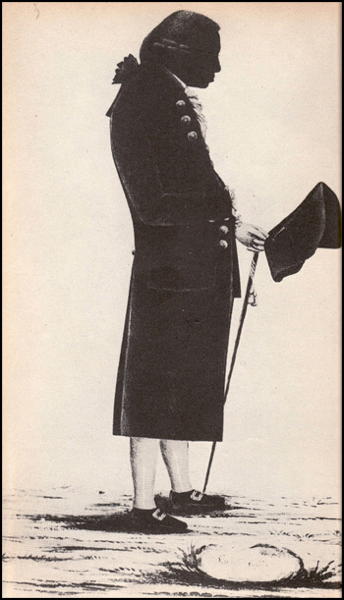
KantIn his Groundwork of the Metaphysics of Morals Kant states that an action has moral worth if and only if it is done from duty.Kant argues for his position by showing that morally right actions done from motives other than duty lack moral worth. He gives two examples:

The Shopkeeper always gives correct change. She does not care whether this is morally right or not. She is only faithful to her costumers because it ensures her making profit. Her sole motivation is self-interest and not duty.

The Philanthropist is kind because of a natural inclination. He just feels like being a morally good person. He too is not concerned with morality. Rather he behaves correctly because that is what he wants to do. He is lacking a feeling for duty.

It might be said that both actions lack moral worth since the agents are not concerned with morality at all. They do not care for whether their actions are moral. It is a happy coincidence that they are. Therefore, the agents do not deserve any moral credit. However, this argument does not prove Kant's claim conclusively. It only shows that actions lacking motivation from duty entirely are morally worthless. What if we understood Kant to mean that the action is only morally worthy if duty is the sole motivation?

Schiller's Joke expresses an intuitive resistance against this reasoning:

“The first speaker says: Gladly I serve my friends, but alas I do it with pleasure. Hence I am plagued with doubts that I am not a virtuous person.

And the reply is: Sure, your only resource is to try to despise them entirely. And then with aversion to do what your duty enjoins you.

Intuitively, this sounds wrong. We are under no obligation to despise our friends. We can confidently like them and our friendly acts would still be morally worthy. This seems to refute Kant's claim that only actions done from duty have moral worth.

However, this objection differs from Kant's examples. Both the shopkeeper and the philanthropist lack motivation from duty entirely. All that drives them to do the morally right thing is self-interest or their natural character. Yet, the person who serves his friends with pleasure can at the same time still believe in his duty to serve his friends. So the case is: In addition to some non-duty directed motivation, the agents believe in their duty to moral behaviour. Do these actions have moral worth?

Read more »

Ai Weiwei and the fine art of the art installation

by Mathangi Krishnamurthy

As a rule, I am wary of art installations. I am never sure if the form they take bear any relation to the political content they claim to espouse. Also, as a rule, I visit modern art exhibitions for their verbosity. The words speak to me of artistic intent that always races ahead, far in excess of its signifying objects. The intent itself I find to be of such beauty, nudging me with its faint hints of revolution and radical joy. Of course, it does worry me that I have to read the labels of things before I can calculate the impact they will have on my fervor and/or joy.

However, on the lowest rung of my pleasure-affording hierarchy lie modern art installations. I remember once visiting the Museum of Modern Art in New York City and staring hard at a diagonal tube light mounted up on a wall. I also metaphorically bonked myself on the head for “Artist” not making the top three on the list of possibilities suitable to my eight year old self's artistic ability or lack thereof.

As I walked into Ai Weiwei's exhibition “Evidence” I thought to myself that I should maintain a healthy cynicism and a suitably controlled set of expectations about what a set of art installations ought to be able to evoke. In the late afternoon of a confusing Berlin summer, I got off the bus already flush with the pleasure of a scarily efficient public transport system, and walked down the lane to the spot on my Google map that said “Martin-Gropius-Bau”. The Bau is a startlingly beautiful building, all neo-Renaissance in its pastiche of dome, entryway columns, curlicued windows and shadowy moldings. Something already felt right. The sun shone bright and the clouds filtered out its strongest rays. I was suitably warm and the light was suitably right. Ai Weiwei in his entire grandfatherly wallpapered aura stared straight ahead and betrayed no amusement at my sudden and unexpected enthusiasm.

Atrium One

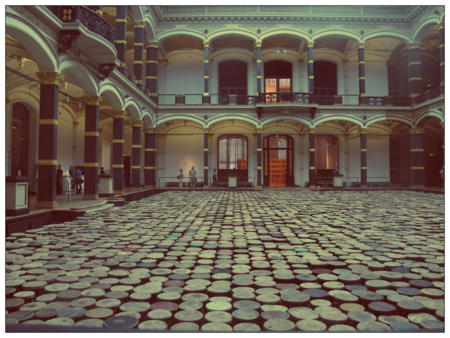
Ai Weiwei: Evidence, Stools, 2014, wooden stools; Martin-Gropius-Bau, Berlin

Across eighteen rooms of the Bau were spread all the works that were being curated under the title “Evidence”. Playing with the concept of both what “discovery” means to police and detective records, and the concept of empirical “evidence” as relating to crimes both contemporary and historical, the main items of this exhibit comprise found, made, and remade artifacts—touchy, feely, gritty physical objects. Most of them display familiar hints of the Ai Weiwei oeuvre. They offer confusing and paradoxical cues by playing with the material they are composed of, they are parts of a much larger story that they bear evidence to, and they are often directly related to aspects of the artist's life.

Read more »

A sin tax on junk entertainment

by Thomas Rodham Wells

Unnamed (1)Governments should tax the production and consumption of junk entertainment like Angry Birds and The Bachelor to correct the market failures that encourage their overconsumption. As with tobacco and alcohol, the point of such sin taxes is not to prevent people from consuming things that are bad for them if they really want to. They are not like bans. Rather, such taxes communicate to consumers the real but opaque long-term costs to themselves of consuming such products so that they can better manage their choices about how much of their lives to give up to them.

At the heart of this proposal is the fact that high art – i.e. real art – like Booker prize winning novels and Beethoven is objectively superior to junk entertainment like Candy Crush and most reality TV. (For now, let us abstract from ‘middle-brow' entertainment like our new Golden Age of TV.) Some egalitarians of taste dispute the existence of any objective distinction in quality between pushpin and Pushkin and argue that the value of anything is merely the subjective value people put on it. I will humour them. The case for the objective superiority of art can be made entirely within a narrowly utilitarian -‘economistic' – account of subjective value: in the long run consuming junk entertainment is less pleasurable than consuming art.

At best, junk entertainment passes the time and brings us closer to death in a relatively painless way. At worst, passing a lot of time in this way makes us stupid by atrophying our abilities to appreciate anything more difficult. Hence the pejorative term ‘junk', for there is a strong resemblance between this sort of mental activity and eating cheeseburgers: the more cheeseburgers we eat, the less we enjoy each new one, and the fatter and more unhealthy we become. In contrast, art has the capacity not only to fill up the limited time we have in our lives, but in the process also to educate us in the enjoyment of its intellectual depths so that it produces more delight in us the more of it we consume. In economics terminology, the consumption of junk entertainment exhibits diminishing marginal utility and reduces our human capital while the consumption of art exhibits the opposite. Art is special.

Read more »

Monday, August 25, 2014

Re-tweeting to the High Ground

by Gerald Dworkin

Many of the quotations that appear in my e-reader Philosophy: A Commonplace Book are one-liners:

There are many ways in which the thing I am trying in vain to say may be tried in vain to be said. —Beckett

Better latent than never. —Morgenbesser

Philosophy is to the real world as masturbation is to sex. —Marx

But often the difference between a one-liner and a many- is arbitrary. Wilde's “I do all the talking. It saves time and prevents arguments” could have a semi-colon instead of a period and be a one-liner. Thus Shaw: One sees things as they are and asks why; another dreams things that never were, and asks why not. Or, as Nabokov put it: The difference between a therapist and the rapist is a matter of distance.

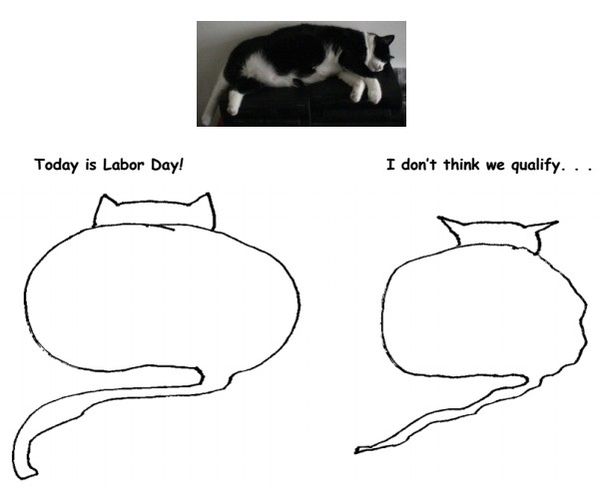
UnnamedThis brings us to the concept of an aphorism. Most definitions, wisely, do not use a precise measure of length or depend grammatical structure. Here are some typical definitions.

1) a pithy observation
2) a terse saying
3) a short phrase
4) a brief statement
5) a concise statement
6) a laconic expression

It was Nietzsche's aim to “to say in ten sentences what everyone else says in a book—what everyone else does not say in a book.” But he was also brilliant at much shorter length. “All truth is simple…is that not doubly a lie?”

Obviously this pithetic character is at best a necessary condition but not sufficient. “Today is Monday” is pithy enough but lacks a certain je ne sais quoi. Again, definitions try to supply the missing ingredient in different ways– “embodying a general truth”, “makes a statement of wisdom” , “astute observation”. The first of these seems, to us now, too weak. “Objects fall when unsupported” is both pithy and a general truth. But Bacon titled one of his books on the nature of science Aphorisms Concerning the Interpretation of Nature.

For what it is worth, the word derives from aphorismos (greek) meaning definition. And indeed historically many aphorisms took the form of definitions. Ambrose Bierce's Devil's Dictionary being a prime example. ACADEMY. Originally a grove in which philosophers sought a meaning in nature; now a school in which naturals seek a meaning in philosophy. PHILOSOPHY. A route of many roads leading from nowhere to nothing.

All of this is by way of introducing the reader to a particularly clever and astute practitioner of that current system of aphoristic communication knows as the TWEET. Now those inclined to resist all things contemporary may object that any message that may be as large as 140 characters cannot be an aphorism. (Joke interruption: I was asked the other day to supply a password with at least eight characters. I decided upon Snow White and the Seven Dwarfs.) And those truly hostile may note that the definition of Tweet given first in all dictionaries is “A weak chirping sound, as of a young or small bird.” But the tweets I am bringing to your attention are both short and clever.

Read more »

Of Dark Matter, And Resonance Across Scales

by Tasneem Zehra Husain

ScreenHunter_769 Aug. 25 13.00I'm a total pushover when it comes to stories of connection. I am delighted by accounts of barriers breaking down and disparate people uniting in purpose, of ideas coalescing and theories fusing to reveal the common threads that underlie diversity. As I look back upon the history of physics, what reaches out and grabs me are the moments of unification when strands long thought separate are suddenly braided together in a whole that is stronger and more beautiful than the sum of its parts. Sometimes we uncover hidden affinities by exploring a motif repeated in apparently unrelated contexts; at other times, we are compelled by circumstance to form alliances with those we may have neglected, to put our heads together and come up with a solution acceptable to all. The conundrum of dark matter falls solidly in the latter category.

For several decades, cosmologists and astronomers had been growing progressively distant from their particle physics colleagues. As one group craned their necks further out into uncharted space, the other crawled deeper into the recesses of the atom. The disciplines began to seem as divergent as the scales upon which they operate, but there is a surprising resonance between the minute and the colossal. Even objects of cosmic proportions are built from subatomic particles. The discovery of dark matter was a reminder that no part of the universe can be completely understood by those who turn their backs on the rest.

Discussions of dark matter (and dark energy) are often front-ended by a startling admission of ignorance: the entire gamut of matter particles we conventionally study – quarks and leptons combined – forms less than 5% of the known universe. There is about five times as much dark matter out there, we are told, while the rest of the universe is made up of dark energy. But, since neither dark matter nor dark energy can be seen, how do scientists justify this shocking claim? An analogy might help. The mechanism of human vision is such that we see objects only when they reflect light. But if you find yourself in a pitch dark room, you don't immediately conclude that just because nothing is visible, the room must be empty. You simply realize that sight is no longer a reliable guide under these circumstances, and you must lean on sounds and smells, and touch (and taste?) to probe your surroundings. For lifeforms less dependent on vision, the darkness is multi-textured and alive with variety. Consider bats, for instance. Where we rely on light hitting objects and bouncing back, bats bank on sound. They emit high frequency calls, inaudible to human ears, and use the resulting echoes to construct a sonic map of their surroundings (the further an object is, the longer it takes for the echo to come back). The moral of the story is this: as long as there is a way for you to interact with an object, you can “sense” its presence.

Read more »