
by Eli Rarey
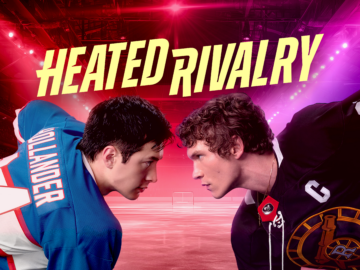 The TV show Heated Rivalry arrives on cinema screens this week, transforming it from a short six-episode TV season into a 5-hour cinematic experience. I for one can’t wait to sit with an audience in a darkened theater and share in Shane and Ilya’s steamy romance. For those of us who love the show, it has always been an epic, monumental narrative, taking an outsized role in our lives. But why? The success of the show has created a kind of mystery—what about this story made it such an undeniable cultural force? Let us compare it to another cultural force which has recently entered the public imagination: Homer’s Odyssey. I am setting aside Christopher Nolan’s version of the story (which I found disappointing) to look instead at Homer’s text, which offers some surprising parallels with our favorite TV hockey romance.
The first four books of The Odyssey, the first sixth of the total epic, concern themselves not with Odysseus and his journey but rather with his son, Telemachus, on the island of Ithaca, where his father is the absent king. The war is over, the other surviving kings have returned. No one knows where Odysseus is. Other men are trying to get his wife Penelope to accept that Odysseus will never return, but so far she has remained faithful to her perhaps-dead husband. If Penelope does remarry, this would likely leave Telemachus, brought up as the son of a king, with no inheritance—maybe even exiled or dead. Telemachus can’t keep these suitors from harassing his mother—in fact, he can’t even keep them out of his house. They’re literally eating all his food. Telemachus responds to this situation by leaving Ithaca in a boat to go visit his father’s friends. Interesting! Telemachus is going on his own little odyssey, a mirror of the journey his father takes—his own sea voyage in which perhaps his character will also be tested. Maybe at each house he visits some challenge will be put before him, and if he triumphs then he will be provided with what he needs to defeat the antagonists at home.
Actually, no. In a series of detailed scenes, Telemachus is graciously fed by his hosts and entreats them for help. They tell him what a great man his father is. There are no confrontations, no narrow escapes, no triumphant victories. There is very little conflict in these scenes. He is treated only with respect, even before anyone knows he is the famed Odysseus’ son. He is welcomed and fed. No secret tensions erupt in violence—each person he meets holds his father in the highest esteem. They regale Telemachus with stories of his father’s great cunning as a warrior and attempt to reassure him that even if the gods have delayed his father (spoiler alert, they have) Odysseus will soon return home to Ithaca. Homer’s tale provides details of where Telemachus sits, who serves him, and when he introduces himself. These detailed social niceties would have had meaning for Homer’s audience, yet the question remains: why are we spending so much time and attention on table manners? Why are the nuances of courtesy so important to the story?
Heated Rivalry is divided into six episodes, so the first episode of the TV show roughly corresponds to the first four books of The Odyssey, in terms of proportion to the overall story. In this episode, Ilya and Shane meet when they are both being recruited as professional hockey players. They are rivals, in that they are competing for first draft pick in their rookie season. They run into each other in a hotel gym late at night, working out on stationary bikes—playing out their public rivalry in private as they race side by side, ironically on bikes that do not move. Again, the conflict in this scene is obscure. As an audience, are we wondering who will “win” the race? Literally, this is not possible. Even if it was, we do not care. We are here for steamy romance. We want to see people who have a lot of reasons to stay apart instead drawn together by irresistible desire. We want to watch them make out. And you know what? We will.
Sitting on the gym floor soaked in sweat and gasping for breath after their bike ride to nowhere, the two begin to get to know each other. Ilya offers to share his water bottle—an opportunity for hints at the intimacy to come, though nothing explicit is shared yet. Again the conflict is largely supplied by denying the audience what we want—but before long Shane and Ilya make a tentative plan to meet later in Shane’s hotel room. When Ilya comes to Shane’s room, we are offered a detailed scene nearly eight minutes long, in which Shane has his first sexual experience with a man. Both carry a great weight of expectation and responsibility in their families, and if an encounter like this became public it could destroy their careers. They take a great risk by meeting in this way—but that doesn’t mean they swear any lasting devotion to one another. They enjoy a safe, pleasurable sexual encounter. Nothing bad happens.
A clear conflict appears in both stories, but it doesn’t drive the storyline. It serves as a kind of frame on which the scenes are suspended, but the central scenes of this narrative aren’t about conflict at all. No one is fighting against each other. A young man goes to his father’s friend’s house and shares a meal. Two young men meet in a hotel room and share, well, a different kind of meal. Both scenes are handled in exquisite detail, and though we might find those scenes in The Odyssey boring we can assume that Homer’s audiences found this as compelling as we find the sex scenes in Heated Rivalry. Completely lacking in conflict, these scenes are full of something that is even more important to storytelling: meaning. But why? If we are not watching to see who wins and who loses, where does the drama come from?
Let me posit that for a story to be meaningful it must have some sense of human vulnerability—someone facing uncertainty or loss. Telemachus could lose everything if his father doesn’t return. Shane could lose everything if he acts on his secret sexual desires. (Furthermore, Shane’s life will lack any joy or meaning if he doesn’t find a way to fulfill his secret desires.) We catch these characters in a moment of profound vulnerability. We understand what this situation means to these characters, why this vulnerability is excruciating to them, why they desperately long to change their situation. What does this person do in that situation? What constrains him? What actions might he take? It is as if we see someone tied to the train tracks, but there is no train coming. We just want to see what it is like for them, there on the tracks. How do they behave? How does being on the train tracks affect their lives and their relationships with other people?
The vulnerable situation in which the characters find themselves might seem contrived to the audience. In fact, it is contrived, and usually we as the audience know it. Someone is tied to the train tracks, the train is coming! The two best hockey players in the league are public rivals, privately falling in love! We enter the story not despite these fantastic elements but because of them. We embrace the fantasy. This is just as true for The Odyssey, in which fantastic elements include traveling to the land of the dead, fighting a giant cyclops, and meeting gods in human form. We have no problem with how ridiculous this might be as a premise, as long as we believe the way that these people behave within that premise. We want to live inside the fantasy, but we demand authenticity as well. The authenticity of the characters’ response to their experience makes the contrived circumstances meaningful to our lives. We need the choices these characters make and the consequences they face to feel like choices we might have to make and consequences we might have to face. We don’t come to a story in order to see who wins in a contest between fictional beings; we want to understand something about our own painfully vulnerable lives. These characters are stand-ins for the audience, and even if the circumstances they face are contrived, the characters themselves need to feel real in order for the story to feel meaningful.
Shane and Telemachus both negotiate complex social cues in a situation they have never faced before, with a lot riding on the outcome. They can behave impeccably, and still they must live with uncertainty, their destiny held in someone else’s hands. They long for something that might be impossible, and take a risk by meeting with someone else who might be able to help. But when Ilya visits Shane in his hotel room, we get a dramatization not of conflict or disaster, but of absolute kindness. We see, in detail, a best-case scenario for how to handle a desperately vulnerable individual in a moment of need. This long, detailed scene holds our attention not because of the trials the character faces, but because of the grace with which he is greeted. Not only do we want to watch this play out again and again, we want to talk about it with others in our community. The characters become monuments signifying and celebrating how men should be. Meeting someone for sex, in the world of Heated Rivalry, is an important part of becoming intimate with someone. This journey to emotional intimacy, it seems, is something we are desperate to understand more deeply—much in the same way the audience for Homer’s epic was desperate to understand how to receive a stranger from an island nation into your home. The table manners in The Odyssey are in fact the point of the story: the overwhelming theme of the epic poem as a whole is how strangers, foreigners, and guests are treated, and how they treat their hosts. Table manners are not trivial. This is what civilization is made of.
In later scenes of the epic this becomes more explicit: will I be invited to dinner or will I be dinner? Again and again Odysseus risks being eaten, devoured, swallowed alive. He will show up in a foreign place and act like a murderous thief, reaping the dire consequences. He will show up in a foreign place naked and afraid, and he will be offered refuge and sustenance. Our modern retellings usually focus on the battles and monsters Odysseus faces, but Homer’s text is much more concerned with the delicate social negotiations along the way. There are certainly battles and adventures, but the proportions of the narrative overwhelmingly favor the scenes of visits and encounters governed by social courtesy rather than physical prowess. Even the famous episode with the cyclops turns on a detail of how Odysseus introduces himself to his man-eating host. When the cyclops asks him who he is, he could have said “I am King Odysseus, and I demand you free me and my men!” If he had, as Homer tells the story, he would never have returned home. We can tell the story focusing on the fight instead of the table manners, but then it becomes mass entertainment, an action-adventure blockbuster instead of epic legend. The Odyssey was not just a story to its audience in Homer’s time, in the same way that Heated Rivalry is not just a TV show to its fans.
Epic storytelling helps us author our world. The heroes of Heated Rivalry show each other masculine tenderness in a world ruled by ruthless competition. It doesn’t feel like entertainment, it feels like a new religion. In our own society, constant optimization for efficiency and consolidation of power has created a kind of antihumanitarian civilization. We feel the painful absence of loving care. We sense that we are racing on stationary bicycles going nowhere. We go to the theater not just to enter the world on the screen, but to rewrite our own society in the process, to pay homage to this monument to love. Watching and rewatching this story becomes a ritualistic act with our fellow acolytes. Heated Rivalry isn’t the first cultural touchstone to take hold of a culture in transition, surrounded by chaos, hungry for meaning. When the first Star Wars film became a worldwide sensation in 1977, at the time it was just as unexpected. I can only hope that explicit queer romance still captivates our mass consciousness 50 years from now. This weekend anyway you will find us watching our favorite TV show at the movies.
Heated Rivalry will be available in a limited theatrical event in North America, the UK, Australia, and New Zealand starting Nov 6.
Enjoying the content on 3QD? Help keep us going by donating now.