
by Jonathan Kujawa
In May, there was a breakthrough result for the Erdos Unit Distance Conjecture. In July, an explicit counterexample to the Jacobian Conjecture was announced. In September, one version of the Millennium Prize question about the Navier-Stokes equation was resolved. All of these were settled thanks to substantial contributions by AI systems [1]. Each one of these could be waved away. I heard many mathematicians dismiss them because Erdos problems weren’t “serious” mathematics, that constructing (counter) examples isn’t the same as proving a theorem, or that throwing millions of dollars at a single problem was a one-off.
For other mathematicians, those responses felt like whistling in the graveyard. Even publicly available AI systems had clearly gotten good enough to meaningfully work at the level of a decent graduate student in mathematics. And progress seemed unlikely to stop anytime soon. Still, one could hope judgment day for mathematics would be years away.
 On October 6th, everything changed. That was the day an AI company dropped a neutron bomb on mathematics. They disgorged 700+ research papers. Those papers claimed to establish significant results across mathematics [2]. For me, at least five of the announced results hit close to home. A couple were questions I had even thought about occasionally, with a vague hope that some new idea might let me make real progress. And I knew of other mathematicians who had spent years of their lives seriously working on some of these problems.
In the days after the announcement, I had all the emotions. It was immediately clear that every aspect of the mathematics profession will be disrupted. And disruption impacts real people, sometimes significantly. That shouldn’t be downplayed. The next few years are going to be a time of change, and it won’t be great for everyone [3].
In the longer run, math will be alright.
Mathematical thinking will remain the best way to reason about the world we live in. Advancing math will remain fundamental to advancing science. And I hope math will remain beautiful, fun, and a source of human flourishing.
But it is up to mathematicians to make the case that mathematics still has value. To the extent people buy the “math is solved” rhetoric coming out of Silicon Valley, that is in no small part due to the fact that the math community hid the deeper virtues of mathematics. We tend to highlight the dramatic mountaintops like the Millennium Prize Problems, the Fields medalists, the dramatic breakthroughs, and skim over the rich ecosystem they sit in.
Worse, when most people think of math, they think back to classes where they solved quadratic equations, did hard integrals, and memorized convoluted techniques that seem designed to trick you into making mistakes. The mathematics community has often been its own worst enemy. We shouldn’t be surprised by the schadenfreude. Or by the discourse that “math is dead”.
So why do I think math will be alright?
First, I’m certain people will continue to learn and study math. For many years I attended an annual meet-and-greet with corporate recruiters. Perhaps surprisingly, they were always eager to talk with the math department representative. They were keen to hire math majors, and not because our students knew group theory, topology, or differential equations. Employers knew someone with a math degree would be smart, hardworking, and self-motivated. They also knew that those graduates would have strong problem-solving skills, have a keen eye for unwarranted assumptions and overlooked influences, an ability to carefully reason, and an appreciation for the importance of giving clear explanations. Those skills will only be more important in the age of AI.
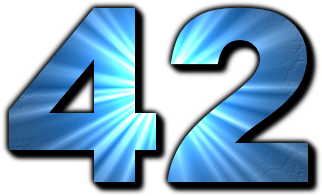
I also trust that people will continue to expand the boundaries of human mathematics. I hope we won’t just let the AIs rip and generate mathematics untethered to human understanding. It will be of no use to have a Library of Babel filled with mathematical results devoid of meaning, context, or purpose. If Deep Thought tells us the answer to Life, the Universe, and Everything is 42, there’s not much we can do with that.
Sure, there will be times when the computers will give us formulas or results that solve specific real-world problems. And that will be great! Sometimes you have a nail and just need a hammer. After all, AlphaFold is amazingly good at predicting protein folding, even though it’s a black box. Just like how we regularly prescribe drugs despite not knowing precisely how they work. But if we want to build on those accomplishments and not end up with a house of cards, we will need to add a foundation of understanding. There will be plenty of mathematics to do, even in the AI era.
And, of course, people will still enjoy puzzling over math just for the fun of it!
If math will be alright, why are mathematicians so worked up [4]? Mathematicians aren’t used to change. We’ve been doing things more-or-less the same way for a few centuries. Until now, mathematics research was done at a human scale and on a human timeline. We had the luxury of knowing that our discipline would be much the same for our entire career. Or so we thought.
Also, until now, time and attention were the real bottlenecks.This fact strongly shaped the culture in mathematics. People generally shared their ideas and steered clear when they knew others were working on something. After all, if you were already working on an idea, that meant you had a head start, and everyone knew the chance of jumping ahead was small. AI will change that culture for the worse.
I expect mathematics will become much more like a lab science. Research accomplishments will be based on the quality and quantity of AI at your disposal, not just your ideas. And those resources will come to those with a track record of big results. This will distort incentives. The generally open nature of mathematics will shrink and be worse because of it [5].
In a few years there will be a new equilibrium and math will be alright. Right now, though, it’s a sloppy mess.
***
[1] One problem right now is that results are announced with, at best, a Lean certificate that verifies the claimed result along with an AI write-up that could be described as a Lovecraftian horror: it might contain an extractable proof that a human can understand, likely contains interesting ideas, and is definitely unreadable, even by experts.
[2] It is important to say that, while many are likely correct, some of the papers have already been retracted due to having errors. Also, [1].
[3] The myriad think pieces that have gone around by Fields medalists and other established mathematicians can sometimes sound like they’re from Dr. Strangelove (“I’m not saying we won’t get our hair mussed“). It’s pretty easy to catastrophize or be sunny when you’re a tenured professor at a big university, knowing that you’ll end up fine.
[4] For some mathematicians, “winning the game” by being the first to solve a big problem is a big motivator. Recent Fields medalist Jacob Tsimerman is one such. For those, AI clearly takes the fun out of it. But that certainly isn’t the only reason.
[5] Sadly, this is already happening. I know of a recent case where a group of researchers found a grad student’s PhD thesis in a university’s thesis repository and then used AI to scoop that student’s ongoing work.
[6] Apple images borrowed from the Heritage Apple Corps.
Enjoying the content on 3QD? Help keep us going by donating now.