
by Steve Szilagyi
I used to sleep with earplugs. Because my wife’s loud breathing kept me awake. I don’t sleep with earplugs anymore. My wife still breathes loudly when she sleeps. But it no longer rouses me from sleep. I’m going deaf.
What are the symptoms?
I can’t hear. That’s the symptom.
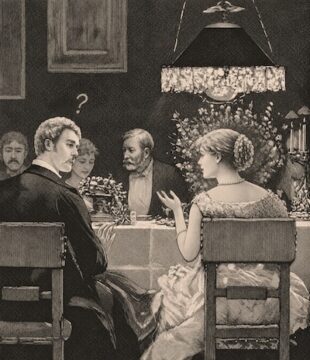
It came on gradually, as these things do. As someone whose wife gives frequent dinner parties, I began to notice with some dismay that I couldn’t understand the conversation at the table. In restaurants like Chipotle, I have to ask the people ladling out the food to repeat what they’re saying so often that they start shouting and I feel like I’m pushing my tray past a review of angry drill sergeants.
Friends and acquaintances suggest I get hearing aids. Well, duh. Of course I have hearing aids. Two pairs. Before I got them, I thought they would provide a seamless restoration of the auditory status quo. That was over-optimistic.
What you hear through hearing aids is not like normal hearing. It is more like being in a movie where the entire soundtrack – including ambient sounds – has been dubbed in post-production. Every trivial noise is foregrounded. It all has the same salience: the rustle of paper; the sizzle of a frying pan; your own breathing and sniffing. Acoustical directionality disappears (at least for me). All sound seems to begin and end in a single place, simultaneously. Picking out the important noise in all this – the sound you actually need to attend to in that moment – is like playing Where’s Waldo?
Hearing aids take you off the stage and put you in the stalls. You experience the sounds of your life not as a participant, but as an audience member. With hearing aids, my head seems to float somewhat apart from the rest of my body. For a time after I put them on, I have to make a conscious effort to align what I’m hearing with what I’m seeing and feeling, and to locate myself in space.
This is not to say that hearing aids are not marvelous and life enhancing. While I was still in the denial stage of my hearing loss, I began to notice that I no longer took the same joy in listening to music. Somewhere, I’d lost that surging thrill that comes with hearing a favorite song. I thought it might be the beginning of the anhedonia that sometimes comes with old age. But maybe not. I still enjoyed my other long-standing pleasures. It had to be the ears. More specifically, the loss of music’s most exciting frequencies – the high ones.
Hearing aids restore the top of the high notes, although in a tinnier register. And that’s okay by me. It’s better than nothing. In any case, I’ve never been a snob about acoustics. The stereo fanatics of the 1960s made me laugh. For me, the returns on listening to records diminished the minute you had to worry about wow, flutter, and coloration – right about the time a needle became a stylus.
If you were alive in the 1950s or 60s, try and recall the first time you heard a favorite song. It was probably on a tiny speaker in bedside radio, a hand-held transistor, or on a car radio turned up full volume to be heard over your faulty muffler. You loved that song more intensely at that moment than ever again, despite the wretched sound quality.
At the intermissions of orchestral concerts, you hear older people pronouncing on the hall’s acoustics, complaining that it’s too dry, too reverberant, too muddy in the bass. Yet if you sit near the back of the hall and look out at the audience from behind, you’ll see that nearly everybody in this bounteously aged demographic has hearing aids tucked behind their ears! Ye hypocrites! We of little hearing have no business pronouncing on delicate nuances of sound. Once, mid-Bruckner, I was startled awake by the rumble of my own stomach thundering in my audio-enhanced skull.
There are more ways to enjoy music than simply hearing it. I once attended the wedding of a young friend who married a congenitally deaf woman, and it was one of the noisiest receptions I’d ever attended. The reason for this was that since the bride was born deaf, but wanted to be able to dance, they aimed the DJ’s speakers at the floor, and played percussive music at a volume guaranteed to make the linoleum vibrate. The bride picked up the beat through the soles of her bare feet. Her face was a beautiful thing to see as she closed her eyes and spun in the spotlight in the middle of the floor.
Studies suggest that regular use of hearing aids may slow cognitive decline. I hope so. I remember the stories, told in hushed tones by older family members, of one of my great-grandfathers, who worked in a noisy factory all his life and gradually went stone deaf. Then he lost his mind. There are stories of him storming down the dark corridors of the house late at night, uncontrollable, bellowing loudly so as to be able to at least feel the vibrations of a voice in his addled skull.
I do sometimes feel my brain beginning to disconnect. Conversation becomes exhausting. You need to focus all your attention on the whole person who is speaking: the eyes, the mouth, the gestures. You try to extract whatever meaning you can from these signals, even as your linguistic brain is trying to fill in the blank spaces between every fourth or fifth word – which is all you can understand. You find yourself interrupting the person more often to repeat what you thought they just said, not only to make sure you heard them correctly, but to slow them down.
The result of this intensely focused attention on your partner is that you have nothing to offer by way of reply. You are reduced to nods and affirmations. And the funny thing is, most people don’t mind. As a matter of fact, they are quite flattered that you find them so fascinating. So they talk even more. Their cheeks glow and their eyes glitter to know that they are making such a hit with you. At the same time, you’re finding it harder and harder to keep up – and go from understanding only every fourth or fifth word, to every tenth or fifteenth. Soon, the brain gives up on the verbal part of the conversation completely, and all your remaining senses are absorbed in the face, the eyes, the hands. The person’s voice is now running babble, more or less musical, often quite pleasing, as they are charmed by all the attention they are getting, and having complimentary thoughts about what a good fellow you are – really much more intelligent than you seem at first.
Expand this out to a whole dinner table over the course of an evening, and you find yourself sitting amidst a small orchestra of voices – piping sopranos, baritones and contraltos – rising and falling in pitch and intensity, exploding into crescendos of laughter. Everyone loves you because you’re smiling and nodding along, looking hard at whomever is taking a solo, not seeking the spotlight: the perfect audience.
Voices begin to canon and fugue. Themes are varied and traded back and forth across the plates and candles. The air resounds to the chorus of merriment and good feelings. And isn’t this the music of life? Can’t I enjoy it the way I enjoy Italian opera, Russian folk songs, and French chanson? Do I have to understand the lyrics?
Enjoying the content on 3QD? Help keep us going by donating now.