
by David Greer
To see a World in a Grain of Sand
And a Heaven in a Wild Flower,
Hold Infinity in the palm of your hand
And Eternity in an hour. —William Blake, from “Auguries of Innocence”
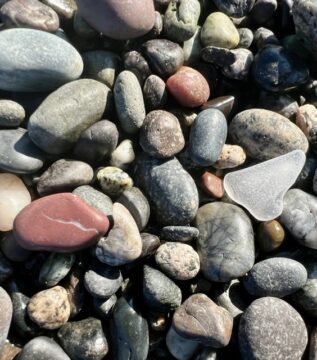 I count among my simple pleasures a walk to a pocket beach not far from my home. Tucked between a couple of small headlands, barely 100 yards long, it overlooks Juan de Fuca Strait, separating Vancouver Island from Washington’s Olympic Peninsula to the south. It’s a quiet spot, empty of the summer crowds that flock to beaches elsewhere in the city, and for that reason a treasured refuge for readers and romantics in search of solitude with a tranquil view of snowy peaks. There’s always the possibility of sighting a pod of the killer whales that frequent these waters.
Casual strollers and swimmers prefer the city’s sandy beaches. The shape of pocket beaches like the one I frequent invites tidal scouring that washes sand away, leaving only pebbles, some of which may one day be ground to sand as well, though likely not in our lifetimes or those of our grandchildren. Geological change moves slowly, except when it doesn’t.
Rapid geological change is rare and, given the propensity of humans to occupy even the remoter parts of the planet, invites casualties. One of the most dramatic such changes in recent times occurred in 1980, when Mount St. Helens, in western Washington state, blew its top one fine spring day, filling the skies with half a billion tons of rock and ash and instantly and dramatically reshaping the surrounding landscape, including by radically relocating the course of a major river. One of the consequences of the event was the establishment of the Mount St. Helens Creation Center, one of a number of “creation science” museums dedicated to the proposition that all creatures great and small, as well as the planet they inhabit, were created in a matter of days a few thousand years ago and not through the course of a few billion years of gradual evolution. What better evidence than a landscape reborn in moments?
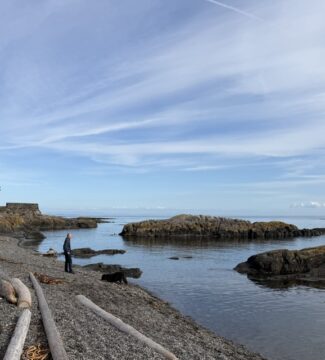 Mount St. Helens is one of several active volcanos in the Cascades range of mountains. Another is northern Washington’s Mount Baker, whose snowy aspect presents a calming vision of tranquility to a viewer looking up from her book on my little beach to scan the eastern horizon. Mountains, like some people, are not always what they seem from a distance. I have a vivid memory of the long moments I spent flying low over Mount Baker’s peak in a pilot friend’s Beechcraft. Wisps of steam curling up from the crater below us suggested an unpredictability masked by the mountain’s gentle face. Not that I expected violent gobs of magma to be hurled skyward into our path, but knowing that Mount Baker is the second most active volcano in the Cascades and one of the more restless volcanoes in the Ring of Fire was momentarily discomfiting.
The Ring of Fire comes by its name honestly. A horseshoe of unstable geology that cradles the perimeter of the Pacific Ocean, both on land and underwater, it hosts roughly nine out of ten of the world’s earthquakes and three-quarters of its volcanoes. The majority of the Pacific’s volcanic eruptions occur deep below the surface. Millions of years in the past, lava oozing from those eruptions spewed the raw material for a variety of the pebbles that today litter my little beach. Jagged though they might have been when they started their lengthy journey, the great rock-tumbler of tidal currents has seen to it that the pebbles I pick up are smooth and more or less rounded.
No two of these pebbles look alike. They’re all shapes and colors. A greyish-black basalt stone the size of my thumbnail likely emerged from seabed lava rich in iron and magnesium. Other pebbles, red and green and brown, are rhyolite jaspers from a lava flow permeated with silica. And then there’s the volcanic stone so localized that it’s named for another beach a couple of miles to the west. Prized by rockhounds for its mix of green epidote, white quartz and pink feldspar, dallasite is found almost exclusively on Vancouver Island and is the unofficial stone of Victoria, British Columbia.
Mingled with these are pebbles with a very different appearance, including sandstones and conglomerates, from other eras and sources. “Some say the world will end in fire, some say in ice,” wrote Robert Frost in simpler times, never dreaming that a century later, some would be saying the world might end in AI-induced plague. But fire and ice can create as well as destroy. In geological terms, fire (lava seething through the Earth’s crust) and ice (glaciers) have heralded new beginnings in the formation of landscapes, including as a starting point for pebbles.
Beach pebbles originating in glacial till are geological infants. The undersea volcanic eruptions that produced igneous beach pebbles such as basalt and jasper may have occurred millions or even a billion years ago. The last great glaciation retreated from this corner of North America a little more than 10,000 years ago, leaving in its wake rocky debris that formed oceanside cliffs that in turn eroded, depositing stone fragments along the shoreline. Many of today’s beach pebbles arrived in debris carried from distant mountain ranges, including granite chunks dragged seaward by melting glaciers or tumbling down rivers into the tides.
It’s not entirely a one-way street, however. There are times when the seabed rises to the mountain, as occurred when the collision of tectonic plates forced ocean floor sediments upwards to create the Canadian Rockies, many tens of millions of years ago. The reality of this fact was graphically impressed upon me once on climbing Alberta’s mile-high Mount Rundle and being startled by the sight of fossilized marine creatures embedded in the shale face by the trail.
The diversity of pebble colors and types–jaspers, granites, basalts, sandstones, quartzes, conglomerates–on the pocket beach seems surely sufficient to satisfy the most discerning rockhound. Being more of a contemplative than a collector, I find myself inclined simply to marvel at the history beneath my feet, millions of years in the making and gathered from widespread origins, each stone’s rough edges worn smooth by aeons of tidal currents. It’s all a little mind-boggling, but that doesn’t deter from the simple pleasure of appreciating nature’s canvas, constantly refreshed and reordered by the twice daily tides.
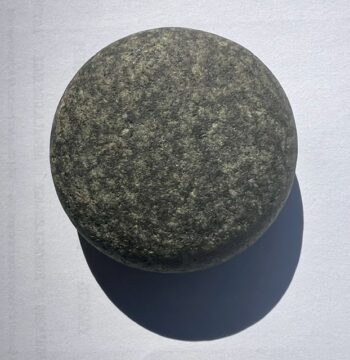 Of course, the tide wields its brush differently on every beach, influenced as it is by the shapes of landforms and the seabed itself. One of my favorite treasures is a perfectly round stone the diameter of an orange that I picked up from a beach on the outer coast of Vancouver Island. On that beach, every single stone was round, thanks perhaps to some local tidal aberration.
Pebbles in turn provide a canvas upon which less ancient forms appear, in addition to driftwood, bull kelp, and rock crab skeletons. Whole books have been written about the origins of different shapes and colors of sea glass, such as Richard LaMotte’s Pure Sea Glass, likely attracting an altogether different cohort of collectors than the rockhounds. Of course, glass and beach pebbles are kissing cousins, glass typically being three-quarters sand and many volcanic pebbles largely silica.
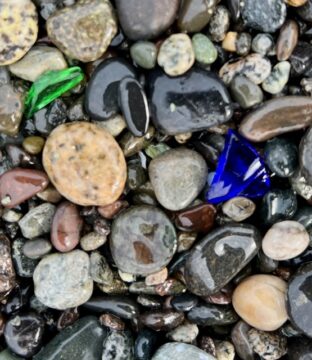 Like pebbles, glass shards are softened and rounded by tidal currents along shorelines. The rarest sea glass colors include red and yellow, though orange is reputedly rarest of all, mainly because it was never used in the manufacture of bottles. In the days before recycling came into vogue, bottles were routinely tossed into the waves and remain the most common source of sea glass. By the twentieth century, most bottles were made from brown, green or clear glass. Blue glass often originated in bottles of medicine or milk of magnesia. My wife, a palliative care nurse, used to go for a walk on a beach after a death, searching for a piece of blue glass by which to remember her patient.
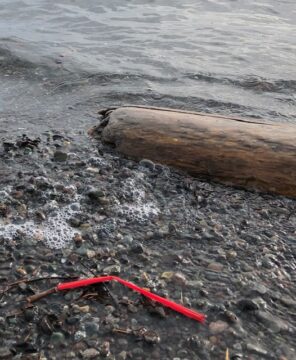 Finally, of course, there’s the ubiquitous plastic, most of it invisible. Pebble beaches act as traps for microfibers, especially microscopic textile fibers and fragments of polyethylene or polypropylene sloughed off from fishing nets or flushed into the sea in wastewater from washing machines used for synthetic clothing. Random surveys of the microplastic content of beaches have found microplastic pollution ranging up to several hundred particles per kilogram of beach. The astronomer Carl Sagan theorized that there are more stars in the universe than grains of sand on all the beaches on Earth. Perhaps it’s just a matter of time before microfibers on our planet outnumber the stars in the universe.
Every landscape has its particular beauty. I’ve been privileged to have lived on the prairie and in the mountains and in the depths of the rainforest, and I love them all, but destiny has landed me by the ocean for the foreseeable future. Peace of mind being an essential foundation for tilting at windmills such as the plastics industry, I’ll continue to pursue the simple pleasure of my walk upon my beloved pocket beach.
All photos by author.