
by Thomas Fernandes
 In this video, too grainy for even a screenshot, you can see 3 men walking up to a pride of about 15 lions while they are feeding on their kill. Upon seeing them the lions all flee, allowing the men to steal their meal.
Why would lions, “king of the jungle”, walk away from outnumbered and weak humans?
The folk view of the human animal has no good answer. In it, humans are weak animals, our bodies’ biggest prowess being to hoist very large brains that allow us to come up with complex tools, weapons and strategies without which we would be helpless.
I have written about many animals before and often, for comparison, looked at human equivalents. Over time I came to the opposite view. Humans have been extremely lethal at least since Homo erectus and our brains play a different role than being smart on the ground.
If you come from a “weak” view of humans your first instinct might be to treat the video as a fake, a one-off or an anomaly. This is easy to address thanks to a survey of lion experts covering ranges that hold more than 95% of Africa’s lions, where humans stole their kills in 66% of the areas surveyed (even when illegal). Even if humans do not purposefully look for kills to steal, when they find one there is a 50% chance they will chase the carnivore away from the carcass.
A 2023 experiment titled Fear of the human “super predator” pervades the South African savanna went further.
They placed speakers 10 meters from a waterhole in an African protected area and played either lion noises (snarling or growling), humans (women and men speaking calmly in a local language) or hunting sounds (gunshots and dogs barking) as well as non-predator control sounds. All at the same volume.
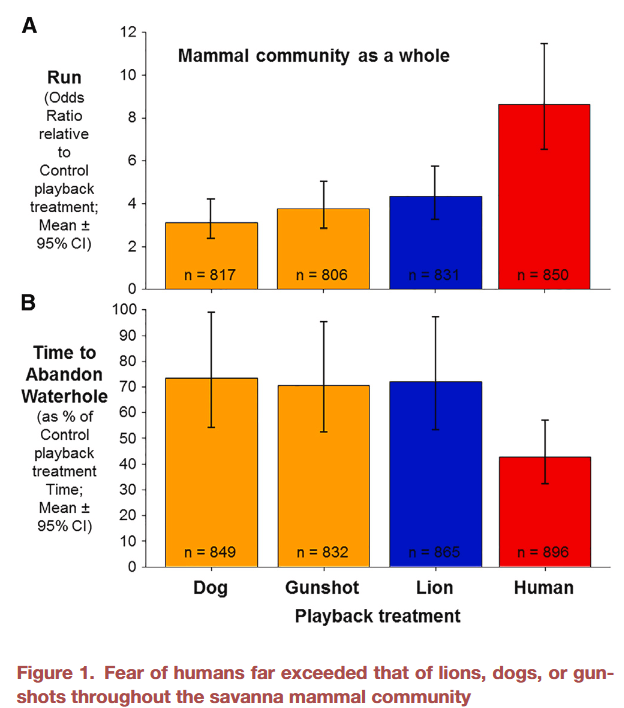
Animals were vastly more afraid of humans than of lions or even gunshots. The gunshot part is key, because the weak-body view would explain all of this as a modern fear of modern weapons. Yet even in a reserve where poaching exists, animals fear our voices more than our guns, the way we are easily afraid of snakes even though cars are far more lethal to us now.
So far, all those observations are in Africa, where humans resided for the longest part of their evolution. When humans moved outside of Africa they met new animals that did not evolve to protect themselves from humans. This happened tens of thousands of years ago (long before electricity, gunpowder or pants were invented) and most large animals they encountered went extinct.
Causality is hard to prove but the pattern is suggestive. We can observe lions flee today because fleeing allowed them to survive. By contrast mammoths looked at us like the Titanic looked at icebergs and went extinct.
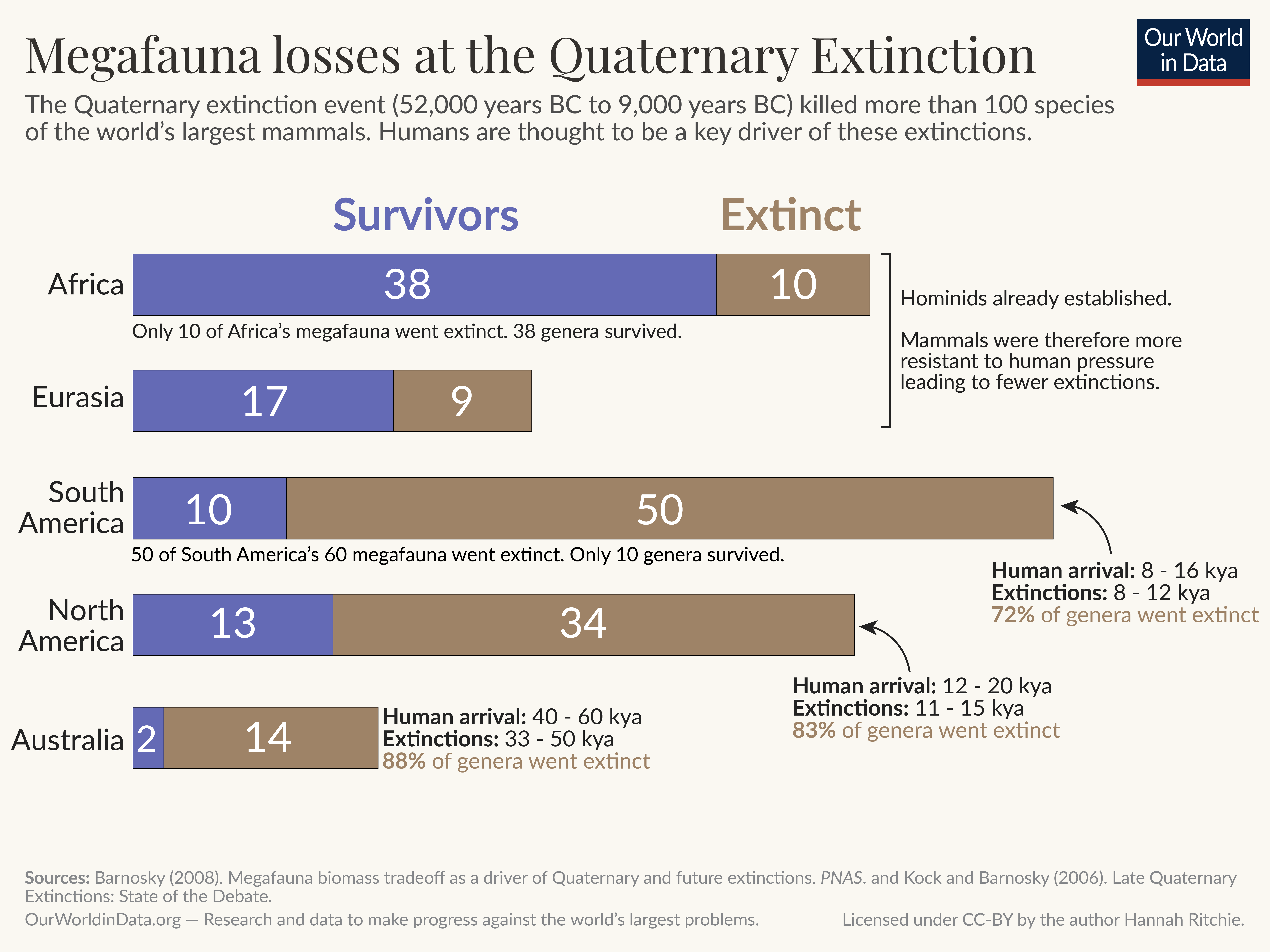
The continents that lost the fewest large animals, Africa and Eurasia, are the two that Homo erectus had already reached, in which the fauna had time to adapt, suggesting our ability to kill predates Homo sapiens.
All of this shows that animals fear us and that we are lethal. It doesn’t yet show why.
The weak-body view has three arguments here. One is that even then we had weapons, and without them we are powerless. Another is that we just come in great numbers, and this is what makes us strong, not our individual capacity. The last is big brains, the idea that we outsmart what we can’t outrun.
All three contain some truth. Weapons help, but they are not always necessary and when using a rock or a sharpened stick, your body does most of the work. Groups and brains matter but not where you would think.
The first hominid tools, rudimentary of course, are found more than 3 million years ago. Homo sapiens is only 300,000 years old. The tools even predate the Homo genus by 500,000 years. In many ways we can say our species inherited its tools, rather than invented them through sheer brain power, especially since back then Australopithecus had brains the same size as chimps.
It would be more accurate to say that most of our strength and biology has been adapted to better exploit the regularity of tools in our environment, and that, when considering prehistoric weapons, there is nothing easy about using them. A sharpened stick is only as dangerous as the body behind it, so let’s look at the body: is it that weak?
Predators are usually faster than their prey, so they can catch up to them in short races. As I mentioned when writing about hunter-prey interactions, lions often begin their hunt within 50 meters and rarely pursue for more than a few hundred meters. But we are slow. Usain Bolt peaks at about 44 km/h, laughably slow compared to a running horse (70 km/h) or lion (74 km/h).
We are however among the best animals at long distance running, think marathon distance. This is already true in cool weather but we are unrivaled in high heat conditions thanks to our ability to sweat. Is this a consolation prize?
A study of thousands of written records of endurance hunting concludes that on the contrary:
Moose, eland, deer, antelope, kangaroos, and guanacos are alert, agile, and fast-sprinting animals. Nonetheless, the evidence warrants a positive assessment of the evolutionary significance of Endurance Pursuit Hunting.
Endurance hunting had an 80% success rate when the information was available, which is only 32 cases. This is probably exaggerated but all reported commentary mentions “frequent success” or “usually ends in a kill”. Whatever the exact success rate, it is very high compared to most animal hunting strategies.
When the party size is known (212 cases), 56% were lone hunters and 44% involved several people running together or cooperating, for example a companion guiding from a hilltop. That is still a majority of lone humans taking down prey, often larger than 250kg.
But even the occasional collaborative hunt or strategy is not especially surprising or a sign of unusual brain power. Lions hunt in groups and spiders with brains the size of grains of rice show elaborate strategies of deception.
Thanks to weapons? No. Some used spears, others merely daggers and some even their bare hands. In this hunting style, the exhaustion is what drives the animals to death, the weapons are only used for execution.
With chases that can last more than 3 hours, sometimes even 8, and cover more than 30km, this almost looks like brute forcing. But like any animal hunt, there is more going on. There is tracking skill, guiding the prey into unfavourable terrain and, even more importantly, guiding it close to home, since after the kill you need to carry back the meat. In one collected anecdote of an endurance hunt:
“He had been running for half a day behind an elk, and several times he had nearly caught it. But, he said, he did not wish to kill it, in order to save the trouble of dragging it home. Hence he sat down several times at some distance from the exhausted brute, gave it time to collect its strength, and regained his own wind also. After a few minutes he would begin his extraordinary chase again, and arranged it so, that the brute was driven nearer and nearer to his hut. At nightfall he had it near enough to his camp, so he went up, drew his knife, and killed it”
For all this ability to run for a long time you would think our muscles were highly optimized for it. Yet analysis suggests that the musculoskeletal system of humans is not tuned to maximize economy of locomotion. One explanation is flexibility, since a wide range of speeds lets you put pressure on different prey without overexerting yourself. The other is a trade-off with other muscle needs, like climbing and throwing.
Speaking of throwing, what do you think of your shoulders? Notice anything special compared to other primates? I sure didn’t, but our ability to throw is a marvel.
Since Homo erectus (2 million years ago) we have had three adaptations that make us the best throwers of any animal by far:
- Decoupled hip vs shoulder. You can rotate your torso while your hips face straight, chimps cannot.
- Better shoulder mobility.
- A change of shoulder joint orientation from upward, for hanging on to trees, to sideways, which allows a better momentum arc when throwing and lets us use both elbow and shoulder joints simultaneously during a throw.
Thanks to those adaptations, despite all their strength, chimps cannot even compete with a 12-year-old in throwing speed. We load with our legs and entire body and then throw by releasing the stored energy, mostly in the tendons, rather than by using a muscular contraction.
A javelin throw would be more analogous to its hunting use but a baseball throw shows the movement and power nicely as well. You can observe a 160km/h throw here. I recommend slow motion to really see the movement.
Baseball analysts describe it in the same terms as the physiology papers: “whiplike extension”, “exceptional shoulder mobility” and “one of the most efficient torque-generating motions ever seen”.
Now translating this to prehistoric hunting, a 2019 study had 6 javelin athletes, trained in throwing but never at aiming for a target, throw replicas of the Schöningen spears (wooden spears). They observed a 25% hit rate at targets as far as 20 m, with the more experienced participant performing better. When the spear lands it impacts with a mean energy of 107.6 J, which exceeds most complex projectiles like arrows or darts due to the mass of the spear. And kinetic energy on impact is the best predictor of wounding capability.
Despite being downplayed for a long time, hand-thrown weapons are not inferior in terms of efficiency. The drawback is that they require high investment in training. Empirically this is also shown in the fact that hand-thrown spears were not universally replaced by more complex projectiles and continue to be used, enabling ethnographic studies in which their efficacy is also supported.
Between our throwing anatomy, 2 million years ago, and the oldest wooden spear, about 400,000 years ago, we expect that stone throwing was already quite effective.
Findings in a South African cave support this. The cave yielded ball-shaped stones, 81% of which, the size of a baseball but five times heavier, sit in the weight range that maximizes damage while staying throwable. This is what a pile of throwing stones would look like.
The stone reached 15 to 20 m/s producing about 100 J on impact, as much as the spear replicas above but on a much larger area. The resulting effect is comparable to an average horse kick (vets simulate kicks with a 2 kg impactor at 6 to 14 m/s meaning 36 to 196 J) but on a lower surface area, so probably more damaging. Rarely lethal in one hit, it would be devastating with repeated throws and combined with pursuit, where the killing blow can also come at short range, after. If needed, rewatch the baseball throw, this time at full speed and imagine it was a rock instead.
Overall, if we recap abilities like in a versus fighting games, I think humans are a pretty overpowered character:
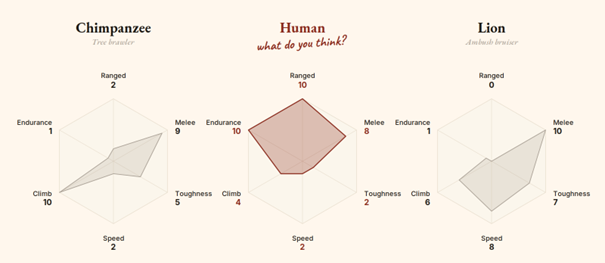
Of course such graphs have little objective reality which is why after spending a lot of time to have real logic and data behind the numbers I ended up winging it. But it tracks evolutionary logic. Chimps for example can act in groups and are very dangerous despite appearing to score poorly here. For chimps that gather more than 90% of their food there is little need for speed or hunting. As for evasion they can climb very well where most predators can’t and this is enough.
We are slow because, like chimps, we did not need to run away. Chimps escape by climbing. We escaped by being too dangerous and by grouping. As evidenced by the non-rigorous graph above, humans have a glass cannon build. Super high offensive capacity and very weak defensive capacity. We don’t need complex weapons like bows or guns (although they further increase our lethality), a rock or a sharpened stick is plenty and we do not seem to display unusually smart hunting strategies.
Which brings us back to the numbers objection, partially addressed with endurance hunting already. Numbers are not so much needed to hunt down others. I think some confusion comes from human-human violence, in which numbers as well as weapons are paramount.
What numbers do is help secure us not only against physical threats but also against variability and bad luck. Sharing also allows specialization. I did mention the inconvenience of wooden spears was the amount of training required. This is where the group helps, by enabling people to develop high skills and to spend entire days hunting, since you are then able to rest, basking in the glory of your hunt, for the next days.
Going one step further into how we sustain and organize ourselves in groups, we find the reason for our big brains. Not to outsmart animals during a hunt or invent improbable weapons through intense thinking, but to gossip. By recent accounts even the pride of human thinking, reasoning, first evolved as a social skill for reputation management and influencing others. Our big brains are best at coalition tracking, holding people accountable and holding grudges. This allowed for increased cooperation in task allocation, sharing and group size.
Out of the many benefits, some trickle down to how well we could hunt: the aforementioned high skill development and increasingly better weapons through social transmission and gradual improvement. Perhaps later on more elaborate knowledge and strategies, again through knowledge transmitted across generations of observation.
Those cumulative improvements happened against the background of an already lethal human. Different evolutionary theories treat this glass cannon build as a determining, or a lesser, factor in the development of cooperation. What they all agree on is that we were killers first, and that the rest followed through complex feedback loops.
Give humans with brains half our current size a rock, they are apex predators. Give them a spear, they drive their prey to extinction. Give them 300,000 years of large-brained social collaboration and they drive species they never met to extinction.
***
For more post like this you can follow me on my substack: Librotium
Enjoying the content on 3QD? Help keep us going by donating now.