
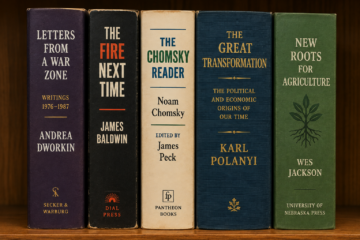
 Many of the books that shaped my work as a professor, author, and activist came into my life during my first two years of graduate school (1988-90), the most exciting period of concentrated learning I’ve ever experienced. As I write in my new book, This I Don’t Believe: A Fulfilling Life without Meaning, I got to grad school and quickly realized that I was “an undereducated person getting a second chance to learn”:
I didn’t really start thinking—in the sense of a disciplined process of trying to understand how the physical and social worlds work—until I showed up for a Ph.D. program in mass communication at the University of Minnesota in 1988 when I was thirty years old. I had graduated from a perfectly respectable public high school and public college, and I had earned a professional MA at a perfectly respectable private university. I had spent a decade working at perfectly respectable newspapers, exposed to a wide range of public officials and ordinary people. In all those endeavors, I learned a lot about the world. But I had yet to think systematically about how the world works.
Here are some of the things I’ve learned and the books that were important to me at the beginning of that education.
What I learned about being male
Letters from a War Zone: Writings 1976-1987 by Andrea Dworkin (1988)
In graduate school I studied freedom of expression, and at the time one of the key debates was over the radical feminist critique of pornography. Like many men, I assumed that the critique had to be crazy, because radical feminists were crazy, because … why? Because I had been socialized to be afraid of feminists. Reading Andrea Dworkin and other radical feminists made me realize that their movement was not a threat to men but a gift, offering us a way to resist the traps set for men by institutionalized male dominance (that is, patriarchy). “I Want a Twenty-Four-Hour Truce During Which There Is No Rape” in this volume may be the most influential essay I have ever read.
(For details, see my 2017 book, The End of Patriarchy: Radical Feminism for Men, and my 2007 book, Getting Off: Pornography and the End of Masculinity.)
What I learned about being white
The Fire Next Time by James Baldwin (1963)
I was born in 1958 in North Dakota. It’s hard to get any whiter, not just in ancestry but socialization. I gave no thought to power dynamics until I went to college, but even then it was easy to ignore racial realities. That started to change when I dropped out of college for a year in the late 1970s and took a low-level clerk job in a government office in Washington, DC. For the first time, I was in a multi-racial setting and worked with black people, which forced me to re-evaluate the stereotypes I had unconsciously internalized. But it was James Baldwin who finally knocked (rhetorically) some sense into me a decade later. Baldwin’s writings from the early 1960s not only opened my eyes to black experience but also to how racism distorts white people’s perceptions of ourselves.
(For details, see my 2005 book, The Heart of Whiteness: Confronting Race, Racism and White Privilege.)
What I learned about living in an imperial state
The Chomsky Reader by Noam Chomsky, edited by James Peck (1987)
When I got to my graduate program, everyone was discussing the propaganda model developed by Edward Herman and Noam Chomsky, which changed the way I understood mass media and my own short career in newspaper journalism. I picked up The Chomsky Reader and realized that I had much more to learn from him. I took his essay “The Responsibilities of Intellectuals” to heart, and his critique of U.S. foreign policy and militarism shaped my decisions about how to engage politically for two decades.
(For details, see my 2004 book, Citizens of the Empire: The Struggle to Claim Our Humanity.)
What I learned about living in a capitalist society
The Great Transformation by Karl Polanyi (1944)
I had only a vague understanding of the Marxist critique of capitalism and knew I had to get up to speed. Unfortunately, a lot of Marxist literature was, and still is, didactic and/or boring. But I found a groove with Karl Polanyi, a critic of capitalism but not a dogmatic Marxist. I started to grasp the implications of the commodification of land and labor, and after reading his work I would never again use the term free market without scare quotes around “free.”
(For details, see my 2013 book, Arguing for Our Lives: A User’s Guide to Constructive Dialog.)
What I learned about ecological crises
New Roots for Agriculture by Wes Jackson (1980)
I always thought of myself as an environmentalist, but Wes Jackson’s book on “the problem of agriculture” deepened my ecological understanding. Going back 10,000 years to the destruction unleashed by annual grain agriculture, Jackson showed how our ecological crises started long before the Industrial Revolution and fossil fuels. His analysis of how well-meaning people have abetted that destruction expanded my analysis of culprits—no longer could I blame it all on greedy CEOs and corrupt politicians. Jackson brought intellectual depth to the famous line from Pogo, “We have met the enemy and he is us.”
(For details, see my 2022 book written with Jackson, An Inconvenient Apocalypse: Environmental Collapse, Climate Crisis, and the Fate of Humanity.)
For almost four decades, my work has focused on these five topics. How does human nature play out in today’s social structures to produce domination/subordination dynamics in sex/gender, race, global affairs, economics, and the human exploitation of the larger living world? These books didn’t offer neat, tidy, paint-by-number answers but laid out analytic frameworks that guided my choices about how to teach, what to write, and where to direct my activist energy.
One last important aspect of this reading: All these books were recommended to me by my late friend Jim Koplin, whom I met in the first month of my graduate program. He had been a psychology professor until he retired early and dedicated his life to political resistance, community organizing, and urban gardening. From 1988 to his death in 2012 at age 79, Jim was my best friend and intellectual partner. He was 25 years older, and I benefited from his wisdom and experience. Jim shows up by name in several sections of This I Don’t Believe, but his influence is in every sentence.
As I’ve said many times, I don’t know who I would be if I hadn’t met Jim Koplin, but I am pretty sure I wouldn’t be the person I am today.