
by Sean Murphy
i.
While there is much to admire and recommend in the excellent documentary Jiro Dreams of Sushi, especially for young creatives or academics who want to better understand–and appreciate–mastery and what it involves and requires, there’s one sequence that has stayed with me. The apprentice chefs are on rice duty before they even touch fish, and this doesn’t involve a single shift, or a week, or even a year. It’s three years of making rice to earn one’s place at the sushi station, where one might spend another five years training. And better still, all this obsessive training and refinement of craft isn’t to make a particular piece of fish taste better or different; it’s to obtain the necessary skills to be sufficiently prepared, to be worthy of the appropriate pieces of fish. In Jiro’s kitchen, the presentation is simple, unpretentious, authentic to the point of resembling something more spiritual than culinary. Therein, generations of the highest achievement teach us, lies the secret. Which is: there are no secrets; there is repetition, respect, compulsion, perfection.
Thinking of this rough algorithm is, it seems, at once more eloquent and immediate than the by-now tired cliche of 10,000 hours. But let’s consider 10,000 hours as a reasonable baseline for approaching expertise in a particular task—that emphasis on repetition and consistency the key to fathoming how one upshifts from good to great. It’s also a useful corrective for our contemporary discourse, where shorts cuts and “hacks” have replaced what we might simply call old-fashioned discipline. We see the ideal baseball swing or the method actor’s award-winning scene, or even the deceptive simplicity of a smart phone’s interface and forget it’s invariably what happens—and for how long—behind the scenes that makes the most complex movements seem unforced, inevitable.
How many free throws did Michael Jordan shoot, alone in a gym or in a dusty driveway in all kinds of weather? How many lines of dialogue did Hemingway write before he arrived at his minimalist style, still imitated more than a century after it made him famous (and infamous)? How many times did his brush touch a canvas before Van Gogh began to master the ways color can invoke mood and feeling? How many times did Max Roach hit a high hat before he became one of the most brilliant and accomplished drummers in history?
ii.
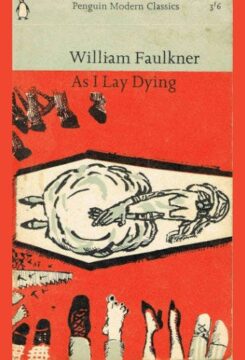
I wanted to be as offline and analog as possible (without doing anything insane like chopping wood or building something or generally making myself useful in any way), so I went as deep as a guy with my peculiar sensibilities can go: I climbed aboard the Dixie Limited and got my Faulkner on, only good. I packed As I Lay Dying, revisiting ground I recall as arid, impenetrable, and suffused with all manner of insects and humidity. To my surprise and delight, it was some of the most satisfactory reading I’ve done in ages.
They don’t make them like Faulkner anymore. Thing is, they didn’t make them like him then, either. A stranger he must have seemed, even to himself, writing words like these, building worlds and recreating the south as it really was, especially the way it wasn’t and both tried and tried not to be, in order to be more or less true to itself.
With neither Cliff Notes nor Old Grand-Dad, I went deep with Uncle William, and am certain I better understand, in no particular order, his writing, his life, his times, myself, my times, America. For starters.
iii.
I have advice I would like to have received, several decades ago. Read Faulkner all the way through, diving into the wave as opposed to inching into the ocean one timid step at a time. Then, when finished, devour every piece of criticism, every review, essay, and analysis, see what other writers have said, see what has become consensus and why, and make as many notes and reference guides as you feel necessary or helpful. Then immediately start one page one and reread the book. Everything will click into place, and the rarest type of literary experience will ensue. And if any author demands slow, deliberate reading, it’s Faulkner.
And, proving that books are magic, you’ll see why the best novels are at once timeless and able to accrue meaning and import in the context of the times in which they’re read. For instance, someone wishing to be away from the unreality of all-things AI could hardly conjure a more appropriate and perfect antidote than As I Lay Dying, with its 17 narrators and narrative logic that strains against every short cut and false note of modernity, efficiency, and accessibility.
It’s challenging to read because it was challenging to write, and Faulkner’s novels are difficult because his life was difficult. Or, he made the impractical, heroic decision to make his life as uncomfortable as possible in order to access the feelings and insights required to pull off such improbable work.
iv.
Which brings us to AI. This increasingly ubiquitous technology is a genuine disruptor and, depending on what you read, presents an existential threat not only to art, but civilization. To be certain, AI is going to make it much easier to imitate and mass produce, with minimal effort, a certain type of content. The silver lining? AI won’t, and can’t, create what makes the best human achievement unique, ineffable, inexplicable.
Computers and their ever-advanced algorithms can reproduce and even mimic, but they lack (at least) two things separating creativity from counterfeit: originality and soul. It seems worth suggesting that, among many other things, art is antithetical to short cuts. This, generally speaking, is true of any achievement: there are no “hacks” to become a proficient musician, painter, or athlete; even granting that appraisals of art are subjective there’s an assumed authority (on the part of both creator and critic) that imparts, if not authority, credibility.
This is why AI will never supplant authentic art, and the artistry of original storytelling. To play the music or write the books in the first place, a sufficient amount of proficiency is required. The routine, whether it’s hours alone in a gym or a pool, at a desk or woodshedding in a soundproof room, is how innovation happens. Sensitive and discerning human beings want to be astonished, and surprised. We want possibility, we want to feel the kind of connections that electronic spectacle, however expensive, cannot quite capture.
As ever, more authentic voices will be the antidote to impersonal technologies and the people using them to disempower those without access. All of which is to say, the need for personal narrative is as imperative and empowering as ever, and the ability to share these stories has never been more accessible, more possible. It’s our obligation—as critics, as fans, as human beings with skin in the aesthetic game—to call out counterfeit and cynicism when we see it, but we should balance our vigilance by focusing on, and promoting, authentic voices otherwise lost in the shuffle of cynicism and artifice. The best way to resist bad stories is telling better ones, and we need more people telling their stories and creating their art, by any means necessary. As it relates to creativity and genuine connection, the truth can absolutely set us free.
v.
So, what does Faulkner have to do with AI? Well, everything. Increasingly, we’re reading about the myriad ways this technology will imperil art, if not civilization. Faulkner, of all people, proves that computers and their ever-advanced algorithms can reproduce and even mimic, but they lack (at least) two things separating creativity from counterfeit: originality and soul.
The miracle of art is the way it enables us to express things at once inextricable from ourselves and more encompassing than the sum of an individual existence. More, it facilitates an exchange, across language, time, and space. In short, it provides the opportunity for connection.
Most importantly, artistry is antithetical to short cuts. This is true of any achievement that informs or inspires: there are no hacks to becoming a proficient musician, painter, or athlete.
When we see Michael Jordan drain a fadeaway jump shot, we can surmise the countless hours of practice, the routine of doing the same thing, the same way, so many times that, when the game was on the line, he could treat unimaginable pressure as just another moment. We also don’t see his family history, being cut from his JV high school team—an indignity that provided ceaseless fuel for his competitive spirit, the ongoing pressure of being the most popular brand on the planet.
It’s also why, when we read Faulkner, we’re not just absorbing once-in-a-lifetime insights from a very particular writer, we’re also getting a front line report from a certain Old South that only existed during Faulkner’s life. But we are also, always, getting those observations filtered through our collective understanding of conditions before, during, and after the author’s death. In other words, we are treated to insights we wouldn’t have without Faulkner, reading—or re-reading them—with the benefit of almost a full century of things he didn’t see or couldn’t know (and likely wouldn’t have imagined). LLMs, as the ominous moniker reminds us, is a set of language systems, is a certain type of language. Our best writers, throughout history, in whatever language, were creating their own system of discourse. This is what we get from art, and what we only get from the infallible, necessarily limited hearts and minds of artists.
This is why AI won’t work as art and will never replace fiction. When we simultaneously acknowledge and appreciate the many writers Faulkner influenced and inspired, we want the “real thing” only certain books by Faulkner can deliver. Today, technology and AI can, miraculously, imitate all these words, styles, and short cuts into something like the fake humans from The Thing—but it lacks authenticity. It lacks the human emotions that are the ingredients of inspiration, innovation, originality.
Mostly, AI doesn’t understand how story is made; why story works. It seems fair to suggest, like all the best artists, Faulkner tapped into a peculiar and quirky magic that made his work resonate so powerfully, across generations. But we shouldn’t mistake the stories he wrote, or the stories any writer, actor, or athlete tells, for something that an algorithm or the most sophisticated software can ever hope to imitate. This is why AI won’t satisfy, and we’ll crave authenticity. We always have.
Enjoying the content on 3QD? Help keep us going by donating now.