
by Malcolm Murray
 Just came back from a trip to China, my first in a decade and my first focused specifically on AI risk. Covering Beijing as well as Shanghai, conferences as well as university events, this was a highly illuminating trip from several perspectives. China has continued to develop extremely quickly since my last visit and has grown even more fascinatingly different from Western countries.
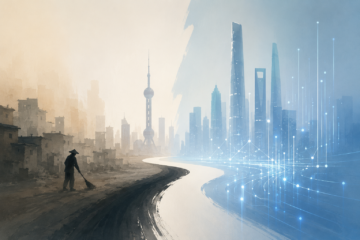
The most interesting takeaway, however, was how jagged China’s modernization is. In some ways, China is ahead of the West, while in others, it lags significantly behind. This can be seen in ways big and small, in different contexts. The trains are faster than in the West, but the toilets are squat-only. Everything is done on a few key apps on your phone, but wi-fi is spotty. The malls and airports are gleaming, while most restaurants are hole-in-the-wall. The conferences are full of robots, but the conference apps themselves are glitchy and frequently break down. The hotels have electronic toilets, but water still leaks in when it rains. The streets are full of electric vehicles from a plethora of local brands, but most people get around on dinky bicycles. The hotel’s cleaning robots take the elevator independently, but the coffee machine doesn’t work. Stores manned by robots are shiny and efficient, while the roads are still swept by men with brooms with a design last updated in the 18th century. The list goes on; the examples are endless.
Now, some of these are of course the result of deliberate choices. Provinces have been incentivized to set up electric car manufacturers which has pushed the cost down and created a huge supply of cheap electric cars. All countries of course prioritize spending on its airports as a key country branding exercise.
Other paradoxes, however, seem like they might be the result of ongoing friction and barriers. It is much easier to insert a cleaning robot and optimize for a small area where it can operate without hiccups, than to ensure every appliance in a hotel works well. Apps used by almost a billion people can afford to streamline the experience inside the app, but that does not mean that there are incentives for every venue to offer decent wi-fi.
It seems therefore that Beijing and Shanghai might offer a compelling vision of what extreme modernization coupled with day-to-day real world friction could look like. This could be similar to the world that we will inhabit in the rest of the world in a few years, as continued rapid AI evolution leads to unprecedented progress in some areas, while other areas remain stubbornly stuck in the 20th century, full of friction preventing progress.
We have gone from AI models in 2023 not creating coherent sentences or outputting blurry images of people with 11 fingers, to now in 2026 having models with super-human coding skills and photo-realistic video creation. Extrapolating these trends of increasing AI capabilities to 2030 and beyond suggests that we will have superhuman scientists discovering new cures to diseases, an automated content creation ecosystem with AI-produced full-length movies and robots that can operate in a regular house without constraints.
However, alongside this, we will also have areas that stubbornly resist modernization. Infrastructure such as roads and the electric grid will take a long time to be affected by AI, cars only get replaced on a multi-year cycle, and inefficient resource allocation will mean many scientific advances will only be available to a few. Most white-collar workers will still go into physical office buildings, even if they take self-driving cars to get there. We will have countries of geniuses in data centers, but outside the data centers, people will still be sweeping the roads.
The Chinese characters making up the words “Artificial Intelligence” consist of some of the most ancient characters, for a person and for a carpenter’s ruler, but also of newer characters for wisdom and abilities. Similarly, the old and new seem to actually be co-existing fairly peacefully. This is despite China’s historically unprecedented speed of development and the resulting high levels of inequality.
In 2030, the world will likely see a similar co-existence of AI-revolutionized industries and societal aspects with those that are AI-resistant. The hope is that we will have a peaceful co-existence of these, a gentle singularity as Sam Altman called it, where most aspects of human existence are still recognizable even as we have superhuman AI. China shows us a positive potential example of this.
Enjoying the content on 3QD? Help keep us going by donating now.