
by Rafaël Newman
 On June 27, 2026, the hottest day recorded to date in Berlin, I emerged from the meagre shade of St. Hedwig’s Cathedral to make a run for it across Bebelplatz, on Unter den Linden in the city’s Baroque center. I had resolved to brave the punishing late-afternoon sun for a souvenir photograph of the skylight set into the middle of the square, which offers a view down into “The Empty Library” (1995), Micha Ullman’s subterranean memorial to the Nazi book burnings on that site on May 10, 1933.
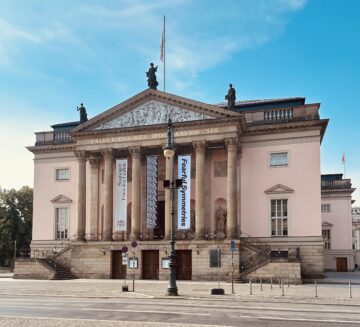
I was in Berlin that weekend to attend a new production of Mozart’s Abduction from the Seraglio at the Staatsoper, also on Bebelplatz (about which more at a later date); to meet with a colleague from a partner institution with whom I will be co-leading an Academic Travel course this coming fall; and to visit Ulf, an old friend who has made Berlin his home for decades.
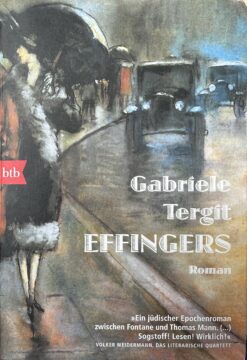
Since I met Ulf in 1990, when we were students at the Freie Universität Berlin, it has been our custom to exchange books on our birthdays, both of which fall in May; and accordingly, if belatedly this year, I had come from Zurich on that blazing weekend bearing a couple of volumes I was certain would interest him, given his professional and personal immersion in Jewish history. One was Melting Point: Family, Memory, and the Search for a Promised Land, Rachel Cockerell’s innovative 2024 account of her great-grandfather’s role in a plan to resettle Russian Jews in Galveston, Texas, in the years before the Great War. The other, older, weightier book was Effingers, by Gabriele Tergit (1894–1982).
Born in Berlin as Elise Hirschmann in 1894, Tergit took as her nom-de-plume an anagram of the word Gitter, German for “grill” or “bars” and, metonymically, for “prison.” Tergit, meanwhile, is a German word in its own right, an entomological term meaning the armor plating on an arthropod. The pseudonym’s suggestive combination of threatened captivity with defensive toughness thus reflects the Jewish-born Hirschmann’s experience: She earned considerable renown as a court reporter during the interwar period, among other things writing up criminal trials in which Nazis might still, in the Weimar Republic, be held accountable, and was for her troubles menacingly identified by Goebbels as “that dirty Jewess”—to which she responded that she was utterly indifferent to his opinion. When Hitler came to power in 1933, however, Tergit realized that her armor would not be powerful enough to protect her from their prisons, and she left Germany, to settle eventually, by way of Czechoslovakia and Palestine, in England.
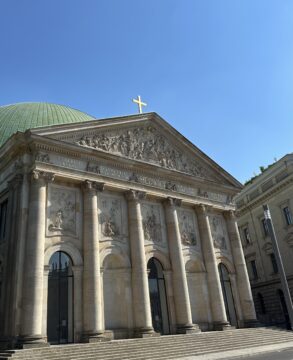
Yet although Tergit, a “dyed-in-the-wool Berliner,” was unable to avoid exile from her native land, her masterpiece, Effingers, a chronicle of life in Berlin from the Wilhelmine period until the beginning of the Holocaust, was at least spared the flames on Bebelplatz on May 10, 1933—because the manuscript, on which she worked for years, was not finally published until 1951.
Perhaps inevitably, Effingers, now at last available in English translation, has been marketed as a “Jewish Buddenbrooks”—and the analogy makes a certain formalistic sense. Mann’s and Tergit’s novels are both multi-generational epics set among the founders and heirs of an industrial dynasty in northern Germany at the turn of the century; both make use of leitmotivs to signal the workings of an archaic fate in an ostensibly realist milieu; both relate the rise and decline of family fortunes in a rapidly modernizing capitalist world. And the “Jewishness” of Effingers is also indisputable: virtually all of its many characters have some sort of Jewish heritage, whether they practice the religion in a traditional manner, like Mathias Effinger, the patriarch of the fictitious Franconian village of Kragsheim, which serves as the pastoral counterpole to cosmopolitan Berlin, or whether they live a secular life as a respected German functionary while proclaiming their allegiance to cultural Judaism during times of crisis, like the urbane, anti-Zionist legal scholar Waldemar Goldschmidt; whether they remain patriots to the end, like Emmanuel Oppner, who fought for the republican side in 1848, later founded a bank, and whose funeral in 1908 is attended by respectable burghers both Jewish and gentile, or whether they must consider emigration, to Palestine, Holland, or the United States, like the cousins Marianne, Erwin, and Lotte Effinger; whether they leave Germany before the turn of the century to make a life for themselves abroad, like Benno Effinger, who founds a factory and a family in England, becomes a British Lord, and sides entirely with the United Kingdom in the Great War, or whether they remain, unmarried and faithful to the family’s provincial roots, in the German countryside, like Benno’s youngest sister Bertha, whose death date in the family tree appended to the novel is the ominous year 1942.
But the idea that Effingers is just like Mann’s novel except Jewish is misleading—or rather, misses its central point. For as Tergit herself said about her work, hers is “not the novel of Jewish fate, but rather a Berlin novel in which very many people are Jewish.” That is, at least at the level of its dramatis personae, Effingers discreetly re-enacts the tragedy of Jewish life in Germany in the modern era, from Gründerzeit to Drittes Reich, in which citizens of the successive instantiations of a German polity are eventually obliged to realize that even glowing Teutschtum cannot protect them against an increasingly murderous ethnonationalism. As Mann himself would suggest in Doktor Faustus, his later, much darker novel of German history, in the character of the profoundly reactionary Jewish intellectual Chaim Breisacher, had it not been for Hitler’s commitment to exterminationist antisemitism, the Führer might have found his most ardently patriotic—indeed, rabidly chauvinist—supporters among Germany’s Jews.
Over the course of some 900 pages, Tergit subjects her enormous cast of mainly Jewish, almost exclusively German characters to the gradual tightening of constraints on their civil liberties, and ultimately on their very right to life. And she does this while maintaining a radically limited authorial omniscience, eschewing Mann’s characteristic psychologizing and free indirect discourse to remain for the most part outside her protagonists’ consciousness. Tergit contents herself instead with suggesting their intentions externally, in protracted, unannotated dialogue, and displaying the consequences of their desires obliquely, in their actions and reactions.
The paradoxical effect of this pathos-free narrative objectivity is that the reader, who has come to form an emotional relationship with at least one of the novel’s many endearing figures, is enabled—even obliged—to supply the internal affective dimension of their lives. And thus experiences personally the notorious “slow-boiling frog” phenomenon: the tyrant’s strategy of incrementally dialing up the political heat on a population targeted for repression, so that resistance is paralysed. (It should be noted that Timothy Snyder, an expert on tyranny, has objected to the frog metaphor—on the grounds that it is unfair to frogs, which do apparently manage to jump out of uncomfortably hot water.)
When the Nazis’ homicidal intentions eventually become undeniable, it is of course too late for many of Tergit’s characters, and we are forced to witness them witnessing the end of their naïve and trusting innocence as if in a dispassionate newsreel, viewed through a static camera:
The little old synagogue in Kragsheim was burning. Bertha stood in front of it, and two old men. They had coats on over their nightshirts, because the SA had hauled them out of their beds. It was an icy cold night, but it was warm enough around the fire. The hired henchmen were tossing the Thora roll with its cover of gold-embroidered satin and its crown into the fire. The little bells on the crown were tinkling softly.
“Hear, O Israel,” the three Jews began to pray, “the Lord our God, the Lord is one.”
At that, one of the SA men took his revolver and smashed it against the singing mouth.
In an often-quoted letter to a friend in 1904, Kafka wrote that “…we need the books that affect us like a disaster, that grieve us deeply, like the death of someone we loved more than ourselves, like being banished into forests far from everyone, like a suicide. A book must be the axe for the frozen sea inside us.”
Effingers is such a book.
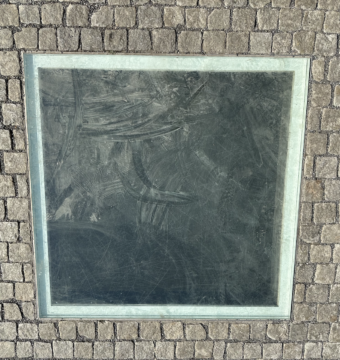
I did manage to get my photograph, that burning Saturday in Berlin just before the opera began. But the view down into Micha Ullman’s “Empty Library,” his installation under Bebelplatz of a white room lined with empty white bookshelves, was obscured: by the dust that had settled on the skylight, and by the contrast between the library’s sepulchral gloom and the glare of the sun, at 6 pm no longer directly overhead but still painfully ablaze in the cloudless sky above.
Is the present, with its heat and noise, overpowering the cold and silent past? Or will we still be able to use today’s light to read yesterday’s books, both the burned and the burning?