
by Mark Harvey

There’s a video of Ivanka Trump going on breathlessly about how she and her husband, Jared Kushner, happened upon an island named Sazan in the Mediterranean while yachting with friends. In her story, they noticed the island in the middle of nowhere, swam to its shores, then hiked barefoot to the summit. She describes the whole sequence of events as if she and Kushner discovered the land a la Vasco de Gama. Then she describes their plans to develop a multi-billion-dollar resort there, but with a light touch so that people can live the way she likes to live.
If you knew nothing about Sazan, and nothing about the gaslighting genes of the Trump family—practically an annex genome—you might envision a virgin isle enshrouded in a soft mist, fairly begging to be transformed by the light touch of Ivanka.
But as with all things Trump, Ivanka’s version of the world travels through a snookering prism so bizarre that it has anyone with a marginally functioning brain hopping up and down yelling, “That’s not true.”
Ivanka’s blasé comments about developing Sazan may not be entirely responsible for tens of thousands of Albanians taking to the streets in May and June to protest what they consider to be a corrupt government and flagrant abuse of power, but the Contessa from Florida definitely added fuel to the fire, in an uprising nicknamed The Flamingo Revolution.
Sazan is a tiny Island of just two square miles and sits where the Adriatic Sea meets the Ionian Sea. It’s part of Albania and is only virgin land in the sense that the Flushing Line of the NY subway system is virgin land. In fact, Sazan shares some features with the NY Subway system in that it is riddled with more than 3,000 Cold War bunkers and 10 miles of secret tunnels. Enver Hoxha, Albania’s dictator from 1944 to 1985, went on a bunker-building spree that made the Soviets look downright Haight-Ashbury, live-and-let-live. He is said to have considered Soviet leaders like Kruschev much too soft and ultimately aligned Albania with China in an effort to find a partner more committed to Marxism-Leninism.
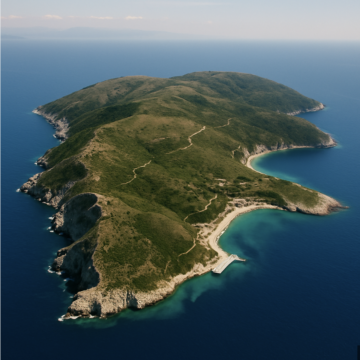
So for decades, Sazan was just an island meant to protect the military in the event of a nuclear war. In about 1990, after the Cold War ended, the military abandoned the area. It had a period of lawlessness and looting when people stripped the bunkers of copper wiring and any metal of value. Drug smugglers used it for a base, but the dangerous atmosphere kept the big crowds from ever visiting. Consequently, for more than sixty years, there was no farming, no logging, and certainly no tourism on the Sazan. With so little human activity, birds, animals, fish and plants have thrived. The land and the surrounding sea have become what ecologists call an “involuntary park” or “accidental ecosystem.”
Accidental ecosystems develop in areas that are, for one reason or another, devoid of heavy human traffic. Good examples include the demilitarized zone between North and South Korea, Chornobyl, and on a smaller scale, any number of abandoned gravel pits and garbage dumps across the United States. The thousands of land mines in the DMZ between the two Koreas have kept human activity down to zero and left the area to plants and animals. Consequently,, it’s become a rich wildlife sanctuary, home to vulnerable species like the red-crowned crane, the Siberian musk deer, and the the Asiatic Black Bear.
The area around Chornobyl had a similar path after the nuclear meltdown in 1986. More than 100,000 people over about a thousand square miles were evacuated around Chornobyl, leaving the area to the feathered and furred. Today, Eurasian lynx, elk, wild boar, brown bears, and European Bison thrive without the human stamp.
But few accidental ecosystems in the world match Sazan. With so little human activity, the island got covered in maquis, the catchall term for dense evergreen scrub. The little Albanian island is covered in Phoenician juniper, wild olive trees, kermes oak, and wild myrtle.
The thousands of abandoned bunkers have become great homes for bats and Sazan has about 14 different species, including the imperiled Mediterranean long-eared bat, Soprano Pipistrelles, and European Free Tailed bats.
During the Cold War, the paranoid Enver Hoxha established a strict military zone in the waters around the island and prohibited any sort of fishing. Consequently, the marine life was protected for a good 60 years and has flourished on the reefs there. Today, the reefs and surrounding waters are home to dolphins, pelagic fish, the endangered Monk seal, and dozens of other marine species. In 2010, Albania established the Karaburun-Sazan National Marine Park to protect its species.
Through his company Affinity Partners, Jared Kushner has quietly—some would say secretly—negotiated a deal to build an ultra-luxe resort on Sazan and a huge assortment of townhomes and villas just across the bay on a peninsula called Zvërnec. In her video describing the development, Ivanka says, “We have five miles of beachfront with a lagoon on one side and the ocean on the other, [with] beautiful white sand beaches.”
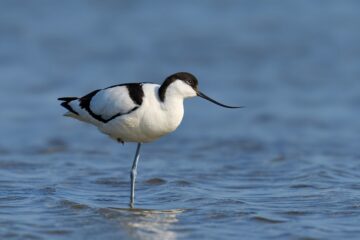
The lagoon she refers to is called Narta Lagoon and is an estuary considered to be an important stopover on the Adriatic flyway, the route millions of birds take between Africa and Europe. It’s home to several endangered or threatened species such as the Dalmatian Pelican, the white-headed duck, and the pied avocet.
As ecologists will tell you, estuaries are delicate ecosystems—sort of intermediate ecologies between land and sea that depend on the refined chemistry of brackish waters. There is a complex hydrology in estuaries that has developed over thousands of years, and the plant, marine, and animal life in those estuaries have evolved to live in that strange mix.
Spokespersons for Preservation of Natural Environment in Albania, the nation’s first environmental organization, say Kushner’s development would destroy the delicate hydrology and ultimately the lagoon.
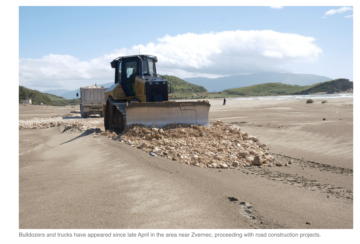
In late May of this year, construction crews began erecting concertina fences on the dunes next to the estuary and building roads with massive bulldozers in preparation for the development. And so began what is nicknamed the Flamingo Revolution for the estuary is also home to thousands of flamingos. Protesters immediately tried to stop the bulldozers and were brutally dragged off by private security teams. Word spread quickly, and Albanians were enraged. Literally the next day, thousands of protesters hit the streets in Tirana, the nation’s capitol.
But they didn’t protest for a day or two, they protested for weeks—tens of thousands of people marching every night, making speeches, carrying signs, seemingly fearless.
Albanians certainly take pride in the wildscapes of what is one of the most pristine countries in the Mediterranean, but it would be naïve to think that their wrath centers entirely around protecting Sazan and the lagoon. My understanding is that the bulldozers and the proposed development were the flashpoint for a long-simmering unhappiness with the government’s corruption, low wages, the high cost of living, and neglect of schools. Sound familiar?
There’s something deeply offensive in Ivanka Trump’s rhapsody about her discovery of Sazan and their plans to develop the area with sensitivity and in pursuit of her brand of lifestyle. In the video, she wears a pink blouse, sports perfectly coiffed hair, and a face that suggests she’s managed to somehow avoid the typical blows and misfortunes of anyone in their mid-forties. It might have been Coco Chanel or George Orwell who said at age fifty you get the face you deserve. Ivanka Trump got the unblemished face that might be labeled “pumpkin spice latte.”
If estuaries are the strange and beautiful evolution of complicated ecosystems where saltwater meets fresh water, Ivanka got anti-estuary face. Hers is the face where Evian meets Acqua Panna. And that might be why she so enraged most of Albania. She is so removed from anything remotely quotidian—car payments, double shifts, farm work, and the like- that the mind stretches to try to figure out where she’s coming from.
I’ve never been to Albania, but I have to assume life is a hard struggle for most in that country. It’s one of the poorest countries in the Western Balkans, with people earning only about the equivalent of $1,000 per month. Consequently, there is a huge diaspora of its people and close to half of Albanian citizens live and work in countries like Italy, Turkey, and Greece.
Albanians have done something that Americans haven’t: they’ve taken an almost universal stance against the egregious corruption and wanton disregard for the well-being of their countrymen so characteristic of the Trump family.
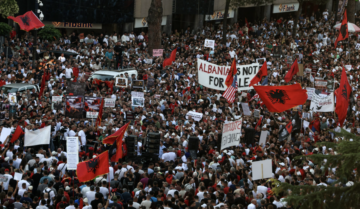
On June 20, during the Flamingo Revolution, close to a quarter of a million people went out onto the streets of Tirana—about a tenth of the entire population. There is some rich irony that a country only recently out from under the iron rule of Soviet style dictators seems to have more spine than Americans when it comes to dealing with world-class grifters. In our mythology, the father of our country crossed the Delaware to attack the unaware Brits on a Christmas Eve, camped with his troops through a hard winter in Valley Forge, and led an army of scrappy men who had little more than a musket, a fife, and a drum. A lot of that actually happened, and yet here we are 250 years later watching our President tear down the White House in the dark of night, shamelessly grift and graft, and lie to the public on a daily basis.
May we take a page from the brave Albanians standing up for their land and facing their corrupt government square in the face.