
by Scott Samuelson
The first noble truth is that life is full of needless suffering. The second noble truth, only slightly less well-known, is that the cause of needless suffering is maxxing.
What’s the problem with maxxing? As I see it, it involves replacing our enjoyment of the goods in front of us with a twisted desire for more, more, more. We end up destroying the only goods that we’ll ever have.
For instance, a young man wants to hook up with a young woman, comes to think that he needs to be better looking, starts microdosing a GLP-1, and soon is smashing his cheekbones with a hammer. Or a university wants to educate young people, thinks that it needs to attract more students, shifts its focus to shiny dorms and bigtime sports, and soon is jettisoning all its educational standards and laying off faculty to finance its associate VPs of consumer satisfaction.
Even in the good old days of Siddhartha or Epicurus, the misplaced desire for more, more, more was regarded as the central problem of the time. Still, it’s unsettling just what a digitized science our age has made of gymmaxxing, sleepmaxxing, softmaxxing, hardmaxxing, moneymaxxing, statusmaxxing, careermaxxing—really, anythingmaxxing, even booksmaxxing and jazzmaxxing!
I’ll go out on a limb and characterize modernity itself as prosperitymaxxing and longevitymaxxing. The maxxing spirit has even infected modernity’s ethics. The central tenet of utilitarianism is that actions or rules are right insofar as they max the moral good and wrong insofar as they do the reverse. As far back as the eighteenth century, Jeremy Bentham was trying to figure out the precise equation for moralitymaxxing. Now radical altruists and longtermists leverage data to max their impact. We’ve gone from wanting to make the world a better place for our children to not having children so future generations can be in a better place.
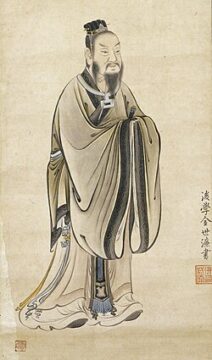
There’s a story from the Confucian philosopher Mencius that neatly illustrates the problem with maxxing, including moralitymaxxing.
Do not be like the man from Song. Among the people of the state of Song there was one who, concerned lest his grain not grow, pulled on it. Wearily, he returned home, and said to his family, “Today I am worn out. I helped the grain to grow.” His son rushed out and looked at it. The grain was withered. Those in the world who do not help the grain to grow are few. Those who abandon it, thinking it will not help, are those who do not weed their grain. Those who help it grow are those who pull on the grain. Not only does this not help, but it even harms it.
Obviously, Mencius’s point isn’t that growth is bad—quite the contrary. The problem is with trying to yank up our plants—or, to update the analogy a bit, trying to make a quick buck by spraying poisonous chemicals on our fields. Just as the fruits of a garden or the healthy produce of a farm come from patient daily care, so too does humane development begin with caring for what’s right in front of us. It’s not simply that we can’t rush progress—though we can’t. It’s that the real good of being human stretches across the entire process of our cares and concerns.
Mencius’s metaphor of a farm points to what I regard as the deep problem with the maxxing of modernity: conceptualizing ourselves as machines rather than as biological beings.
Education is a good example of what I’m talking about. Ancient and medieval philosophers conceive education through the biological metaphor of digestion. Students must take in a complex whole, break it down, assimilate something valuable, excrete what can’t be used, and convert the energy into significant activity. The metaphor that modernity has adopted to understand education starts with the idea that the mind is a machine. Students are to perform like computers in meeting learning objectives that can be measured by precise metrics.
As far as I’m concerned, the machine metaphor has been disastrous not only for education but for our entire way of being. We end up filling our lives with anxiety and trashing the planet.
But I don’t think that we should jettison modernity’s noble urge to make life better. Mencius isn’t saying that the only way to live is to accept things as they are, even when they’re terrible. He celebrates the desire to make things better, provided we conceptualize “better” as growth instead of maxxing.
So, in my eccentric formulation, the third noble truth is that we don’t need to compound our difficulties by maxxing. And a fine statement of the fourth noble truth can be found in a letter that Carl Jung sent to a woman who’d written him for guidance on how to live.
Dear Frau V.,
Your questions are unanswerable because you want to know how one ought to live. One lives as one can. There is no single, definite way for the individual which is prescribed for him or would be the proper one . . . If you want to go your individual way, it is the way you make for yourself, which is never prescribed, which you do not know in advance, and which simply comes into being of itself when you put one foot in front of the other. If you always do the next thing that needs to be done, you will go most safely and sure-footedly along the path prescribed by your unconscious. Then it is naturally no help at all to speculate about how you ought to live. And then you know, too, that you cannot know it, just quietly do the next and most necessary thing. So long as you think you don’t yet know what this is, you still have too much money to spend in useless speculation. But if you do with conviction the next and most necessary thing, you are always doing something meaningful and intended by fate. With kind regards and wishes,
Yours sincerely,
C.G. Jung
***
Scott Samuelson is the author of several books. His most recent, To Taste: On Cooking and the Good Life, comes out this fall.
Enjoying the content on 3QD? Help keep us going by donating now.