
 Tycho Brahe was a significant figure in my family. Why? Because my father’s parents were from Denmark, and Tycho Brahe was Danish. Danes were thus important in the Benzon household, as was Danish pastry (wienerbrød, Vienna bread), the real stuff with cardamom seeds, not the fluff you get in diners. And then there is rabarbergrød, a cloudy translucent rhubarb pudding laced with slithers of almonds. Not to mention Danish layer cake, five thin cookie-like layers alternating with custard and currant jelly topped with a lemon-juice & powdered sugar icing, once a year on my father’s birthday. But I digress.
We were told about Leif Erikson, who made landfall in the Americas half a millennium before the Italian. About King Christian X, known for his defiance of Hitler, which – wouldn’t you know? – became embroidered with legend. But most important of all, Victor Borge, an important comedian in mid-century America known for his dry wit and use of music as a comedic medium, which called forth his considerable skill as a concert pianist.
Whoops! I digress.
This essay isn’t about desserts, kings, or even comedians. It’s about a living intellectual, the economist Tyler Cowen. I won’t bother with boilerplate basics, you can find that in Wikipedia. As for his similarity with that long-deceased 16th century Danish astronomer, Tycho Brahe, we need to have some appreciation for what Cowen has done before stacking him up against the dead Dane.
First up, Cowen’s blog. Then we blitz through a list of 59 people he’s interviewed (out of 279 so far), then on to philanthropy, after which we slow way down to look at his current monograph, The Marginal Revolution: Rise and Decline, and the Pending AI Revolution. When we’ve gone through that we’ll understand the comparison with Tycho Brahe.
Who is Tyler Cowen? The Marginal Revolution Blog
Tyler Cowen became director of the Mercatus Center at George Mason University in 1998 and was awarded the Holbert C. Harris Chair Economics in 2000. With his intellectual legitimacy established, he could concentrate on informing and educating the public. One obvious channel is through books such as Create Your Own Economy (2009), The Great Stagnation (2011), Average is Over (2013), Stubborn Attachments (2018), and Talent (2022), with Daniel Gross.
But the Marginal Revolution blog functions as his virtual home base. He’s been posting there every day since he and Alex Tabarrok established the blog back in late August 2003. As of June 13, 2026, there are, by my calculation 39,735 posts at Marginal Revolution, most but by no means all, are Cowen’s.
Marginal Revolution, however, is not how I first learned about him. That was through an article he’d published in Slate in April 2006. Among other things, He suggested that shantytowns should be constructed in post-Katrina New Orleans. He observed:
To be sure, the shantytowns could bring socioeconomic costs. Yet crime, lack of safety, and racial tension were all features of New Orleans ex ante. The city has long thrived as more dangerous than average, more multicultural than average, and more precarious than average for the United States. And people who decide the cheap housing isn’t safe enough will be free to look elsewhere-or remain in Utah with their insurance checks.
Shantytowns might well be more creative than a dead city core. Some of the best Brazilian music came from the favelas of Salvador and Rio. The slums of Kingston, Jamaica, bred reggae. New Orleans experienced its greatest cultural blossoming in the early 20th century, when it was full of shanties.
I thought Cowen expressed a disingenuously romantic idea of the relationship between creativity and poverty.
I don’t know when I found my way to Marginal Revolution, but the oldest mention of Cowen on my blog, New Savanna, dates back to May 5, 2010. It follows that I found my way to Marginal Revolution somewhere between those two dates, April 2006 and May 2010. Just when I don’t know. Whenever it was, I began reading Marginal Revolution daily as part of my early-in-the-day check of the internet.
To be sure, his center-right libertarian politics are different from my left-liberal politics, but I have little interest in marinating in my own views. That he is an economist is all to the good regardless of the particular flavor of his ideas. I need to be kept aware of matters economic, and zipping through Marginal Revolution is a good way of doing that.
But there’s more to Marginal Revolution and to Tyler Cowen than economics. Of the half dozen or so posts a day, one of them will be a collection of links to this, that, and the other. Three or four more will be excerpts (50 to several hundred words) from this or that, with perhaps a paragraph or two from Cowen. These days Alex Tabarrok, his blogging partner, will have a substantial post, generally on some economics topic. Cowen will also have an occasional long-form post of some 100s of words.
Then there are those posts where Cowen will ask for advice about this or that travel destination. He takes extended-weekend trips every couple of years and has traveled to over 100 countries on six continents. Upon return home he’ll generally give us a few hundred words about the place, including recommendations on food. He’s well-known as a foodie (his dining guide).
Music? Yes, lots of it. He’s a big fan of Paul McCartney, Bach, and Carnatic (South Indian) music. Novels? Of course. He’s read his way through Knausgaard, and Ferrante too. Movies? What do you think? Best of 2025, 2024, and so forth. Here’s a link to “best of” on the blog. You get the idea.
Cowen played chess in his youth and was the youngest New Jersey State champion at 15. It’s through chess that he became interested in AI. While stopped actively pursuing the game in his mid-teens, Cowen follows it on the blog.
Every few weeks he runs up a post giving a sentence or two about a half-dozen to a dozen books he’s recently read. He’s got an extraordinary capacity to soak up knowledge from reading and knows more about more things than just about anyone I’ve ever come across – though perhaps my undergraduate mentor, the late Dick Macksey, could have given him a run for his money. It’s Cowen’s extraordinary intellectual range that makes Marginal Revolution so interesting to me. Though my range is not quite so wide, and I certainly don’t have any particular facility in reading, my curiosity ranges wider than that of most scholars. Moreover I am actively engaged with and write about a wide variety of topics. Marginal Revolution is good grazing territory; I generally find at least one or two items per week that I then investigate further.
I could ramble on with this, but you get the point, no? Still, if you really want to get a better fix on the range of his Cowen’s interests, that’s easy enough to do.
Conversations with Tyler
Starting on April 6, 2015, Cowen had the first of his Conversations with Tyler. These were originally held before a live audience, mostly at George Mason, with audience questions after the conversation. When the pandemic hit, however, Cowen was forced to move entirely online. Once restrictions were lifted, Cowen returned to live conversations interspersed with online ones.
Cowen has posted 279 conversations as of June 12, 2026. I’ve listed 59 of them in the next paragraph. In the list I’ve given the interlocutor’s name, the number of the conversation, and a phrase or two to characterize them. If you want to know more about them you can dump the list into your favorite chatbot and ask it to provide more information. I don’t claim that the list is representative, but I went for variety and, with exceptions, name recognition. If you see five, ten, or 17 conversations you’d be interested in, I’ve done my work well.
Peter Thiel (01), venture capitalist, public intellectual; Kareem Abdul-Jabbar (06), athlete, writer; Jonathan Haidt (08), psychologist, Camille Paglia (09), literary, public intellectual; Steven Pinker (14), cognitive scientist (language & mind), public intellectual; Fuchsia Dunlop (15), Chinese culture, esp. food; Joseph Henrich (16), cultural evolution, Gary Kasparov (22), chess expert; Raj Chetty (23), economist; Dave Barry (27), humorist, writer; Larry Summers (28), economist; Russ Douthat (32), columnist (NYTimes); Martina Navratilova (37), athlete; David Brooks (42), columnist (NYTimes); Michael Pollan (47), journalist (food, psychedelics; Paul Krugman (51), economist, Paul Romer (55), economist; Jordan Peterson (60), public intellectual, Sam Altman (61), entrepreneur, co-founder of OpenAI; Margaret Atwood (65), novelist, Neal Stephenson (71), novelist, Ted Gioia (79), music critic, journalist, Mark Zuckerberg (bonus), tech executive; Daron Acemoglu (81), economist; Esther Duflo (82), economist; Slavoj Žižek (84), philosopher, public intellectual; Ezra Klein (86), columnist (NYTimes; John McWhorter (89), linguist, public intellectual, NYTimes; Ashley Mears (97), sociologist; Matt Yglesias (104), journalist, public intellectual; Alex Ross (105), music critic; Jimmy Wales (109), Wikipedia founder; David Deutsch (124), physicist; Alexander the Grate (127), homeless person in Washington, D.C.; Zeynep Tufekci (130), sociologist, columnist (NYTimes); Stanley McChrystal (134), former Army general; David Salle (135), artist; Steward Brand (142), journalist, public intellectual, creator of Whole Earth Catalogue; Sam Bankman-Fried (145), cryptocurrency executive, (& now a convicted felon); Thomas Piketty (148), economist; Marc Andreessen (152), venture capitalist; William MacAskill (156), philosopher (ethics); Ken Burns (164), documentarian; Glenn Loury (171), economist, public intellectual; Brad DeLong (172), economist; Peter Singer (181), philosopher (ethics); Noam Chomsky (182), linguist, public intellectual; Reid Hoffman (183), entrepreneur, venture capitalist; Ada Palmer (191), historian, novelist; Fareed Zakaria (208), journalist (CNN); Joseph Stiglitz (215), economist; Neal Stephenson (226), novelist; Carl Zimmer (235), science journalist; Jack Clark (240), AI entrepreneur, co-founder of Anthropic; Dan Wang (263), financial journalist, expert on China, Alison Gopnik (265), developmental psychologist; Andrew Ross Sorkin (269), financial journalist (NYTimes); Craig Newmark (276), founder, Craig’s List; Toby Wilkinson (278) Egyptologist.
Emergent Ventures and Fast Grants
One of Cowen’s persisting concerns is how risk averse the academic world is. While the elite schools like to say they’re going boldly where no minds have ventured before, it ain’t necessarily so. In 2018 the Thiel Foundation granted George Mason University’s Mercatus Center one million dollars for Emergent Ventures, which is a program “to jumpstart high-risk, high-reward ideas that advance prosperity, opportunity, and well-being.” The application process is short and sweet; decisions are made quickly.
One of the very first grants went to one Lenny Bogdonoff for a project about graffiti, something that interests me a great deal (I’ve been photographing graffiti for two decades).
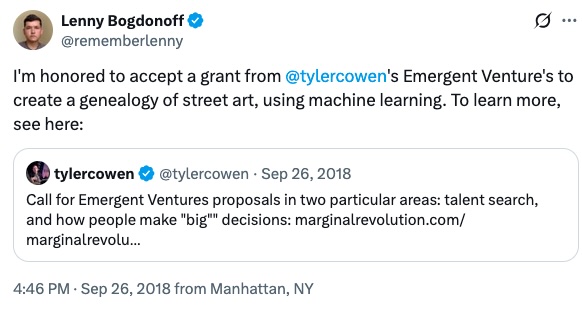
There have been 54 cohorts of general grants so far and 16 cohorts designated for India. Here’s a searchable database of all the winners.
When Covid hit, Cowen and Mercatus responded with a program of Fast Grants in April 2020. The program offered $10K to $500K per grant with a response to applications within two weeks and funding over 250 grants as of April 2021. Writing in Future, Patrick Collison, Tyler Cowen and Patrick Hsu observed:
A common theme across all of these is that fairly obvious opportunities were not pursued by incumbent institutions. We give examples of actions Fast Grants took not to indicate some kind of supposed brilliance but rather to emphasize the opposite: Fast Grants pursued low-hanging fruit and picked the most obvious bets. What was unusual about it was not any cleverness in coming up with smart things to fund, but just finding a mechanism for actually doing so. To us, this suggests that there are probably too few smart administrators in mainstream institutions trusted with flexible budgets that can be rapidly allocated without triggering significant red tape or committee-driven consensus.
This lack of empowerment touches upon broader challenges of institutional judgment and institutional courage that have been consistent features during the pandemic.
One of their conclusions is simple: “alternative models of science funding can work.” That’s one of the persisting themes of Cowen’s work, we need alternatives to current institutional models.
Though I am somewhat embarrassed to admit it, the fact is that I’ve read Cowen’s blog for 15 years without actually knowing just what the Marginal Revolution was. Oh, I wondered about it from time to time, but knowing that didn’t seem essential to understanding the material I found in the blog. I suppose that makes me one person whom Cowen has reached who didn’t quite know what he had been reading all these years.
Then, a couple of months ago he published a short monograph, The Marginal Revolution: Rise and Decline, and the Pending AI Revolution (2026). “Ah,” thought I to myself, “at last I can learn what it’s all about.” So I downloaded the book and began reading, blogging about my reading as I went along. No more than four or five pages into the book I knew what marginalism was. Intuitively.
The paradigmatic example of marginalism is something called the “diamonds-water paradox.” Water is essential for life while diamonds, though perhaps beautiful, are all but irrelevant to staying alive. Why then are diamonds so much more valuable than water? Here’s how Cowen explicates it (p. 5):
If someone had to choose between having no water and having enough water to avoid dying of thirst, they would be willing to pay a very high price for water (the exact final price still would depend on how many suppliers were competing to sell you water and the cost of getting you the water, questions which also can be addressed using marginalism). But that is not the choice for most people. Most people have a fair amount of water, and they are paying for more water, or you might say water at the margin. And the value of water at the margin just isn’t that high. In American restaurants, many people don’t even drink the glass of water they get for free.
To consider diamonds, if you could receive plenty more diamonds by turning on your kitchen tap, diamonds probably wouldn’t sell for much in the market, just as water doesn’t. Of course, that is not the case and real diamonds remain relatively scarce, thus boosting their value. That said, circa 2025 competition from high-quality artificial diamonds, which can be made in the lab, is threatening to further depress diamond prices. Again, that is consistent with marginalism.
He goes on to point out that Galileo, the famous astronomer and physicist, was the first one to resolve the paradox, doing so in 1632 (p. 6):
For Galileo, the water-diamonds issue was part of a broader dispute between Copernican and Ptolemaic cosmologies, and the relative nobility of the earth and the heavens. He probably didn’t know he was stating an important principle of economics, though I suspect he was pleased to have presented this kind of philosophic, scholastic point so clearly. In any case, the words of Galileo and other earlier appreciators of marginal utility theory, such as the Salamancan theologians of 17th century Spain, basically were ignored.
There it is, that phrase, “marginal utility,” that’s what this monograph is about, when and how marginal utility was identified as a distinct conceptual object and why that’s important. In my understanding of such matters, by which I mean language and thought, not economics, Galileo wasn’t actually aware of marginal utility as a distinct conceptual object. I rather doubt that those Salamancans were either.
“But how,” you might be thinking, “how could Galileo have resolved diamonds-water without knowing what marginal utility was?” That’s a very good question. Intuition is one way to think about it, and the concept of intuition is very important in the book. We can have intuitions about all sorts of things without actually being able to articulate a basis for those intuitions. But intellectual revolutions aren’t based on intuitions; they’re based on articulated concepts. Converting intuitions into explicit ideas is perhaps the single most difficult aspect of the intellectual enterprise, and the least understood.
Before returning to that I want to give you two more of Cowen’s examples of marginalism (there must be 30 or 40 in the first chapter, perhaps more).
Having gone through water-diamonds Cowen gives us a bit of math and then presents a second example (p. 8):
Why do drivers in China sometimes intentionally kill the pedestrians they hit?
Well, under some compensation schemes it is cheaper – in terms of fines – to kill the person and pay a fine than to have to pay for his continued upkeep. If you as a driver kill a pedestrian, the associated fine – at least circa 2015 – can run in the range of $30,000 to $50,000. But if you have to pay for lifetime care for a disabled surviving victim, that can run into the hundreds of thousands of dollars. At the margin, you lower your penalty if the victim dies. That is why there are some reported cases of hit-and-run drivers returning to the scene of the crime, and running over the victim again, to make sure the “work” is finished off. At the margin, there is no financial penalty for worsening the crime.
Whoa! Where’d that come from? It’s a different universe of discourse from the very concrete world of physical substances, water and diamonds.
Here’s a third example (p. 21):
Let’s say you had two friends, but you had time to drive only one of them to the hospital. One friend has a hangnail and seems vaguely out of sorts, and the other broke their arm and is screaming in pain. Which friend would you take to the hospital?
The answer is so obvious that you might claim that that’s hardly an economic judgment. But Cowen notes, to the contrary, that “the judgment has some scientific and empirical content in any case, whether or not you choose to call it economics.”
Abstractly considered those three examples display the same pattern. In these cases someone is choosing among alternatives:
- Do I pay nickels and dimes for water I need, or thousands of dollars for a diamond I don’t need?
- Do I pay a large fine for vehicular manslaughter or a much larger sum over the lifetime of a person I injured?
- I can only drive one friend to the hospital. Which one?
Those three examples may make intuitive sense as stated. They all involve marginal reasoning, but stating explicitly what they have in common is tricky. You may see it, feel it, but you can’t quite explain it.
To identify the pattern explicitly you need to abstract over those and many other cases. Then you must: 1) identify the different conceptual objects in these situations, and 2) specify the relationships between those objects. In this particular case you need some math to specify those relationships. When you’ve done that you will have isolated marginal utility as a distinct conceptual object.
For most of us the marginal utility of water is quite high, while the marginal utility of diamonds is quite low. If you want to give someone an impressive gift, however, the marginal utility of a diamond will be quite high, much higher than that of a glass of tap water or a case of Evian, Glaceau Smart Water, or San Pelligrino. Whether or not you can afford the diamond is another matter.
Cowen devotes his second chapter to explaining how William Stanley Jevons and some other 19th century economists did that, making marginalism the dominant school of economic thought through the 20th century and into the 21st. In chapter three Cowen sketches an account of conceptual development. To be honest, I found it disappointing. The chapter would have been much better if Cowen had mentioned the account of scientific change that Thomas Kuhn gave in The Structure of Scientific Revolutions (1962) and then either adopted a perhaps modified version of it or explained why he had to reject it. That deficiency has little bearing on the argument I’m making, however, but if you’re curious, you are welcome to read my critique, Why doesn’t Cowen mention Thomas Kuhn on scientific revolutions? and here and there in Botanical classification and the theory of evolution.
The Current State of Economics
And that brings us to Cowen’s fourth and last chapter, “Why Marginalism Will Dwindle, and What Will Replace It?” Here’s how he opens the chapter (p. 85):
The underappreciated news is that marginalism is on the way out. Furthermore, this is old news, though the trend is accelerating.
Most of all it is underdiscussed news. As economics continues to evolve, marginalist insights – probably of all different kinds – will lie ever further from the frontiers of research and knowledge.
I find it easy to imagine that – less than 20 years from now – marginalism will be viewed as a historical curiosity rather than a central analytical engine of economics. No one will quite come out and say that, nor will they present marginalism as false or destructive. Rather it will be seen as of limited relevance, much as we might view parts of the earlier classical economists, such as their expositions of the quantity theory of money. New and different analytical frameworks will replace the ones that have dominated neoclassical economics to date.
Think about that, think about it very carefully. When thinking about it remind yourself that Cowen named his blog, his virtual home base for the last two decades, after marginalism.
For a professional academic to say that the world in which they were trained, the structure of ideas within which they have worked, which they have nurtured in students, which they have communicated to the public at large, which they have come to love, to say that that world is slipping away into the past, man, that’s rough. And rare. Not many have been able to do it.
Back in 1946 the great physicist, Max Planck, remarked, “A new scientific truth does not triumph by convincing its opponents and making them see the light, but rather because its opponents eventually die, and a new generation grows up that is familiar with it.” Thomas Kuhn referenced that remark in The Structure of Scientific Revolution, and the economist Paul Samuelson gave a compressed version in a 1975 article in Newsweek. It would appear that Cowen has gotten the message and decided that, rather than dropping dead, he’d give the new ideas a boost.
After that sobering opening, Cowen reviews what happened between the late 19th century and now. He lands on price theory. Price theory? – “the view that the basic intuitive economic concepts, as would be taught in intermediate microeconomics, are highly useful and for advanced problems too” (p. 91). There’s that word, “intuitive.” Cowen explains:
Your hypothesis should be intelligible in terms of microeconomic concepts that you can hold in your mind and understand. In most (maybe not all?) cases, you should be able to explain some version of those principles to a well-educated, non-economist onlooker.
A couple pages later we arrive at something called “Topkis’s Theorem” which is very mathy (p. 94). Two pages after that: “Economic intuition, RIP. And marginalism with it.” Whoops! “I am seeing the traditional, intuitive approach to economic reasoning retreating from one field after another. To give one vivid and also important example, machine learning and neural nets are overturning the world of finance.”
A couple of pages later Cowen gives us a striking example. It’s from something called Arbitrage Pricing Theory (APT) (pp. 99-100):
APT typically looks for “factors” in the data which predict excess returns, and a traditional APT model might have found five or six such factors. Are “inflation” or perhaps “the term structure of interest rates” useful factors? Well, that can be debated, but if so, those results sound pretty intuitive. But those intuitions seem to be disappearing. In a paper by these authors, they apply machine learning methods to look for more factors. As we know, machine learning is very good at finding non-obvious relationships in the data. The largest model they built has 360,000 (!) factors, and it reduces pricing errors by 54.8 percent relative to the classic six-factor model from Fama and French. Bravo to the authors, but what kinds of intuitions do you think possibly can be supported by those 360,000 factors?
Don’t understand that? Don’t worry, I don’t either (though it sent me through a very interesting wormhole).
I believe the assets in question are stocks. What you need to pay attention to is 1) the contrast between six factors and 360,000 factors, 2) the fact that one set of factors is intuitive while the other certainly is not, 3) but the unintelligible, unintuitive, collection of factors does a better job of pricing. That’s the new world toward which economics is moving. While the old intuitions are gasping for breath the new-fangled are numbers fit as a fiddle and ready for duty.
Cowen remarks (p. 100):
Finance is one of the first fields to be revolutionized in this manner, in part because the data are so good, and in part because the stakes are so high that it makes sense to put a lot of time, money, and talent into these research lines. But there is no reason to think finance will be the last area of economics to change fundamentally, even though other fields of investigation will require more time and investment and are likely to change more slowly than did finance.
Cowen then moves outward from economics though this, that, and the other and finally lands on the large language models (LLMs) that power chatbots such as Claude, ChatGPT, Gemini, and Grok (pp. 106).
His message: AI is to stay and it is going to get better. While I think he’s too credulous about the standard industry story of LLMs being a sharp break from the past, I agree with his general point. We’re moving to a whole new world.
What Does This Have to do With Tycho Brahe?
As you may know, Tycho Brahe was a 16th century Danish astronomer (as well as an astrologer and alchemist) and perhaps the greatest pre-telescope astronomer. He found himself stuck between the philosophical attractiveness of Ptolomy’s geocentric model of the solar system and the geometry of the heliocentric model devised by Copernicus. He devised a compromise system in which the sun moved around the earth (philosophical comfort) and the planets moved around the sun (geometric tractability).
Similarly Cowen is suspended between the intuitive satisfactions of marginalism and the growing empirical success of the mathematically complex machine learning models used by a new generation of economists. Without abandoning his intellectual commitment to marginalism, which he sees becoming “baked into the inputs we fed our tools of artificial intelligence” (p. 85), Cowen sees clearly that sophisticated AI-enhanced empirical work will lead us to a new intellectual future. And, just as Tycho’s assistant, Johannes Kepler, used Tycho’s data as the basis of his new laws of planetary motion (thereby permanently displacing geocentric yearning), so it is likely that some of the recipients of Emergent Ventures grants will develop new approaches to economics grounded in AI and giving rise to new and utterly foreign intuitions about economic activity.
I suspect, however, that Cowen is aware of his situation in a way that Tycho would not have been. The penultimate paragraph of the book reads like a moderately anguished elegy:
There is however a slightly scarier version of this story yet. Maybe our intuitions about the world, including the economic world, were never so strong in the first place. Maybe we put so much value on “intuitive” results, in 20th century microeconomics, as a kind of cope and also security blanket, to make up for this deficiency. But our intuitions, even assuming them to be largely correct, always were just a small corner of understanding, swimming in a larger froth of epistemic chaos. And now the illusion has been stripped bare, and the true complexities of economic reasoning are being revealed.
Swimming in a froth of epistemic chaos? Yikes! But Cowen’s final sentence parries the blow with an ironic comment that is worthy of Kurt Vonnegut:
As Arnold Kling would say, “Have a nice day.”
Cheers.
I wrote every word of this article other than the quoted passages. But I’ve had extensive consultation with Marge, the instance of Claude attached to the online text of The Marginal Revolution. Marge helped me with attribution verification, textual reference, structural guidance, and copy editing, especially in the second half.
Enjoying the content on 3QD? Help keep us going by donating now.