
by Michael Liss
[I]t was the first solemn declaration by a nation of the only legitimate foundation of civil government. It was the corner stone of a new fabric, destined to cover the surface of the globe. It demolished at a stroke the lawfulness of all governments founded upon conquest. It swept away all the rubbish of accumulated centuries of servitude. It announced in practical form to the world the transcendent truth of the unalienable sovereignty of the people. It proved that the social compact was no figment of the imagination; but a real, solid, and sacred bond of the social union. —Secretary of State John Quincy Adams, July 4, 1821.
On some past Fourth of July, their store closed for the holiday, my parents packed up a pair of children, hats and sunscreen, coolers filled with salami and roast beef sandwiches, sliced red peppers and cucumbers, and bottles of soda “to wash things down.” Plus a pair of Rolleiflex cameras and rolls upon rolls of Agfa film (with 12 shots to the roll, you needed a lot of rolls). There were also maps (of the paper kind) and towels (of the cloth kind), sunglasses (prescription and flip-up), and packets of Sun-Maid Raisins and Planters Peanuts, just in case we got lost and had to live off the land. Important to be prepared.
North on the Taconic Parkway we went, through Westchester, through Putnam to Dutchess—destination some town or hamlet that would be having a Fourth of July celebration. I rooted for proximity to the Old Rhinebeck Aerodrome, where, along with patriotism on display, there were also biplanes, but, on this occasion, I don’t recall the merging of the secular and religious. The town for which they chose to turn off the road did not have a Sopwith Camel, but it did have a Fourth of July celebration and parade.
Signs, flags, buntings, displays. Food stands. High school marching band, leading a group of what were likely local worthies. Middle-aged WW-II vets in their (slightly tight) uniforms, their families waving at them as they went past. A fire truck. Vintage cars, and particularly the big open ones that carried the WW-I vets—everyone clapped and waved at them. How could you not?
Somewhere, at some point, the parade ended in a town square, with people merging in front of a set of stands and a podium, and, from there, a local worthy (a Mayor, perhaps even a Congressman) got up from a chair and delivered a Fourth of July Speech. Perhaps it wasn’t quite up to John Quincy Adams’s offering, but it was the kind of speech that recalled a great moment of our past and urged us to reaffirm our commitment to the ideals expressed that day.
Countless Fourth of July speeches have been delivered, some by the most celebrated orators in history—Edward Everett and Daniel Webster, Frederick Douglass and Susan B. Anthony, Oliver Wendell Holmes and a then-aspiring member of the House of Representatives, John F. Kennedy. Abraham Lincoln and Ronald Reagan and even Winston Churchill. Few (except for Douglass) are so memorable as to be quotable. The Declaration of Independence has its own melody—it’s like a work of art that can’t be described by mere eloquence. Analyzed, yes. Critiqued, yes, but the essence of the original must be communicated whole, passed on through the generations as a legacy to be retold, honored, and acted upon in a manner that respects it as a covenant.
We think of the Declaration as largely Jefferson’s, but that’s just a partial picture. His first drafts were reviewed by a Committee of Five composed of Jefferson himself, John Adams, Benjamin Franklin, Roger Sherman, and Robert Livingston, and then by the entire Continental Congress. Even before one set of eyes became five, and five became many, Jefferson himself was influenced by the writings of European thinkers like Locke and Rousseau, and particularly by George Mason’s thoughts in the Virginia Declaration of Rights.
It is natural to attribute great national deeds to a handful of Great Men. Jefferson the Author of the Declaration of Independence. Lincoln, who won the Civil War and freed the slaves. Washington, the Indispensable Man. But every leader, no matter how great his accomplishments, must work from a foundation of individual acts done by others. Eisenhower, speaking to Walter Cronkite 20 years after D-Day, caught this perfectly, recalling “little individual acts of heroism, leadership coming to its very acme.”
So, as we near the 250th anniversary of our “Origin Story,” I want to go back more than four decades before that to a “little individual act of heroism” and the story of John Peter Zenger.
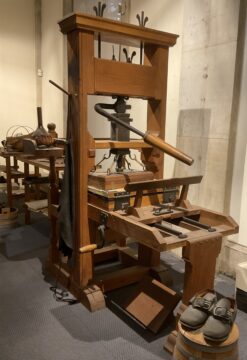
Zenger was German born, coming to the American colonies when he was about 13, and bound for eight years to an apprenticeship with the printer, William Bradford, considered New York’s first professional printer. By 1725, Bradford was publishing the New-York Gazette, the first (and for a while the only) newspaper in the Province. Zenger, having fulfilled his bond, acted as production manager and junior partner of Bradford. In 1726, Zenger went out on his own and began publishing books and pamphlets. Bradford maintained his preeminent position, but the market had room for two printers, and Zenger became a modest success.
At this time, Colonial New York was controlled from afar by Britain: it was the British who made the laws, and the British Crown that appointed Royal Governors without much, if any local consultation. The Colonists were irritated by British dominance, but not sufficiently riled to do much more than grumble about it. Bradford’s paper, reflecting commercial reality, was generally supportive of the Governors, and they, in turn, assigned him printing contracts. In 1731, Governor John Montgomerie passed away. His replacement, William Cosby, already had a bad reputation as an exploitative and domineering Governor elsewhere. He reaffirmed it by taking 13 months to get to New York, and, upon his arrival, by demanding, and then suing the acting Governor, Rip Van Dam for half of Van Dam’s salary.
One would think Cosby’s chances of winning that lawsuit would have been remote, but one would be wrong. This was a different world of law, one of rule by fiat. The Governor had broad powers, which Cosby used liberally, and, in 1733, he won his case, over a written dissent from New York’s Chief Judge, Lewis Morris.
That wasn’t enough for Cosby. Angered by Morris’s apparent apostasy, he struck back by removing him from office altogether. Morris, however, had his own resources. First he ran for, and won the Eastchester seat in the Province’s Assembly. Then, together with Van Dam and attorneys James Alexander and William Smith, he set up the first truly independent newspaper in New York, the New-York Weekly Journal. To print it, they hired John Peter Zenger.
The partners produced a large quantity of critical-to-Cosby content—everything from serious reporting to satirical verse—accusing him of tyranny and violation of the people’s rights. Cosby was not fond of criticism, much less opposition, and used the power of his office to strike back. As a target, he chose Zenger, even though he knew Zenger wasn’t writing content. Put the printer out of business, Cosby reasoned, and the paper would die.
Cosby hand picked a recently arrived British barrister, one Daniel Horsmanden, to conduct an inquiry. Had the Weekly Journal printed material that constituted Seditious Libel? If it had, that was more than a civil matter; it was a crime, defined as “the intentional publication, without lawful excuse or justification, of written blame of any public man or of the law, or any institution established by the law.”
Cosby thought the law clear, yet, twice in 1734, Grand Juries refused to indict Zenger. The printer remained free, and the critical commentary continued. Cosby wouldn’t quit, and, believing himself not merely unconstrained by the law, but, instead, in control of it, he struck again. He asked the Assembly to authorize the public hangman to hold a ceremonial public burning of several of the newspaper’s issues. The Assembly turned him down. Then he ordered the Sheriff to do it, but the Sheriff couldn’t get authorization from a different tribunal.
Cosby fumed, and Cosby escalated. He directed his ally, Attorney General Richard Bradley, to use the controversial practice of filing an information, which would allow a prosecution to proceed without a grand jury indictment. Bradley did so before a Cosby-dominated court, the Supreme Court of Judicature, and Cosby’s allies there—Chief Justice James De Lancey and Justice Frederick Philipse—finally delivered what he craved…a bench warrant for Zenger’s arrest. Zenger was taken into custody and deposited into New York’s infamous Old City Jail.
Zenger’s attorneys, James Alexander and William Smith, promptly sought a writ of habeas corpus, and Zenger was brought before Chief Justice De Lancey, one of the two judges who had issued the warrant in the first place. De Lancey granted bail, but set it at a figure far beyond Zenger’s means, and so the printer returned to Old City.
We are 21st Century people, and so it’s hard to contemplate just how precarious a situation Zenger was in. A charge of seditious libel created immense complications for the defense because, to the jury, the truth of the “libel” was irrelevant. Their role was limited to determining whether the defendant said the words at all. It would be up to the Court to decide whether the statement constituted criminal libel, and, in Zenger’s case, it would be the same Court dominated by Justices De Lancey and Philipse.
After five months of rotting in jail, Zenger was arraigned in April, and a new set of obstacles emerged. His counsel challenged the validity of the judicial tribunal on a number of grounds, including that Cosby’s removal of Morris had been illegal. That made De Lancey’s subsequent appointment as Chief Justice invalid. Further, if the appointment of judges were “at the Governor’s pleasure,” then all appointments were invalid when the Governor was a party. Once again, the Court was not happy, and so it disbarred both James Alexander and William Smith from appearing before it.
So now, shortly before the trial was to begin, Zenger had no lawyers. He applied to the (same) Court for an attorney to be appointed. It granted the application, selecting newly admitted John Chambers, who, whatever his other attributes might have been, was also known as an ally of Governor Cosby.
It is hard to imagine what Zenger must have been thinking. There he was, stuck in jail, his wife trying to hang on to his printer’s shop, “legal” doors being slammed in his face, and all he had done was print the allegedly libelous words, not write them.
It was here that his luck began to change. The Court moved the trial date to August, so that Chambers could prepare. Chambers showed himself diligent and adept at jury selection, and the extra time gave Zenger’s allies the chance to recruit Philadelphia’s Andrew Hamilton, considered perhaps the best lawyer in the colonies.
When the trial commenced on August 4, 1735, in City Hall, the courtroom was filled—mostly by supporters of Zenger. Cosby was broadly disliked, both for his governance “style” and his greed. The attorneys first provided the expected—Attorney General Bradley laid out the substance of the case; John Chambers entered a not-guilty plea and then took the Court through the basics of the case and what Bradley would have to show. Then the dramatic tactical moment: Andrew Hamilton essentially preempted the Attorney General’s case by admitting that Zenger had published the journals as alleged. “I do (for my Client) confess that he printed and published the two News Papers set forth in the information, and I hope in so doing he has committed no crime.”
It was a thunderclap, and a huge risk for the defense, as it joined the argument in an entirely different way. Bradley had victory in hand, if he could just have the law applied as seemingly written—the jury would decide whether the words were spoken, and the Court would decide whether those same words constituted Seditious Libel.
Had Hamilton admitted Zenger was guilty? Bradley thought so, and jumped on it, claiming the trial was in effect over, and, in fact, that even continuing testimony would enhance the peril. The Government, he said, was a “sacred body,” and it was a crime to libel it. That’s the position the Attorney General was taking, and it was probably the only case he could have made. To argue to the jury that Zenger was guilty because he engaged in Seditious Libel was to concede that the jury could have greater scope for its findings. The point that the jury’s role was limited dominated Bradley’s closing argument, and with this Court, that would surely carry the day. In the Court’s own statement, which can be seen at the very end of the transcript (just before the jury verdict), it cited another case and quoted another Judge to advance the following Alice-in-Wonderland argument:
To say that corrupt officers are appointed to administer affairs is certainly a reflection on the government. If people should not be called to account for possessing the people with an ill opinion of the government, no government can subsist, for it is very necessary for all governments that the people should have a good opinion of it. And nothing can be worse to any government than to endeavor to procure animosities; as to the management of it, this has been always looked upon as a crime, and no government can be safe without it be punished.
To both the prosecution and the Court, Hamilton was endlessly frustrating, because he wouldn’t engage on their terms. The Court even admonished him during his summation, but he went on nonetheless, speaking directly to the jury, asking it to intervene. He closed with this:
[T]the question before the Court and you gentlemen of the Jury is not of small nor private concern, it is not the cause of a poor printer, nor of New York alone, which you are now trying: No! It may in its consequence affect every freeman that lives under a British government on the main of America. It is the best cause. It is the cause of liberty; and I make no doubt but your upright conduct this day will not only entitle you to the love and esteem of your fellow citizens; but every man who prefers freedom to a life of slavery will bless and honor you as men who have baffled the attempt of tyranny; and by an impartial and uncorrupt verdict, have laid a noble foundation for securing to ourselves, our posterity, and our neighbors that to which nature and the laws of our country have given us a right—the liberty—both of exposing and opposing arbitrary power (in these parts of the world, at least) by speaking and writing truth.
The members of the jury may or may not have known about every twist and turn in the case, may not have grasped every legal nuance, but they clearly saw and knew how to choose between two sets of reality. A vote to convict was a vote to surrender their own freedom.
It took them 10 minutes to find for Zenger. The crowd erupted, not just inside the courtroom, but also in the adjoining streets.
John Peter Zenger was released from prison, went home to his family, and returned to his printing press. His lawyer was lionized, but Zenger himself became one of Ike’s quiet heroes, a person who just did. He lived another 11 years in comparative quiet. I’d like to think he got great satisfaction that the cause he fought for, the cause of free expression of ideas, of freedom of the press, and the rejection of the idea that the monarch can have unlimited authority, could fire the imagination of people who would, in Jefferson’s time, be ready for liberty.
Enjoying the content on 3QD? Help keep us going by donating now.