
by Daniel Gauss
When I went to Hanoi for the first time, I began a travel ritual I now follow in every city I visit.
I had grown up reading about the Vietnam War, mostly from our perspective, but still grim and unflinching, full of failed policy and the atrocities our military carried out. It was not just the insane level of the violence but its cruel senselessness that affected me, that so much suffering and death had been meted out gratuitously and malevolently by military and political leaders who knew we could not win. We kept killing innocent people and sacrificing our own troops, long after it was clear we should have stopped.
Because it was my country that inflicted the egregious pain and my own compatriots who were harmed by the war, it unsettled me deeply and tore apart the benevolent image of my country I had been taught. I knew that going to Hanoi would be more emotional than any trip I had taken before.
I felt I couldn’t just show up in Hanoi, I needed to go somewhere meaningful on my first day and offer a type of silent prayer. I now find a meaningful place in every city I visit to offer a prayer for those who have suffered.
Hanoi
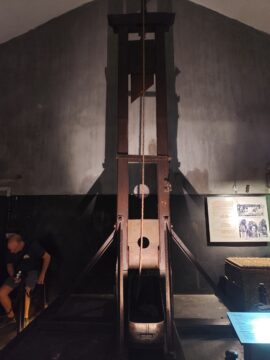
I prayed at Hoa Lo Prison, the old French colonial hell where Vietnamese freedom fighters were tortured and executed by guillotine from the turn of the 20th century until the early 1950s. The guillotine is still there, along with the small, dark, oppressive cells with concrete bunks and iron ankle restraints, calculated to break the human spirit. Most of the prison, however, was demolished for condos and malls in Vietnam’s race to development.
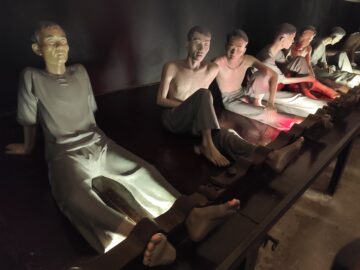
The section where American POWs were held in what the POWs called the “Hanoi Hilton” had been torn down, replaced by cheerful placards showing US prisoners playing ping pong, eating turkey and smiling with guards…no mention of torture. As a kid I had read U.S. POW accounts of sickening torture there, and walking into Hoa Lo was emotionally intense for me due to those accounts.
I silently thanked our guys for doing what they believed was right and enduring what they endured, even as I felt remorse for the devastation our government inflicted on the Vietnamese people.
I prayed for the Vietnamese who had wanted generations-long foreign oppression gone, for the hundreds of thousands of civilians who were killed, for the children harmed by Agent Orange and for our troops who, mostly, did not want to be there. I prayed for my homeland, which keeps fighting the same losing war over and over.
Phnom Penh
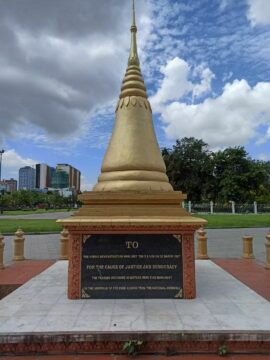
In Phnom Penh, I was led by a ghost (she called herself this to avoid disclosing her identity) to what we can call the Memorial to the Martyrs of Democracy/1997. The Cambodian government has never formally named or listed it in official government or tourism materials. Five previous versions constructed by opposition supporters were torn down before this one was allowed to stand (repeated destruction had begun drawing too much attention).
I was in Cambodia as one of the world’s longest reigning dictators, Hun Sen, prepared to hand power to his son after another rigged election. In 1997, when he feared losing power, Hun’s bodyguards apparently hurled grenades into an opposition rally killing 16 and maiming scores.
A teenage girl selling sugarcane juice had her legs blown off and died in abject pain and horror in the back of an ambulance several minutes later. An American was injured, the FBI investigated, and they think it was Hun’s thugs who did it. Many have top governmental positions now and live in luxury in a country dominated by poverty.
Under Hun’s “leadership” (he still seems to be pulling the strings) many Cambodians survive on about $3 per day, and tens of thousands of foreigners have been kidnapped, tortured and forced to work in “scam factories,” with apparent ties to individuals in government.
In Cambodia I had a dream that the ghost was the ghost of the sugarcane juice girl. In my dream, if you have a good heart and approach the memorial, a young woman dressed in white will meet you and guide you there. In my dream, she likes it when you place flowers at the site where she finally died.
I prayed for the sugarcane juice girl, that her ghost be able to rest in peace when justice is better served in this world. I prayed that the Cambodian people, who have suffered for so long, and still suffer, gain responsible and responsive government. I prayed for the tens of thousands who may feel abandoned by their governments to lives of living hell and violent deaths in Cambodian scam factories.
Tokyo
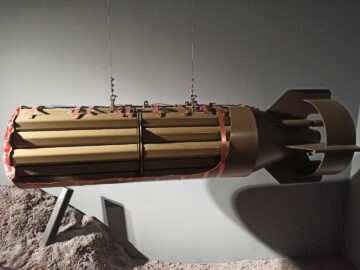
I went to the Center of the Tokyo Raids and War Damage, one of the few places that addresses the American firebombing. The photos and testimonies show plainly that the U.S. incinerated more than a hundred thousand civilians, and destroyed over 250,000 buildings in a single night. This museum is a place where the victims are able to speak about what was done to them, and how American leadership felt it had the moral right to kill innocent civilians in war time, including children.
There is another site in the city I heard of, a memorial hall in Yokoamichō Park, but I wasn’t able to visit it. Tokyo rebuilt so quickly that almost nothing marks the firestorm that killed more people (immediately) than either atomic bomb.
I prayed for the people burned alive in a war they never chose, caught between two empires that saw them as either instruments or targets. I prayed that innocent lives are no longer taken in the belief that war allows one to demonize and slaughter children.
Osaka
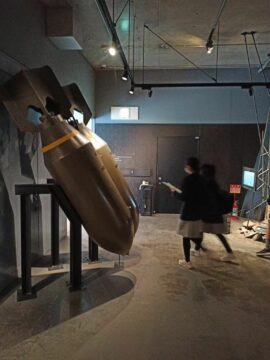
When I was in Osaka, the International Peace Center confronted militarization head‑on, reconstructing a wartime classroom to show how children were trained to see themselves as future soldiers or servants of a military regime. Before the war, Osaka was Japan’s great merchant city and, for a time, even larger than Tokyo, a commercial and industrial powerhouse rather than a military one.
The city was pulled into the conflict by a militarist elite in Tokyo who ravaged the fragile parliamentary system and dragged the country toward imperial conquest, spreading untold suffering through Asia. Osaka, which had never been a center of militarism, paid for that decision in 1945, when American firebombing reduced vast parts of the city to ash.
I prayed for the gentle and humorous people of Osaka, past and present. I prayed for people forced into wars they don’t want. I prayed for us.
Seoul
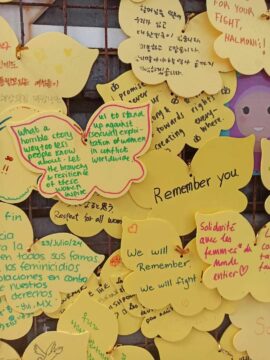
In Seoul I visited the War and Women’s Human Rights Museum, dedicated to Korean women and girls forced into Japan’s wartime system of military sexual slavery. They were deceived, coerced or kidnapped and forced into military brothels, where they endured repeated rape, horrific violence, dehumanization and lifelong physical and psychological trauma. The museum preserves their testimony and documents how survivors bravely came forward to demand acknowledgment and justice. Their voices became central to one of the most important human rights movements in modern history. God bless the Halmoni.
I prayed for all women who have been subjected to sexual violence, whether in or out of war. I prayed to end the wider pattern in which women are objectified, exploited and attacked. I prayed that sexual violence in any form must be condemned and eradicated. Dear Halmoni, there will be even greater justice in the future.
Manila
In Manila I went to Rizal Park, where José Rizal was executed in 1896. Rizal was a doctor, novelist and political thinker who confronted Spanish colonial rule peacefully but forcefully. His writing exposed corruption and awakened a sense of suppressed dignity in Filipinos. He was killed because he made colonial rule by the Spanish morally impossible to accept.
In works like Noli Me Tangere and El Filibusterismo, he showed friar abuse, colonial injustice and systemic corruption as central forces shaping Filipino life under Spanish rule.
I prayed for this peaceful warrior, and for all peaceful warriors. The right words can reach and challenge an oppressed people to take a stand. I prayed for the Filipino people still suffering from corruption and poverty, and for all who believe change can come from creative non-violence. I pray the Filipino people elect a leader and government worthy of Rizal’s sacrifices.
Kuala Lumpur
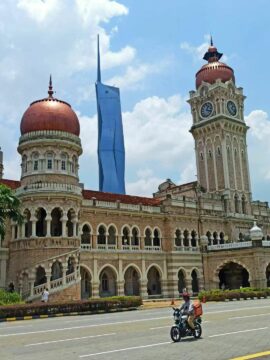
I prayed at Merdeka Square, where Malaysian independence was declared, without dismantling the system that made independence necessary. The first Prime Minister of Malaysia shouted “Merdeka!” (freedom/we are not slaves!) seven times in 1957, but the new state continued the British security system almost intact: secret police, detention without trial, counter-insurgency laws repurposed for domestic control.
The British “Emergency” (its war against communism in Malaysia) never really ended as its methods simply changed hands. Independence rested on entrenching Malay political primacy while leaving Chinese and Indian communities politically vulnerable. The square marks a beginning that has not even arrived.
I prayed for real political reform for the Malaysian people. I prayed for real political reform around the world and not just rhetoric disguising entrenched injustice.
Taipei
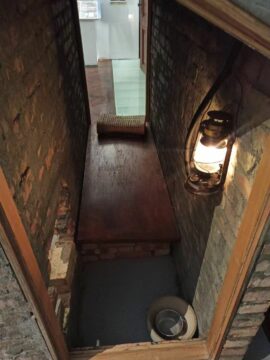
Taipei’s 228 Memorial Museum taught me about the man who hid behind his brother’s wall for eighteen years to avoid torture and death during the White Terror of Jiǎng Jièshí or “Chiang Kai‑shek.”
After losing the Chinese civil war to Mao and Zhou En Lai, Chiang dragged a rag-tag, defeated army to Taiwan and turned the island into a pressure cooker of paranoia and cruelty. Martial law, soldiers patrolling the streets, midnight knocks, interrogation rooms where “confessions” were tortured out of people. Authoritarian rule lasted from 1949 at least until 1988.
The man who hid behind the wall was Shih Ju‑chen, a Taiwanese democracy activist who became a target after the 1947 massacre known as the 228 (February 28) Incident. He had already been jailed once for resisting Japanese rule, was shot while protesting Chiang’s occupation, and joined a small left‑wing study group. When members of that group were arrested, mercilessly tortured and then executed, Shih understood exactly what awaited him. He hid in a space sixty centimeters wide while the regime raped his wife, tortured his parents and jailed his uncle. He died in 1970 from lack of sunlight.
I prayed for Shih and for all who are still hiding, figuratively or literally, waiting for repressive regimes to fall so they can emerge and live like human beings. I prayed for all repressive regimes to fall like the walls of Jericho.
Hong Kong
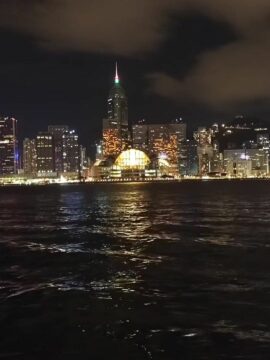
In Hong Kong I prayed along the Tsim Sha Tsui waterfront, where the Qing government’s authority was erased after the Opium War. When Britain imposed the Treaty of Nanking onto the Qing, one of the first acts of colonial consolidation the British committed was to dismantle the customs station there and absorb the land into the colonial harbor system.
I prayed for Hong Kong because it did not become a paradise after the British conquest. Frankly, it is a mess of social problems to this day due to the colonial conquest. The entire housing market is engineered to keep prices artificially high because the government has traditionally relied on land sales for revenue. That means tiny subdivided flats, “nano apartments,” illegal rooftop shacks and whole families living in spaces the size of a parking spot. Many elderly men live in “cage” apartments (it’s exactly what it sounds like). Hong Kong’s housing crisis was created this way under British rule. Another major problem is inequality. Hong Kong has one of the highest Gini coefficients in the developed world. The wealth gap is obscene and getting worse.
Hong Kong is aging fast, and many older people live alone in tiny flats, surviving on meager pensions. Young people feel locked into a future where they will work 60 hours a week for a room the size of a closet. High-pressure schooling, long work hours and social isolation have created a mental health crisis with suicide rates among youth and the elderly persistent and troubling.
I have lived in Shenzhen, just across the river on the “mainland.” Shenzhen is a city of new housing, rapid construction and a government that treats livable space as infrastructure rather than a luxury commodity. The contrast is so sharp that, frankly, I find myself praying for Hong Kong to be integrated more fully into a system that can actually solve its housing crisis and other problems. I am convinced the mainland has the capacity and the political will to fix problems that Hong Kong’s old colonial-era structures have left untouched for decades, for the sake of the people there.
Nanjing
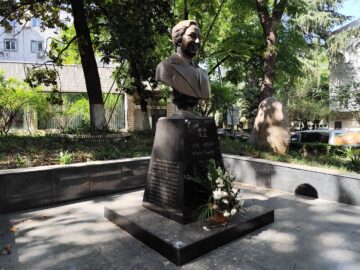
I visited the Memorial Hall to commemorate the lives of the 300,000 civilians who were massacred in Nanjing in the late 1930s by the Japanese military. There is a large, darkened room where countless photos of victims are displayed from floor to ceiling. Walking through this space is a heart-breaking experience, as you can see the individual personalities, the humanity in each person, the whimsy and mirth, the kindness, studiousness, sincerity, the basic decency and innocence of these people who were murdered, often in horrific ways.
The individual Japanese soldier had been taught to believe that he was a member of a superior ethnic group and he was encouraged to show contempt for non-Japanese. To demonstrate his superiority to his peers, he was encouraged to overcome, as it were, that sense of emotional pain we feel when confronted with the suffering of others and to openly and gleefully cause pain and death. Nanjing was just one of many massacres and atrocities committed by the Japanese military during World War 2.
I prayed that we recognize the lie in the argument that someone deserves suffering because they are different or because we can rationalize our hatred to cause harm. I prayed that we stop believing we have the right to hurt others because we hate them.
Ho Chi Minh City
At the War Remnants Museum, the Agent Orange room is almost unbearable. Among the exhibits are photographs of the horrible deformations that children are born with, to this day, in Vietnam, because we created a defoliant to destroy their jungles. The horror of the photos is overwhelming. It was so difficult to get through that room. Dioxin persists for decades; its effects span generations. Vietnam estimates 400,000 killed or permanently injured, two million ill and half a million children born with defects.
In my silent prayer I thought of the generations of Vietnamese families who have lived with the consequences of dioxin, the children born with conditions they never chose, the parents who have carried grief for decades and the communities still living with the effects of a war they did not ask for. I prayed for the strength of those who continue to care for those harmed long after the war ended.
Bangkok
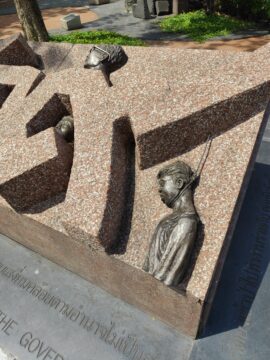
In Bangkok I was guided by another ghost to the Thammasat University Massacre Memorial, in remembrance of the students who were murdered in 1976 by police and paramilitary groups. From 1973 to 1976, Thai students created the only real democratic opportunity Thailand has seen since the 1932 “revolution” which removed power from the king and gave it to the military.
Their protests in 1973 forced the military out of direct power. In the three years that followed, students, workers and intellectuals built an open political space: independent newspapers, unions, public debates, new parties and a functioning parliament.
The massacre on 6 October 1976 was the violent destruction of that student‑built democracy. One of the most haunting images of modern Thai history is of the student who was hanged at Thammasat, by people so filled with hate that they are beating his hanging corpse with folding chairs.
What do you pray for when you’re standing on ground where a country killed its future? In my silent prayer I held the memory of the students who were killed at Thammasat. I prayed that they are remembered and their lives continue to inspire peaceful change and a future where such violence is unacceptable. I prayed for true democracy in Thailand, the people want it and deserve it.
Denpasar
In Bali, there is a large monument in Denpasar called Bajra Sandhi, built to commemorate the Balinese struggle against Dutch colonial rule from the 19th century through the mid‑20th century. The core historical event behind it is the series of Puputan, mass, last‑stand confrontations where Balinese rulers, soldiers and civilians chose to fight to the death rather than surrender to Dutch forces.
In the 1906 Badung Puputan and the 1908 Klungkung Puputan, Balinese leaders refused colonial terms and royal courts marched out in ceremonial dress to face Dutch rifles. Thousands died in these confrontations and they became the defining symbol of Balinese resistance to Dutch rule.
In my silent prayer I honored the Balinese who chose death over abandoning their way of life.
Yogyakarta
On Java, in Yogyakarta, the 1 March 1949 General Offensive Monument honors Indonesians who fought to assert independence against Dutch reoccupation after World War 2. It marks a coordinated Indonesian military operation during the Indonesian National Revolution. On that day, Indonesian forces under Lt. Col. Suharto launched a six‑hour assault that temporarily retook Yogyakarta. The goal was to prove that the Republic still had operational capacity after the Dutch claimed it had been thoroughly defeated.
In my silent prayer I honored the Indonesians who carried out the 1 March Offensive, the soldiers, civilians and organizers who risked everything to show the world that their struggle for independence was still alive. It was a grand moment of apparently hopeless defiance, but it worked. I prayed for more hopeless defiance, it usually works.
New Delhi
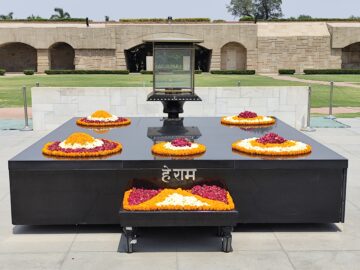 In New Delhi, I went to Raj Ghat, close to Gandhi’s cremation site. This represents where the violence of empire was peacefully defeated by moral resistance. I prayed for those who try to meet power with conscience, who attempt to answer domination without becoming what they oppose. Here’s to those who look inside themselves and choose goodness unconditionally and then work to make sure their goodness has a real and tangible effect in the world.
My article about insights I derived at Raj Ghat: https://3quarksdaily.com/3quarksdaily/2026/05/gandhi-and-the-move-from-micro-to-macro-morality.html
Enjoying the content on 3QD? Help keep us going by donating now.