
by Andrea Scrima
A few years ago, when I learned that a large trove of photographs taken, for tax purposes, between 1939 and 1941 of every building in each of New York City’s five boroughs had been digitized and published online, I set out to look for my parents’ birthplaces. Sitting at my desk in Berlin, I suddenly found myself on East 148th Street between Brook and St. Ann’s Avenues, searching for the building my mother’s grandparents purchased with the earnings of the family business after arriving in New York in the late nineteenth century. I remembered that I’d seen it in the background of an old family photograph, and so I fetched the ladder and hauled down the heavy tin box and found the picture in an old manila envelope marked “Bronx.”
My mother had been dead for several years, but here, in this sepia-toned, scalloped-edged photograph, she was a little girl of three or four, her sister eight or nine. It was summertime, she and Frieda were wearing sleeveless white dresses, and they each had a white ribbon in their hair. My mother’s right hand was resting in her sister’s lap; they were sitting on a low stone wall, scowling. Heavy shadows hung over their features, and it was difficult to tell if they were angry or merely squinting in the bright sunlight. And then I saw that what I’d long taken to be a metal grate or fence of some kind in the background was actually a stretch of arched windows reflected in a large fountain or pool.
My discovery that it was not, as I’d long believed, the steps of my great-grandparents’ building that the two were sitting on was due to the fact that I’d finally found it, found 516 East 148th Street in the online archive of the New York City Department of Records and Information Services. It was a respectable-looking five-story brick structure with flower boxes on the windowsills; it had long since burned in the Bronx fires of the 1970s and been torn down. I wondered what floor they’d lived on. My mother and her sister had grown up there, attended P.S. 27 around the corner and played in St. Mary’s Park across the street from the school.
Holding their photograph in my hands and staring at the screen before me—at this building I’d gone searching for once, many years ago, only to discover that the lots had long since been redrawn and that the house number, which would have been one last trace of the vanished building, no longer existed—I felt caught in time between the two images, and all at once I understood that this picture of my mother and her sister scowling in the sun was, at the very moment a city employee photographed the building nine or ten years later, resting in a box somewhere behind that brick façade; that it was, in some form, physically present in the image, and that a twelve- or thirteen-year-old version of my mother was somewhere nearby, absent from this photograph of 516 East 148th Street, but alive and breathing; a seventeen- or eighteen-year-old Frieda, alive and breathing, just outside the camera’s frame, perhaps, or indoors, doing schoolwork.
The photograph seemed to have been taken from an empty lot across the street; in front of the building was a parked car with a man standing next to it, bent over the trunk. He looked tall and elderly, and my great-grandfather would have been tall and elderly, but his face was concealed and there was no way of knowing if it was him. There was, of course, no way to cross the street and enter into that sunny summer day, but I didn’t fully understand that yet, and so I zoomed in and out, and looked and looked, waiting, perhaps, to discover some previously unnoticed, all-important detail that would magically grant me entry into a lost time. I consulted a map for the Block and Lot numbers of the building next door and entered them into the search box, and there the building was again, this time only partially visible, with the camera pivoted to the left and centered on the adjacent structure. In both photographs, a young woman whose face, already blurry, dissolved into shades of gray when I attempted to zoom in closer was sitting on the front step of the neighboring building. A man in a white undershirt was seated on a windowsill two floors above; he, too, was visible in both photographs, but too far away to distinguish his features clearly. They were irretrievable, forever unknowable, and yet my mother must have known their names, must have said hello to them on a daily basis. I decided to look up the property across the street and found the empty lot that my great-grandparents’ building had been photographed from; lines of laundry hanging in the courtyard were visible behind it, and in the foreground, to the very left of the frame, a corner of my great-grandparents’ building, closer now and flanked by the wooden fence of the building next door. But there must be more, I thought, surely I can find more, and eventually I discovered that entering the Block number on its own yielded a suite of thumbnails at the top of the page corresponding to a continuous section of the street. And so I made my way, building by building, down East 148th Street: six doors down was a sign for a moving company and what looked like a moving truck; a little farther down the street, two girls on roller-skates were taking a break on the sideboard of a 1937 Ford V8 to watch the photographer take a picture of the building behind them.
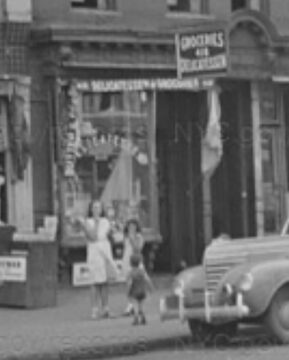 By the time I arrived at the corner of 148th Street and St. Ann’s, I was restless; they had to be somewhere, my mother and Frieda had to be somewhere on this hot summer afternoon, and so I set out to search for my great-grandparents’ store, a German delicatessen my grandmother had begun helping out in at the age of fourteen. Maybe that’s where my mother went after school that day, I thought, and so building by building, I scoured the neighborhood and eventually a good part of the South Bronx, scrutinizing every delicatessen I could find. Standing outside a little shop on Brook Avenue near the corner of 144th Street were two girls, and like Frieda, the older girl was wearing glasses. They were holding ice cream cones, or maybe they were eating dill pickles, but although the ages corresponded, and it even looked a little like them, I didn’t think that my great-grandparents would have set up their business four long city blocks away. I found another delicatessen on the corner of Brook Avenue and 147th Street, much closer to home, with a different two girls standing out front, presumably sisters, and while they were clearly not my mother and Frieda, I was taken in by them. They were wearing identical short-sleeved floral-print dresses with white trim, and because they had similarly slender bodies and the same long dark hair, it was easy to think they were twins. When I studied the photograph more closely, however, I discovered that one of the girls was standing perhaps two feet nearer to the camera. The doubling of frocks left and right, the perfect alignment of heads, the way they were facing away from the viewer gave rise to a symmetry that presented itself as fact. I told myself that the two girls only appeared to be the same height, that if they were standing side by side, one would be nearly a head taller than the other, yet the illusion persisted. They were standing in the building’s shadow, gazing across the sunlit sidewalk and 147th Street; the younger girl had her hand to her mouth in a gesture of pleasurable anticipation. On the other side of the street was a horse-drawn cart that appeared to be parked at the curb, but it was the boy in a striped shirt coming in their direction, captured against the cart’s huge spoked wheels, who was the object of their attention. He was looking down at his hand, he was holding something, but I couldn’t see what it was because his small figure was hidden below the waist by the tax assessor’s sign, mounted on a thin pole and positioned a few feet from the camera.
The delicatessen at the corner of Brook Avenue and 147th Street appeared in another photograph of the New York City Department of Records and Information Services, in all likelihood taken the same day. Crossing the street on the other side of the avenue—oddly, because although passersby don’t often feature in the archive’s images, each of the day’s searches seemed to yield girls or women in sets of two—was, once again, a pair of young women; in the background, barely visible, was the display for Ruppert’s Beer in the storefront window, and above it the striped awning. The two women were gazing directly at the camera, frozen mid-step, their arms mid-swing, and the way they were paired reminded me of the two girls standing outside the shop a short time before. The woman on the left was carrying a large package on her shoulder, and the bend in her knees, in contrast to her friend’s easy gait, betrayed its weight. The sun was coming from the east; judging by the length of the shadows, it was mid-morning. While the woman on the left had on high heels, her companion was wearing oxfords. The heel of her left shoe had just touched the pavement; the ball of her right foot was about to leave the ground behind her. It was a sunny summer day, she was squinting at the photographer, whom she would forget, perhaps, only a moment later, yet in the picture she was suspended mid-stride, gazing into the camera, the middle section of her body covered by the tax assessor’s sign, frozen in place and crossing 147th Street forever.
In the mid-nineteen-fifties, after her husband died, my great-grandmother sold the building at 516 East 148th Street and moved, together with my parents and grandparents, to Staten Island. She was in her eighties, she was implacable, and she’d long resisted the unmistakable signs that the urban decay eroding the Bronx would continue and that she was powerless to prevent it. Twenty years previously, the government-sponsored Home Owners’ Loan Corporation had drawn up maps that color-coded city districts across the U.S.; although it was a thriving mix of Jewish, German, Italian, and Irish immigrants, the South Bronx had been deemed a “hazardous” place to grant credit or underwrite mortgages and was consequently coded red and given the classification “D,” the worst grade possible. The lines had been drawn based on the belief that an influx of Blacks was a sign of inexorable demise; as the “redlined” neighborhoods were starved of investment, and more and more whites abandoned them for the suburbs, the value of the properties plummeted. By the time my great-grandmother finally agreed to sell the five-story building at 516 East 148th Street, it brought just enough to purchase a small two-family. I’m not sure what her views on institutionalized racism or inner-city racial segregation were; it’s unlikely that she understood the precise forces contributing to the rapid decline of the Bronx. Perhaps she believed, as many European immigrants did, that the stark increase in the Black population following the Great Migration from Jim Crow and the rural South was the culprit, but somehow, I don’t think so. She was a businesswoman, with an instinct for business shenanigans, plenty of which were and had always been afoot in New York and had eventually nibbled away a substantial part of the fruit of her life’s labor.
 When I eventually made an appointment with the New York City Municipal Archives in downtown Manhattan to search the data bases for my great-grandparents’ store, it took two days of poring through documents on microfilm until I finally found an entry in a 1909 telephone directory: William Sticker, Delicatessen, 3711 Third Ave. I almost couldn’t believe my eyes; I spent a considerable amount of time trying to make a legible photocopy from the strip of microfilm, and then made three. I’d found it at last, and contrary to expectation, it was farther north and not in the neighborhood the family lived in, at least not in 1939. And then it occurred to me that they must have long since given up the shop and retired. When I looked up the address in the image base, I found a photograph of an empty storefront gazing blankly in the early-morning sunlight. The crisp shadow of the elevated train that once ran along Third Avenue was visible on the pavement, a latticework pattern cast by the wooden stringers and metal rails overhead; a 7 Up sign was still hanging outside, but perhaps it belonged to the candy store next door. I stared and stared, trying to will myself into the murky space behind the reflections on the plate-glass window. There was a sign taped to the glass, but of course it was illegible.
In 1961, the year after I was born, the family moved again, to a two-family house on the south shore of Staten Island. It was part of a new settlement that hadn’t yet been built at the time the photographs were taken for the New York City Dept. of Taxation; the area still consisted largely of wetlands that spread inland from the Atlantic shoreline. I scoured the website and found a structure on nearby Hylan Boulevard, a diner called “Park Lunch” with a sign hanging out front that read “Eat.” The photograph had been taken in the winter; the pavement was covered in slush. Evidently, the photographer couldn’t get the tax assessor’s sign to remain straight; his hand was jutting in from the right of the frame, holding “3649–59 R” in place. Directly below the man’s arm, in the distance, was a fire hydrant. This was the first photograph I’d come across in the archive in which the person of the photographer was present in any way. His arm was covered in a black coat sleeve, his hand in a dark glove; judging by the wet street, it must have been just above freezing. He would have spent the entire working day, day after day, outside in the damp cold; perhaps he took breaks at Park Lunch and warmed up with a cup of coffee. Somehow, and I knew that my imagination was playing tricks on me, even though Staten Island was still largely rural in 1940, and would remain so for another twenty-four years before the Verrazano Narrows Bridge connecting it to Brooklyn was built and set off the first serious influx from the other boroughs of New York City—and even though it was still a small-town road dotted with the occasional neighborhood business and not the congested artery of supermarkets, used-car dealers, diners, nail salons, and fast-food chains it later became—something about the Hylan Boulevard of 1939 nonetheless felt familiar. I grew curious; I checked Google Earth. There was now a Kentucky Fried Chicken where Park Lunch used to be, and when I used the swivel function to view the other side of the street, I saw the fire hydrant, in all likelihood the same hydrant, in the very same place it occupied eighty years ago.
All at once, it occurred to me that six years before purchasing the two-family on the south shore of Staten Island, the family had first moved to Greenwood Avenue, near Silver Lake. I had no memories of this earlier house, but recalled a photograph of my father holding a dog on a leash and standing in front of an older clapboard structure. Surely it must have been there in 1940, I thought, and I searched for it on the archive website—and there it was, and once again, out front, was a pair of women. Here, too, it was summer, and the two were dressed in identical-looking white short-sleeved belted shifts and high-heeled shoes. The woman on the left was wearing ankle-high nylons; her hands were resting on her hips. Both appeared to be middle-aged; they were contemplating something on the walkway, a planter, perhaps. It looked like they were trying to decide what to do. At the curb was a garbage can and two cardboard boxes; perhaps they were throwing something out, discussing how best to break it up, and while I knew that these women were not and could not possibly be my mother and her sister—my mother would have been twelve at the time, and it was ten years before she met my father, fifteen before they moved into that very house—a strange feeling nonetheless took hold of me. Were they sisters?
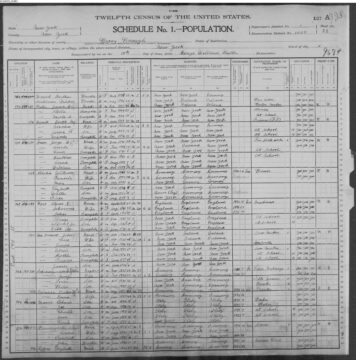
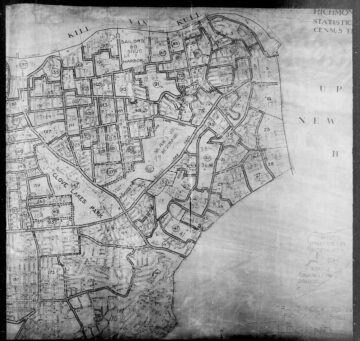 The digitized files of the federal census documents were held in the National Archives Catalogue, and a greater degree of persistence was required to navigate them. It was time-consuming, and tedious, but the handwriting on the large spreadsheets or “Population Schedules” drove home the realization that these were the original paper forms attached to the census-takers’ clipboards, and I thought about these men—and they were all, as far as I could tell, men—recording the information in the designated boxes while standing on the doorsteps and thresholds of people reluctant to invite them inside. I entered the street name “Greenwood Avenue,” and two multiple-paged documents appeared for Census Enumeration Districts 43–49 and 43–52A, which purportedly covered the length of the small street and its environs. Moving from page to page, however, each of which took several minutes to load, I realized that the addresses hadn’t been properly indexed: the Population Schedules for Greenwood Avenue were missing entirely. I consulted a map and entered the name of a street around the corner, upon which I discovered that a section of Greenwood Avenue appeared in a different Enumeration District, namely No. 43–52B. This document was larger and took longer to load, and when it finally appeared I progressed through the pages, trying to decipher the street names penned sideways along the left margin, some of which were bleached out in the scan. On the pages containing Greenwood Avenue addresses, the house numbers ended part of the way down the block. What if the census taker hadn’t bothered to walk the full length of the street? I tried another census district nearby, which brought me to the south end of the park. As I scoured dozens of Population Schedules, watching the “Preparing Image” icon do its barber-pole rotation each time, I realized that block by block, first in one direction, and then in another, I was drifting farther and farther away from Greenwood Avenue. I no longer knew what I was searching for; I grew agitated. I had pored through countless districts, I’d examined each census page carefully, but I was afraid that I’d somehow missed it—and as I began to realize that while I might never find 36 Greenwood Avenue, or learn the names of the two women, it seemed to me that they held the key to something I urgently needed to know. I backtracked, checked my notes; I had more than twenty tabs open on my browser. Once again, I opened the website with the tax photo of the building and studied the sequence of thumbnails at the top of the page. When I clicked on the one to the far left, I unexpectedly found another image of the two women. This time, the object of the photograph was the house next door, but there they were again, standing off to the side, facing each other: the woman on the left still had her hands on her hips, they were still deliberating, but this time I could see quite clearly that the object before them was a playpen. I returned to the only Population Schedule that included at least some part of Greenwood Avenue and noticed that the house numbers began with three digits and suddenly dropped down to two: what an odd sequence of addresses, I thought, Greenwood Avenue is a cul-de-sac, it’s far too short a street to warrant house numbers in the hundreds.
Another hour had gone by; my thumb was starting to ache from the touchpad. There was no house number 36 in Enumeration District 43–52B of the 1940 census, or anywhere else, for that matter, and although I knew from the New York City Department of Records and Information Services that the house had been built in 1931, and that it existed—that the two women and the crib and the boxes at the curb and the trash can had existed—I was beginning to understand that I might never find them, might never find these people who’d lived in the house my great-grandmother would purchase fifteen years later. Would it matter to know that the house numbers on Greenwood Avenue were reallocated somewhere between the day the census was conducted and the day the photograph was taken, presumably that summer or the summer after—and that No. 316 had been changed to 36? Would it matter to learn that the occupants were not the building’s owners, but renters; that a Mary Campbell, aged 55, lived there with her husband and two daughters, Mae and Lillian; that a Ruth Houseman, who was listed as Mary’s 32-year-old sister and also lived there with her husband and three children, was, according to the censuses of 1930 and 1915, in fact her daughter and spelled her married name without an e? And then I saw it: on Line 69, the youngest, Kenneth, was listed as “nephew,” “male,” and one year old. The crib on the walkway the two women were setting up that sunny summer morning on Greenwood Avenue was for none other than Mary’s grandson, little Kenneth Housman, but I can find nothing to explain the falsehood, apart from the fact, gleaned from an earlier census, that Mary had also, at one time, had a one-year-old boy, and had lost him some twenty years previously.
(Excerpt from a novel-in-progress)