
by Rafaël Newman

Amid the present surfeit of geopolitical obscenities, one incident is distinguished—by the absurdity of its moral aesthetics. On April 20 this year, the New York Times reported that the Israeli military was investigating an IDF soldier who had allegedly sledgehammered a statue of the crucified Jesus in a village in southern Lebanon. Local Lebanese authorities and Christians in Israel expressed their dismay; the Israeli army condemned the soldier’s actions as “wholly inconsistent with the values expected of its troops” and noted that it was assisting the affected community with the restoration of the statue; and Prime Minister Benjamin Netanyahu promised “appropriately harsh disciplinary action against the offender.”
Setting aside for a moment the grotesquery of solemn protests at vandalism perpetrated on a depiction of the putative son of God while the IDF has been murdering with impunity actual children of God in Lebanon, Gaza, and Iran, the soldier’s alleged actions might be considered under two opposed aspects. One could understand, even empathize with his (presumed) rage at the image of a suffering Jew serving as the central symbol of a religion whose central tenets are love and forgiveness. At the same time, however, it seems that the soldier will have thus misunderstood the more crucial (and more sinister) theological message of the crucifixion, which is that human sacrifice is not to be renounced, as promulgated by the Old Testament parable of the Binding of Isaac and by the consequent Jewish rejection of Christ as the Messiah, but rather that such sacrifice may, in fact, be necessary for redemption: and that such a message is one of profound and important significance for Israel’s current campaigns in the territories that surround it, where the lives of civilians are being treated as necessary collateral damage in the pursuit of Israel’s (and, as it happens, Netanyahu’s own) larger aims. And that it thus serves as a ready justification of that same soldier’s other, more lethal actions in Lebanon.
As for the Israeli administration’s severe condemnation of the soldier’s alleged action, that likely has a different, more cynical motivation: namely, the fear of offending, and thus alienating, the vital American lobby of Christian Zionists. Their support for Israel depends in turn on a Messianic vision in which Jews must assemble in the Holy Land to prepare a path for the spiritual redemption of the world: exiled for millennia, Jews are now to perform Aliyah, in the Zionist terminology, to “go up,” or ascend, to the Land of Israel, and thus to fulfil, as human sacrificial victims, a millenarian plan.
This invidious support, finally, is crucial to the continuation of US financing for the Israeli military, which is currently in jeopardy not only on account of the unpopularity of US involvement in Israel’s various fronts, but also because, as the Times reports, Israeli attacks on Christians and Christian sites have been on the increase generally since October 7, 2023. It is therefore a matter of national security for Netanyahu to declare that “Israel cherishes and upholds the Jewish values of tolerance and mutual respect between Jews and worshipers of all faiths,” and to publicly decry the defacement of an image of the crucified Jesus, who is thought by Christians to have redeemed the world from sin with his sacrifice and paved the way for the return of the exiles, whose exalted transport to the Holy Land and preparation of the End Times was prefigured by his own death, resurrection, and removal to heaven.
In House of Day, House of Night (1998; English translation 2002, reissued 2025), Olga Tokarczuk invokes this same Christ, albeit under a rather different aspect, in her prose portrait of Silesia, in what is now southwestern Poland, but which was, until 1945, part of the German Reich. Tokarczuk’s characters include present-day Poles as well as Germans in the 1940s, deported to make way for the citizens of liberated Poland, themselves transplanted from the newly Soviet east, who took possession of the Germans’ properties along with the valuables their predecessors had left hidden there.
Among those Polish settlers is Marta, a shaman-like figure who affords the narrator comfort but is “not a therapist at heart” and “doesn’t try … to work out the chronological order of important events by asking, ‘When did it start?’” A signal feat of self-restraint, the narrator reasons; because after all:
Even Jesus couldn’t resist the pointless temptation of asking the madman he was about to heal, “So when did it start?” But in fact the most important thing is what’s going on here and now, right before your eyes,and questions about the beginning and end tell you nothing worth knowing.
In a region like post-WWII Silesia, Tokarczuk seems to be suggesting, it might be particularly difficult not to pose “questions about the beginning” (if not, perhaps, the end) of the current state of affairs. How did Polish settlers come to occupy the homes of their German former owners, in other words? Where did those Germans go? And why did they leave so many treasures behind them when they left?
Two recent, non-fiction publications have (happily) succumbed to the same “pointless temptation” as Tokarczuk’s Christ—to ask how the settlement of Palestine, a region even more violently contested than Silesia, began: or rather, to suggest how its history might have ended differently. Here Where We Live Is Our Country: The Story of the Jewish Bund (2026), by Molly Crabapple, tells the story of the secular, socialist, anti-Zionist movement dedicated to fighting for a Jewish life outside of Palestine, in the countries where Jews happened to be living. (Because, as Tokarczuk reminds us, “the most important thing is what’s going on here and now, right before your eyes.”) Indeed, the Bund believed that the project of settling Jews in Palestine was not only wrongheaded escapism, but a form of nationalism offensive to its progressive, universalist politics.
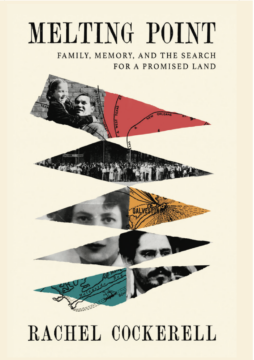 Rachel Cockerell’s Melting Point: Family, Memory, and the Search for a Promised Land (2024), meanwhile, is an idiosyncratic and utterly absorbing archival documentation-cum-family history that recounts the efforts to settle Jews anywhere but Palestine, in the early 20th century, and thus to save them from death at the hands of Russian pogromists without creating new hardships. In a fabric of citations deftly sutured together from contemporary accounts, Cockerell ventriloquizes the celebrated story of Theodor Herzl and the World Zionist Congress, the less well-known story of the British-Jewish playwright Israel Zangwill and the splinter group known as the Jewish Territorial Organization (ITO), and the heretofore mostly unknown story of her own great-grandfather, David Jochelmann, whose work for the ITO, which had been foiled in its attempt to adopt the British government’s “Uganda plan” for Jewish resettlement, involved moving thousands of Russian Jews to safety in Galveston, Texas, in the early years of the 20th century, before the First World War changed everything.
If the Galveston Plan had been successful, it would not only have better distributed new arrivals from Russia around the country, alleviating the ghetto-like conditions prevailing among Jewish immigrants on the East Coast of the US; it might also have relieved the Zionist pressure to colonize Palestine. And thus the modern history of that region might be completely different—it might have started, and thus ended, differently, in the words of Tokarczuk’s Christ—and its inhabitants, both Arabs and Jews, might not have been subjected to suffering over the past eight decades on behalf of an exogenous religious vision.
This past week, Christians in various parts of the world celebrated Ascension, the day on which Jesus is believed to have risen bodily to heaven. Ascension, which comes 40 days after Easter and is thus movable in the secular calendar, happens in 2026 to have coincided with the week in which Palestinians observed Nakba Day, on May 15, the day after Israelis marked the 78th anniversary of the Israeli Declaration of Independence.
On May 14, 1948, the Zionist dream of Aliyah, of Jews “ascending” to the Biblical land of their forefathers, became a political reality, one for which thousands of Palestinians had been relocated or murdered to make way for the settlers. Settlers who continue to relocate and murder Palestinians to this day, supported in their work by Christian Zionists in the US, whose own designs are driven not by compassion for the well-being of Jews, in Israel or elsewhere, and still less for that of Palestinians, but by a will to sublimate all of their earthly forms in the fulfilment of a promise made by a religion born of their region, but since spread well beyond it: the redemption of all humanity and its transport to a celestial afterlife, following their savior Jesus Christ, who, Christians believe, ascended to his Father in heaven following his death on the cross and resurrection from the tomb. A grisly prefiguring of the intended fate of Israeli settlers, and, incidentally, of the actual fate of those they have since displaced.
To which members of the Jewish Bund (and perhaps David Jochelmann of the ITO as well) might respond, in the Yiddish of their roots in Eastern Europe: Nisht gestoygen un nisht gefloygen—“He didn’t climb and he didn’t fly.” In other words, as Michael Wex glosses that sarcastic expression in Born to Kvetch: Yiddish Language and Culture in All Its Moods (2005): “Bullshit.”