
by John Allen Paulos
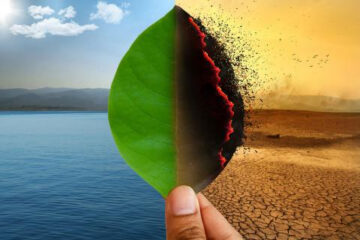 Donald Trump has famously called climate change and global warming a hoax. Ignorant and benighted as he is, he is far from alone. Skepticism about global warming and its causes is widespread. One overly kind reading of this skepticism is that it is, to an extent, a consequence of the general problem of dealing with very big numbers and very small numbers. Such numbers fall outside people’s familiar mid-size range, and so intuition about them isn’t well-developed. Also unfamiliar to most are the effects of exponential growth or decline.
To illustrate the latter, let’s first consider a classic illustration of exponential decline and the huge effect of repeated tiny declines over time. Say you put $1,000 into a bad investment and it loses just 1/10th of one percent of its value every day. After ten years when you finally sell, it will be worth $26. ($1,000 x .999^3,650 = $26)
Money can be discussed with some precision but, having mentioned Trump, I note a different kind of very steep decline. Small erosions of political norms and practices can lead over time to a similar enormous decline as in the monetary example above. An increase in daily lies and misinformation leads inexorably to growing suspicion of politicians’ motives and then to policies tainted or even dictated by special interests. At first this is somewhat tolerable, but over time these transgressions metastasize and the body politic becomes dysfunctional.
Relevant to the above sort of examples is the notion of a discount rate. It arises when we consider the question, What is the worth now of something of value (or of negative value) in the future? In the example above, the $1,000 you invested ten years ago is now worth only $26 (given the assumption of its daily decline). Unfortunately humans tend to posit a steep temporal and spatial discount rate for distant or future events. The events are discounted in the same way that money is, whether the money is a reward to be received or a debt to be paid. If, for example, we incurred a million dollar debt that is scheduled to be collected from us twenty years from now, the debt would be considerably smaller and easier to bear were we able to settle it now by paying its present value. Depending on the discount rate, the creditor might be willing to receive $200,000 from us now instead of $1,000,000 from us in twenty years,
Back to global warming. The relevance of a short-sighted high discount rate to a future with greenhouse gases, extinct species, uninhabitable cities, and other related effects is unfortunate to say the least. The discount rate gives an estimate of the present assessment of future environmental damage, and so a high discount rate of future environmental costs minimizes the estimate of their present cost. A high rate thereby fosters short-term thinking and despoliation and affects how much we’re willing to sacrifice now for a cleaner future.
One can cite example after example where tiny but repeated changes have outsized consequences. Evolution itself indicates that tiny physiological and environmental changes over thousands of generations of plants and animals naturally lead to extensive divergence and variation.
One particular example I’ve always liked (especially since as a kid I had similar thoughts) provides a vivid illustration of the psychology underlying the dismissal of global warming. It shows that the consequences of our decisions need not occur in the distant future for us to discount them. They can occur out of sight or after so many steps as to seem distant. The example (embroidered a bit here) appears in Derek Parfit’s book “Reasons and Persons,” where he discusses the case of a man strapped to a hospital bed, say by a psychopath, in some indeterminate place with electrodes attached to his heart. Rotation of a dial on the other side of the world minusculely and imperceptibly increases the current in the electrodes and the stress on the man’s heart.
Perhaps a free piece of candy, a pleasant buzz, and a snapshot with the dial are on offer from a mysterious donor as an incentive to anyone in the distant location who twists the dial. Assuming it takes 10,000 people, each rotating the dial once to electrocute the victim, what degree of guilt, if any, do we assign to each individual dial-twister? After all, none of the dial-twisters know the poor man in question nor have they ever been in his part of the world. They might well doubt there is such a man if the situation isn’t clearly communicated to them or if it is ridiculed by a few influential people. Whatever their excuses, however, they are likely to be at least vaguely aware of rumors about the situation. How then do we deposit all these tiny bits of personal guilt into some moral bank account to save the victim. Or do we just shrug and dismiss the significant probability of ordinary indifferent people killing the distant stranger?
The real question of course is, What is the impact of thousands of small environmental or personal abuses over time? In the context of this rather morbid tale of a psychopath, most environmentalists would probably opt to stop rotating the dial or at least to rotate it very infrequently. They would also probably try to find other sources of candy (in reality wind and solar rather than oil and gas).
Trump and the “drill, baby, drill” people, on the other hand, would perhaps argue that it takes many, many more than 10,000 twists of the dial to stop the victim’s heart. Or perhaps they would argue that the free candy we get until the eventual electrocution is worth it, or else they’d come up with some other rationale for indulging their sweet tooth.
The inconvenient truth is that the electrodes are attached to the heart of our planet. Moreover, the dial twisters are the normal people who are the psychopath’s somewhat unwitting allies.
***
John Allen Paulos is an emeritus Professor of Mathematics at Temple University and the author of Innumeracy and A Mathematician Reads the Newspaper. These and his other books are available here (https://johnallenpaulos.com/booksandreviews.html).
Enjoying the content on 3QD? Help keep us going by donating now.