
by Mary Hrovat
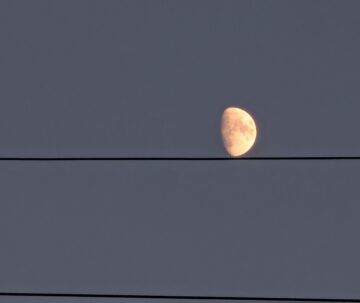
I’m tired of hearing about parades of planets. That term is used by astronomers to describe the presence of more than a few planets above the horizon at one time. Although it’s genuinely unusual to have five or six planets above the horizon at the same time, it’s not always an impressive sight for casual viewers. Moreover, the term is sometimes used rather loosely, and some sources provide incorrect or incomplete information about what constitutes a particular parade or how easy it will be to see.
The only planets that are reliably easy to see without optical aid such as binoculars or a telescope are Venus, Mars, Jupiter, and Saturn (and, of course, Earth). The visibility of even those four planets depends on how high in the sky they are. A recent parade of planets included a few that were very low in the west after sunset, which made them difficult to spot. It wasn’t much of a parade, in my opinion. Moreover, you’ll need optical aid and fairly dark skies to see Uranus and Neptune, and you’ll need to know your way around the sky well enough to locate them.
Moreover, the images that accompany some stories about planetary parades are misleading. Planets may be more spread out on the sky than the drawings indicate, and if they’re not at their brightest, they might not stand out well against a starry background.
The most egregious example I’ve seen so far is a recent Facebook post, which claimed that Mercury, Mars, and Saturn were aligned in the same part of the sky and were visible to the naked eye under clear conditions on the morning of May 1. According to a much more reliable source, Sky & Telescope’s Sky at a Glance for May 1–9, Mercury is invisible because it’s too close to the sun in the sky, and Mars and Saturn are very low in the east before sunrise and require at least binoculars to be seen.
In addition, the post claims that the alignment of these three planets is rare. However, there’s nothing unusual in the fact that the planets appear roughly along a line in the sky. The planets all orbit in more or less the same plane, and they appear along the zodiac, a region of the sky that includes the path that the sun appears to follow through the sky (which is called the ecliptic). Loose lines of several planets, as well as tighter gatherings of two or more planets aren’t frequent events, but they’re not uncommon.
If you’re interested in learning about what’s happening in the night sky, I’d recommend checking a reputable source such as Sky & Telescope’s Sky at a Glance, Astronomy Magazine’s In the Sky page, or the EarthSky site. Be wary of hyperbolic language, and trust only illustrations from a reputable source or from planetarium software such as Stellarium (which you can use in a browser or as open-source software).
∞
Well, there’s a lot of rubbish on the internet, and sky hype is among the less pernicious types. Sometimes it’s best to look away in the interests of maintaining your mental health. But it bothers me that people who are interested in seeing the planets are being led to expect more than they’re likely to be able to see. That disappointment might turn them away from trying to observe the many things that the night sky does offer.
Also it saddens me to see the night sky reduced to a series of extreme events: parades of planets, supermoons (full moons that are slightly larger than average). The night sky is always worth looking at. It is inherently capacious, peaceful, and full of quiet beauty. It offers that lovely combination of variation within regularity that makes nature so endlessly worthy of attention. That quality is best appreciated in the context of familiarity with the sky, rather than episodic attention to less-common sights. It’s a delight to watch the sky from night to night and see the cycles of the solar system playing out before your eyes.
∞
I think the best way to know the night sky is to learn it and become familiar with its patterns. If you make a habit of looking upward when you go out at night, you start to notice things about the moon’s phases and the changes in the starry background over the course of a year; you may notice the slow motion of the planets among the stars. The night sky can become part of your life. (And if you enjoy parades of planets, they might be easier to observe if you know your way around the sky.)
The very first step to learning the night sky is simply to pay attention to it when you go outside at night. To help you get your bearings, there are online sources for learning the starry guideposts of the night sky. The website of the University Lowbrow Astronomers of Ann Arbor provides a guide to naked-eye observing, which includes a beginner’s overview of the constellations of each season, with illustrations. (It’s an older site, but naked-eye stargazing doesn’t change much.) A familiarity with the brighter stars and the overall locations of the constellations gives you context for information about what’s currently visible.
Learning the constellations by sight in the sky is necessarily a leisurely process, because many constellations are seasonal. Every constellation that’s visible from your latitude passes by overhead every day, but you’ll see them only when they’re above the horizon when it’s dark. Depending on your latitude, some of the constellations that appear in your sky will be visible year-round, and others will come and go.
In spring in the northern hemisphere, you can look to the northeast on a clear evening and see the Big Dipper, which is part of the constellation Ursa Major. If you follow the arc of the handle of the Big Dipper away from the bowl of the dipper, you’ll see the pale amber star Arcturus, which is part of the constellation Boötes. If you continue along that same arc to the southeast, you’ll find Spica, in the constellation Virgo. That’s one of the ways you can star-hop your way from something that’s easy to see to something that’s less obvious. The Sky at a Glance page is a good place to learn more of these rubrics.
Once you tune in to the sky after dark, you can start to pay attention to the planets and how their brightness varies with time (and their location relative to the sun and Earth). You might begin to notice things that are usually not hyped in the media but that are beautiful to watch. I love to watch the moon move past whatever planets are visible as it changes from a crescent to full and then back to a crescent. For example, on April 18, the crescent moon appeared close to Venus in the western sky; several days later and somewhat larger, it was near Jupiter. These moon-planet pairings are often lovely.
It’s also well worth watching closely as the moon goes through its phases. When it’s a crescent, you can usually see Earthshine on the unlit part of the moon; this is light that has been reflected from Earth onto the moon and then reflected by the moon back to us. You can see the moon most days in the month, although the time of day it’s visible depends on its phase; at some times, it’s in the sky mainly during the daytime. (Be careful if you’re looking for it close to the sun.)
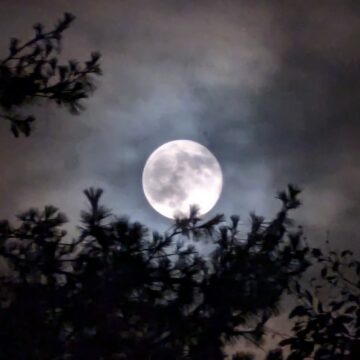
Another thing that’s interesting to notice is how far north or south the moon is at different phases. The sun moves from north to south and back again over the course of the year, in the familiar cycle of solstices and equinoxes. The moon does essentially the same thing over the course of a month. The full moon, for example, is high in the north in winter, when the sun is low in the south, and vice versa. Because the full moon rises at sunset, it roughly follows the sun’s summer path in winter and the sun’s winter path in summer. The tilt of the crescent moon also varies from month to month. Finally, although clouds make serious scientific observing impossible, they can enhance the beauty and interest of the moon.
Along with these relatively slow changes in the night sky, the celestial cycles do sometimes produce events that occur within a certain time range. Lunar eclipses are the most obvious example. There are also occultations, where the moon passes in front of a planet or star. Meteor showers are also time-limited events. If you live in a place with a lot of artificial lighting, you might need to get away to a darker site to see these well.
Conjunctions, where two or more planets appear close together on the sky, are also relatively brief. I find that watching the planets approach each other and then move apart before and after the conjunction is at least as interesting as seeing them on the day they’re closest to each other. For example, Venus and Jupiter are both visible in the evening sky in May. I’m looking forward to watching them move closer together in the sky; they will be in conjunction on June 9.
∞
Although we now have other ways of telling time, the sky still provides both a clock and a calendar. The position of the sun gives you a rough idea of the time of day and the season. Because some constellations are seasonal (and even the ones that are visible year-round in your location are more notable at some times of the year than others), watching the night sky can gradually give you a sense of the time of year based on which constellations are above the horizon at any time. The phase of the moon is also a rough guide to time.
I love this less precise but deeper view of time—deeper because the patterns of the solar system that we see in the night sky, lunar eclipses and planetary arrangements, repeat in cycles that have been going on for much, much longer than we’ve been here. They’re also a connection to a time when humans lived more in touch with the seasons and read the time from sun and moon and stars. These ancient rhythms and patterns can be deeply comforting and grounding.
∞
I took my title from various old nature guides, for example, How to Know the Birds, by Roger Tory Peterson; How to Know the Trees, by Howard A. Miller and H. E. Jaques; How to Know the Rocks and Minerals, by Richard M. Pearl; and How to Know the Ferns, by Frances Parsons.
You can see more of my work at MaryHrovat.com.
Enjoying the content on 3QD? Help keep us going by donating now.