
by Jochen Szangolies
Recently, a meme has been making the rounds, alleging that with JD Vance lecturing the Pope on Catholicism, Pierre Poilievre lecturing Mark Carney on economics, RFK jr. explaining vaccines to medical researchers, and Pete Hegseth quoting from Pulp Fiction instead of the bible, we seem to have arrived at the dystopic world of the 2006 satire Idiocracy. I think that this rests on a misconception. Now, don’t worry, I’m not going to defend any of these instances of, well, utter idiocy: they are just as dumb as they seem on the surface. But there is an inference here that this is somehow an aberration, a deviation from the norm, an external influence akin to a virus infection that has hijacked politics and perverted our institutions, and that if we could only root out this corruption, everything might return to normal again. Unfortunately, I don’t think this is the case: the call is coming from inside the house—the problem is not one of rogue actors snatching away the reins of society, but rather, a system which encourages such individuals to thrive and promotes them to its highest offices.
The problem is not, of course, a new one. In a 1933 essay on the rise of the Nazi movement in Germany titled ‘The Triumph of Stupidity’, Bertrand Russell posited that “[t]he fundamental cause of the trouble is that in the modern world the stupid are cocksure, while the intelligent are full of doubt.” In WB Yeats portentous poem ‘The Second Coming’, first published in 1920, we read that “the best lack all conviction, while the worst/are full of passionate intensity”. Many, at present, can surely empathize with this diagnosis (although the ending of Russell’s essay, where America is identified as the “brightest spot” in “this gloomy state of affairs”, rings with a certain hollow irony today).
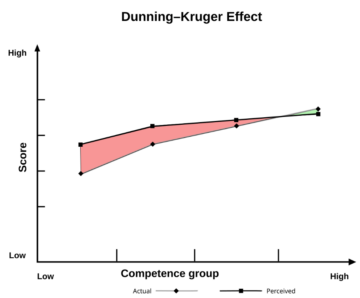
The state of affairs of the worst being full of certainty, while the best are full of doubt, is presented as contrary to expectations, nearly paradoxical. One should think that those who have dedicated themselves to study or self-betterment should be sure of their capabilities, while those more limited in either reach or grasp ought to heed these limits. An easy explanation to reach for, here, is the much-cited Dunning-Kruger effect: the idea, as popularly perceived, that one may be too ignorant to grasp the extent of one’s ignorance—that it is just one’s lack of ability to survey an area of expertise in the whole that leads one to overestimate one’s command of that area.
I think this explanation falls somewhat short. For one, there is not always such a correlation between metacognitive awareness and cognitive capabilities as needed by this explanation: being bad at chess doesn’t automatically mean that I consider myself better than I am. These are, at least to a certain degree, distinct abilities. The Dunning-Kruger effect is also more narrowly framed than the popular interpretation, which has ignorance in general implying ignorance of one’s ignorance in the specific. Rather, the effect obtains in the self-assessment of certain skills, where the unskilled typically do worse than highly skilled individuals, even if the former are of perfectly normal, or even high, intelligence. The case may rather be that all of us tend to think of ourselves as generally above average, when pressed, which when specifically selecting individuals lacking a certain skill then manifests as the appearance that the unskilled overestimate themselves.
I think what is rather at issue here is the combination of two factors. One is that, quite simply, we’re dealing with a case of inverted causation: it isn’t the case that the stupid are ‘cocksure’ despite their stupidity, it is that they remain stupid because of their certainty in their own superiority. Why revise your own beliefs if you know you’re right? Why work on yourself if you’re already great? Conversely, the doubtful are wise precisely because of their doubt: because they have examined their beliefs, questioned and revised them, thrown out what they found wanting and adopted what they thought more apt. It is not a surprise that those most self-assured are also those most lacking in sophistication, it’s a consequence.
There would, of course, not be any great problem with this state of affairs, if it weren’t the case that for some reason, it seems to be increasingly the crass, the unjustifiably self-assured, the ones unfazed by their own incompetence that seem to be running the show. If they’re so incompetent, then how is it they come to power? This is the second factor: our world has increasingly become one that rewards certainty over doubt, no matter whether there is any base for such certainty, or whether the doubt just reflects genuine vagaries. The reason for this, I will argue, is quite simply the management of complexity and information flow in a hierarchical system: a strong signal, any signal, is preferable to uncertainty.
Russell put the cart before the horse: the trouble with the world is not the dominance of inexplicably confident idiots, but rather, that the systems of power reward the sort of confidence that breeds ignorance over honest doubt.
The Marc Of An Educated Mind
There is a certain evolutionary force behind the rise of the confident incompetent: those showing excessive doubt, questioning themselves, going back on their own opinion are weeded out in favor of those that project certainty and confidence regardless of the actual facts. (Of course, here, like everywhere else, blessings are not equally distributed: not every demographic can get away with such misplaced confidence; it helps if you check the right boxes, like e. g. being white and male.) But recently, a novelty has bloomed on this dungheap: the assertion that, not only is self-reflection not helpful in achieving some vaguely-defined greatness, it is actively detrimental. This has most polemically been put forward by Marc Andreessen, billionaire venture investor and co-founder of Andreessen Horowitz (‘a16z’). (See here for a refresher on Andreessen’s position within the current authoritarian tech network.)
Andreessen has claimed that he has ‘zero, as little as possible’ introspection. People who introspect, according to him, get stuck in the past, and he is all about moving forward. Move fast, break things, regret nothing. And success bears him out, right? Aren’t all the movers and shakers of the world, the disruptors, the innovators, in the end those that don’t obsess over their own state of mind, and rather make their will manifest in the world? But again, there is an issue of misplaced causality: is it that these men of action (and there is cause for using the gendered term here) succeed because of their alleged lack of introspection, or is it that success—even if, perhaps, accidental—just never fosters qualities of reflection?
First, though, there are some staggering claims of fact in Andreessen’s tirade. Introspection, he claims, is a modern malaise. 400 years ago, it never would have occurred to anybody to be introspective. Andreessen’s interlocutor, podcaster David Senra, whose main claim to fame seems to be having read 400 (actually now 410, he takes time out of the 1:30 clip to remind us) biographies of ‘history’s great entrepeneurs’, does not press him on this point. But of course, counterexamples readily come to mind. We can look to what many think of as the foundation of Western philosophy, indeed perhaps Western thought, where Socrates taught that ‘the unexamined life is not worth living’ (shortly before, of course, being put to death for promoting rather more examination than the authorities were comfortable with). The Delphic maxim gnōthi seauton, ‘know yourself’, has been a recurrent theme in Western philosophy, from Plato all the way through Kant, Hegel, and Goethe. (Eastern traditions, which with the Hindu mahavakya or ‘great saying’ tat tvam asi, ‘you are that’, may have a similar principle are omitted here solely due to the present author’s even more pronounced lack of knowledge.)

It would be tiresome to list all the ways in which self-knowledge is an important factor way earlier than 400 years ago; and after all, what are these philosopher’s ramblings to a go-getter like Andreessen? But I think one important ‘great man’ of years past, who against Andreessen’s repeated pronouncements did spend a considerable amount of time interrogating his own motives and ethical groundedness is relevant here: another Marc A., Roman Emperor Marcus Aurelius. His main work is known in English mainly as the Meditations, although, being notes intended mainly for his private perusal, it likely never had a formal title. In Greek, the book is often referred to as Ta eis heauton, ‘Things Unto Himself’.
Writing within the Stoic tradition, Marcus Aurelius’ project in the Meditations is largely his own self-improvement: just the thing alien to the Andreessens of this world. Significantly, the book was written ‘in the trenches’, so to speak: while the Emperor was campaigning to secure the empire’s Eastern borders against Germanic incursions, he was simultaneously wrestling with the burden of making difficult decisions with no other guide than his own self-reflection. Contrast this with the move-forward attitude of Andreessen.
An important point is that Marcus puts this self-evaluation into the context of a cosmic, timeless perspective: to strip away the annoyances of the moment, and instead, regard it sub specie aeternitatis, aware of how “the void before birth and that after dissolution are equally infinite” (Meditations, book 9.32). I believe that in this, there is a certain balm for the kind of ‘analysis paralysis’ that may befall those prone to excessive doubts. Because, much as it pains me to admit, there is a certain kernel of truth in Andreessen’s ramblings: doubt, which I absolutely consider to be a virtue in many situations, can become a vice if indulged excessively, and indeed can greatly encumber action. However, Andreessen’s ‘cure’ to throw it out wholesale is worse than the disease, and the fact that it has come to be a dominant strategy—that is, one likely to yield rewards—in contemporary society heralds an urgent need to learn again how to properly doubt.
Aimless By Design
Consider the old analogy by proponents of Creationism, i. e. the idea that life as we know it is not the product of the mindless toil of evolution, but rather, betrays a supreme and vast intelligence behind it all: if you encounter a watch, its sheer complexity makes it reasonable to infer that it is the product of design, of a shaping intelligence that put together all of its components to accomplish a definite aim. A single cell is orders of magnitude more complex than even the most sophisticated watch. Therefore, should we not see in this complexity likewise the hand of a grand designer?

The fallacy of this logic is, of course, well known: complexity can indeed increase through a process of random exploration of possible paths together with a competitive weeding out of less well adapted strategies. Yet it is hard to resist such ‘watchmaker-logic’ sometimes. It is most obviously at play when we attribute to strategy and genius what is more aptly explained by chance and selection.
This happens whenever we think that success must be the result of careful planning, brilliant ideas, and hard work. That the reason people like Andreessen have reached their elevated station is because of their supreme talents: that they are the watchmakers of their own success. But consider the fact that we’re running an unprecedented number of statistical experiments in parallel: pure chance will ensure that, at least occasionally, absolutely harebrained decisions will lead to spectacular, widely popularized success, while survivorship bias ensures that we never hear of the failures. Joan R. Ginther won the lottery on four separate occasions, each individual win in excess of US$2 million, for a grand total of US$20.4 million. Her success does not mean that playing the lottery is a good strategy, but merely that if you have a large enough sample size, unlikely things can happen with quite some regularity.
Combine this global-scale Monte Carlo-experiment in life strategies with the fact that there are some strategies that nobody could have predicted would work, yet that, through some combination of filling just the right niche at the right time and sheer luck, turn out to be actually well-adapted to the current social fitness landscape, and you’ll see a glut of successful people whose apparently brilliant ideas and grand strategies are just as illusory as the design of the living cell. This phenomenon goes beyond the individual, seguing into what I have called ‘emergent conspiracies’: apparently willful, ‘designed’ patterns in the chance-cum-selection process of history (one might call this appearance of will from random exploration ‘evolition’).
This produces a self-reinforcing loop: those too confident to doubt their own skill will see this success as proof of their genius, where a more self-reflective person would hold out doubts. To this, there is added a cultural lens of assigned genius: you could take, say, Peter Thiel’s spoutings on the katechon and the antichrist as the college-dorm level nonsense that it is, or think that there must be some brilliance behind it because otherwise, you’d have to accept that Thiel isn’t any better than your average moron, and then that society is such as to enable those people to have power over you. But the latter then self-perpetuates and makes any resistance futile, because how could you ever hope to resist the machinations of such genius?
Hierarchies And Information Compression

But the reverse causality of the un-self-reflective remaining unsophisticated and the ‘evolitionary’ selection mechanisms amplifying strategies of accidental aptness do not quite serve to explain our apparent slide into idiocracy. A third factor is societal: a hierarchical structure inherently needs to compress data looped through the rungs upwards to a central authority in the service of simple computational power—reporting everything to levels of oversight would simply yield an unintelligible mess of data, most of which would probably be irrelevant. This is one of the key points made by physicist and engineer turned amateur nerd-sociologist Moritz Q. Flink in Das Gesellschaftliche Problem (‘The Social Problem’), where he turns a lens shaped by thermodynamics and information theory onto the question of the emergence of social structures. (If you’re conversant in German, you may also want to check out his YouTube channel, featuring a rambling and halting appearance of yours truly.)
Central control of complex systems inevitably necessitates the lossy compression of data available to the control system, meaning that the act of control itself implies the impossibility of having a faithful representation of the system under control. It is not just, as the cyberneticists had it, that ‘control falsifies’, it also starts from at least partly false premises. A part of this is due to what I have called ‘misaligned proxies’: quantities that are intended to correlate with desirable properties, but where the correlation is broken exactly by their serving as indicators. A good example is citation counts in academic research: good research is often highly cited, but if achieving high citation counts is rewarded (by grant money or tenured positions), citation counts can be artificially increased while actually weakening the quality of research.
But another source of error is what one might call ‘strong signal bias’: loud, confident voices (again when originating in the right demographic, at least) are often acknowledged over those voicing honest doubt. Doubt, even when appropriate, does not easily provide a recommendation for action; but confident support for one alternative over others, even when misplaced, enables exactly the kind of ‘move forward’-actionism championed by the likes of Andreessen. This is ultimately a sort of ‘availability heuristic’, albeit not directed at recalled, but reported information.
The data relied upon to shape the policies of central governing organs in hierarchically organized systems will thus bias actions advocated by the loud and confident over the reflection of the doubtful. Thus, since these actions are self-serving more often than not, those voices will more easily slot into positions of power. The shallowly self-confident, evolving successful strategies through pure numerical chance, are amplified in their power by the necessities of a hierarchical system.
There remains the question: what can we do? How do we resist this mechanics? I won’t pretend to have anything like a remotely comprehensive question to this answer, but I think that whatever that answer will be, its first word is simply ‘doubt’. Doubt yourself, doubt your most deeply held convictions; doubt the genius of billionaires, doubt power to be a liar; doubt even that hierarchical control is necessary, doubt that there is no alternative. But doubt in a way that doesn’t consume you and leave you paralyzed; rather, with Marcus Aurelius, doubt from ‘the point of view of the cosmos’. This kind of ‘view from nowhere’ can help you achieve the benefits of doubt, while ameliorating its crippling self-perpetuation.
Enjoying the content on 3QD? Help keep us going by donating now.