
by Jochen Szangolies
Recently, a meme has been making the rounds, alleging that with JD Vance lecturing the Pope on Catholicism, Pierre Poilievre lecturing Mark Carney on economics, RFK jr. explaining vaccines to medical researchers, and Pete Hegseth quoting from Pulp Fiction instead of the bible, we seem to have arrived at the dystopic world of the 2006 satire Idiocracy. I think that this rests on a misconception. Now, don’t worry, I’m not going to defend any of these instances of, well, utter idiocy: they are just as dumb as they seem on the surface. But there is an inference here that this is somehow an aberration, a deviation from the norm, an external influence akin to a virus infection that has hijacked politics and perverted our institutions, and that if we could only root out this corruption, everything might return to normal again. Unfortunately, I don’t think this is the case: the call is coming from inside the house—the problem is not one of rogue actors snatching away the reins of society, but rather, a system which encourages such individuals to thrive and promotes them to its highest offices.
The problem is not, of course, a new one. In a 1933 essay on the rise of the Nazi movement in Germany titled ‘The Triumph of Stupidity’, Bertrand Russell posited that “[t]he fundamental cause of the trouble is that in the modern world the stupid are cocksure, while the intelligent are full of doubt.” In WB Yeats portentous poem ‘The Second Coming’, first published in 1920, we read that “the best lack all conviction, while the worst/are full of passionate intensity”. Many, at present, can surely empathize with this diagnosis (although the ending of Russell’s essay, where America is identified as the “brightest spot” in “this gloomy state of affairs”, rings with a certain hollow irony today).
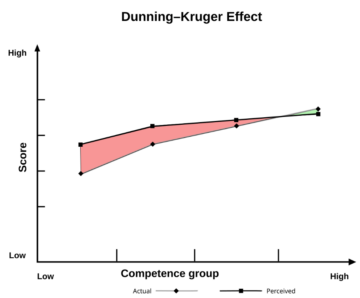
The state of affairs of the worst being full of certainty, while the best are full of doubt, is presented as contrary to expectations, nearly paradoxical. One should think that those who have dedicated themselves to study or self-betterment should be sure of their capabilities, while those more limited in either reach or grasp ought to heed these limits. An easy explanation to reach for, here, is the much-cited Dunning-Kruger effect: the idea, as popularly perceived, that one may be too ignorant to grasp the extent of one’s ignorance—that it is just one’s lack of ability to survey an area of expertise in the whole that leads one to overestimate one’s command of that area.
I think this explanation falls somewhat short. Read more »