
by Gary Borjesson
Note: This piece stands on its own, but it can also be read as the third and final part of a series that progresses from the mythological origins of the Eleusinian Mysteries through its role in the flowering of western culture to this essay, a personal reverie on clinical applications.
I saw Karen twice a week for two years before she lost her job, quit therapy, and left the area. A bright, creative woman in her mid-twenties, Karen’s mother died when she was five. She and her younger brother were raised by a brokenhearted and neglectful father. Growing up, Karen spent much of her time in her room. Around twelve she discovered video games and, shortly after, cannabis. A habit developed that persisted through college and the time I knew her: using cannabis daily, drinking Red Bulls, eating candy, playing video games, engaging in heated arguments on FaceBook and Reddit, and being chronically sleep deprived. Her dad wasn’t around much, but when he was around, he was preoccupied and glad she could amuse herself. She made it through college, but after that became increasingly isolated, depressed, paranoid, and periodically psychotic.
I met Karen early in my career as a psychotherapist, having recently opened my private practice. She loved my dog, who was always present for sessions, and that helped establish a warm rapport. I found her likable, quick and imaginative, and I was eager to be of some use. Before long I felt worse than useless. Toward the end of our time together there was little I could say that didn’t provoke angry outbursts from her. Though she’d had many therapists and psychiatrists and medication regimens, her condition had continued to deteriorate, as it did with me. From her I learned how intractable mental illness can be; my attempts to join with her were regarded as intrusive attempts to control her. Even my silences were regarded as judgments. I came to dread the sessions.
One afternoon stands out in my memory. Sunlight streamed through the windows, lighting up her face, which was knotted in rage as she yelled at me, accusing me of being part of a conspiracy that included her boss, ex-boyfriend, and brother. Now she was lumping me with “the enemy”, and I felt the last brick in the wall between us being fitted into place. I remember that day because it’s when I started to feel our work together was hopeless. It was time yet again to try something new, but what else could I do? I could try to refer her, but who would take her on? I couldn’t imagine outpatient therapy helping, and she was opposed to residential treatment.
Feeling stuck and helpless, I found myself fantasizing about Karen time-traveling back to ancient Greece and being initiated into the Eleusinian Mysteries. Maybe an experience like that would help her come out from behind all the defenses that kept her walled off from meaningful contact with anyone. The rest of this essay fleshes out the fantasy of how such an initiation—and in particular the therapeutic use of a psychedelic or MDMA—might help a patient like Karen.
Karen’s imagination would be lit up by the prospect of a real-life quest, much as she was lit up by her quests in the gaming world. I imagined her weeks-long preparation for the journey and then setting off with her fellow initiates on the long walk over several days to Eleusis. In addition to getting out of her room into the sunlight and company of others, she would be detoxing from her diet of sugar, caffeine, cannabis, and video games. As she underwent the rites of purification along the way—fasting and bathing in the sea for example—I imagined her feeling better and more open to the camaraderie with those pursuing a common cause. Along the way to Eleusis, she might begin to see her addictions and grievances as the narrow and confining things they’d become.
When they arrived at Eleusis, the main event would be a group ceremony held at night, involving a mixed drink called the kykeon, which likely contained a psychedelic compound. Initiates commonly reported having their vision radically expanded, habitual boundaries dissolving as they experienced the continuity between life and death, between the human and the divine, between their personal identity and an expanded sense of Self through which they felt their unity with others and all things.
In Karen’s case, I imagined her defenses dropping enough so that she could experience others not as threats but as fellow travelers and allies. I hoped she might see her self in a more compassionate light, as deserving better than what she’d been giving herself. In my fantasy, she might come back to our therapeutic work after such an initiation more able to rebuild her relationships, address her addictions, and heal from trauma. The tragedy for patients like Karen is that a good therapeutic alliance is often their best hope for escaping the rigid cramped space in which their psyche is sheltering. Yet it is often as desperately defended against as it is needed.
Exercise, fasting, socializing, and cooperating in a shared pursuit would all do Karen good. Another less tangible good would come from being initiated into a meaning-saturated rite, one that didn’t just temporarily release her from her paranoid strait-jacketed mindset, but offered a more expansive experience of her place in the cosmos.

There’s research to support some of the effects I hoped for from Karen’s fantasized initiation. In therapeutic settings psychedelics tend to increase a person’s capacity to break a cycle of addiction. People often report feeling repulsed by their habit of smoking or heavy drinking, and often find it easier not to start again after their experience. Research suggests psychedelics reopen a critical period of increased neurological plasticity that can last for days and weeks after the experience. During this time there’s less resistance to developing new patterns and dropping old ones.
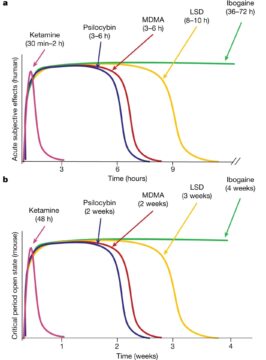
Robin Carhart-Harris, a neuroscience researcher at University of California, San Francisco, offers a metaphor for how this increased plasticity works. Imagine your mind is a ski slope rutted with tracks that represent your habits of feeling, thought, and behavior. (Tracks that imaging technology makes visible as patterns of activation in your brain.) These tracks are your typical way down the slope of your day. A therapeutic dose of a psychedelic precipitates a storm that blankets the slope with snow. The ruts aren’t gone, but now there’s enough new snow covering them that you can explore new paths without getting drawn into the old tracks.
In fact Karen (or anyone struggling with paranoia and psychosis) is not a good candidate for psychedelic-assisted therapy. What would likely be helpful is MDMA-assisted therapy. MDMA increases openness by reducing the threat response (Karen’s wall) and enhancing embodied cognition. In contrast, psychedelics tend to increase openness by loosening or dissolving the ego, which can further destabilize someone like Karen who is already unstable.
Specifically, MDMA reliably produces the experience of feeling more safe and connected, to self and others. By increasing oxytocin, it lowers threat response and supports feelings of connection. What we’re ordinarily too defended to hear from a spouse or friend or therapist becomes possible to take in and consider. Importantly, this includes warm and loving communications. Karen was too walled off to take in anything.
MDMA also enhances intellect and judgment by several means. First, because threat response is decreased, we feel safer, less reactive, and thus more able to think. MDMA increases dopamine and serotonin levels, which translate into more motivational energy, enhanced recall, and more positive mood. There’s a telling study that looked at how MDMA affected subjects’ “favourite and worst autobiographical memories.” It found that MDMA had an augmenting influence on favorite memories (more vivid and emotionally intense) and an attenuating effect on worst memories. MDMA thus reduces the cognitive bias toward negativity, making room for more positive, constructive thinking.
Thinking back to that day, I imagine being with Karen that afternoon if she had been stirred up by MDMA instead of the usual toxic cocktail. Her paranoia and defensiveness having decreased, she might feel more open and hopeful about our time together. Her mind might gravitate toward more positive memories and stories about herself and others. She might feel safe enough to open the door, a crack, and let me in, a little. We might make good eye contact, increasing oxytocin and feelings of connection. She might feel encouraged to think that maybe I could prove trustworthy. I like to imagine her saying, in a quieter voice: I’m so tired. Nothing ever changes. I’m ready for something different. What do you think, Gary?
Interested readers can subscribe for free to my Substack, How We Help, and receive a short note each week devoted to the art, science and philosophy of alliances.
Enjoying the content on 3QD? Help keep us going by donating now.