
by Derek Neal
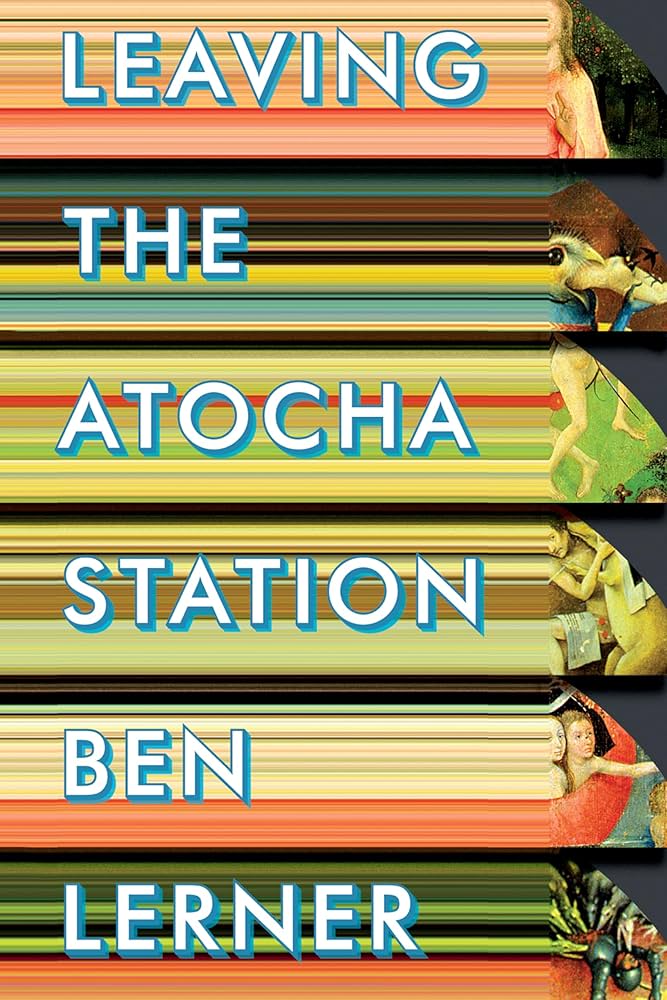 I had meant to read Ben Lerner’s new novel, Transcription, but in a process I don’t understand, all the e-books were in use at the library; I borrowed his first novel, Leaving the Atocha Station (2011), instead. I’d never read Lerner, this despite having written a long essay defending autofiction in The Republic of Letters (Lerner is considered one of the genre’s main exemplars), focusing instead on the non-American writers of autofiction (Knausgaard, Cusk, Ferrante). I’ve always preferred European literature to American literature, the one exception being Americans who write about Europe, like Henry James or James Baldwin, but when I opened Leaving the Atocha Station, I discovered that Lerner also writes about Americans in Europe; in this case, the American is Adam Gordon, a version of Lerner who is on a poetry fellowship in Madrid, much like Lerner was a Fulbright scholar in Madrid in 2004, the year the book takes place.
The novel is full of doubles, copies, and repetitions, which seems to be Lerner’s signature preoccupation—before reading the novel, I’d read a handful of reviews of Transcription, thinking I’d be reading that book, and I’d listened to Lerner’s interviews with Michael Silverblatt about his first two novels; somewhere in this reading and listening, I’d read/heard about the focus on doubles, which must have primed me to appreciate this aspect of Leaving the Atocha Station, and indeed, when I read the opening section about Adam making espresso in his attic apartment overlooking La Plaza Santa Ana, then walking through the streets of Madrid with a bag of books, I thought, wait a second—that’s me! I, too, had rented “a barely furnished attic apartment” overlooking a bustling European square; I, too, had wandered the streets with a book in my backpack and a notebook to write in while sitting on a park bench or at a café table; I, too, had wondered if I was going to be a writer, was already a writer, or was simply a fraud, a stereotype of the young American in Europe.
Lerner’s narrator, Adam, goes to the Prado museum every day to stare at a painting, then one day finds another visitor in his place; he impulsively goes to Grenada with one casual girlfriend, Isabel, then goes to Barcelona with another, Teresa; he uses Spanish poems by Lorca as the basis for his English poems; he wonders if he’s a poet or just pretending to be one; he thinks about Antonioni’s film The Passenger, in which Jack Nicholson steals the identity of a dead man, trading in his old life for a new one. These doublings haunt Adam because they encapsulate the way he feels divorced from himself, alienated from his own being, which manifests in an intense self-consciousness that he medicates with tranquilizers and other drugs.
The most interesting character is not Adam, however, but Teresa, a Spanish poet who embodies everything that Adam is not. Whereas Adam is awkward and “fraudulent,” Teresa is repeatedly described as “graceful”—at a protest in the wake of terrorist bombings in Madrid (“History,” Adam calls it), she “blended in gracefully, taking up the chant…pumping her fist in the air with the rest of the crowd without any of it seeming affected or silly.” At one point, Adam tells Teresa that she is “the most graceful and protean person I know,” and later, he thinks of her “inscrutable smile” and “uncanny grace.” Teresa explains that Adam is describing “the personality of a translator. From apartment to protest, from English to Spanish.” While Adam is obsessed with authenticity and originality, Teresa understands that there is no original without a copy, or, put another way, that an original only takes on significance once a copy is made; the copy is not a lesser version of the original but a crucial part of a dialectic. Teresa transcends Adam’s duality, as in when she tells him “No,” and Adam comments, “whether in English or Spanish I couldn’t tell.”
The true subject of Lerner’s novel, then, is language and its relationship to reality. As Adam progresses in his Spanish, I recalled my own experience studying abroad in France. When I spoke French, I said things I never would have in English, and at first, the French language seemed unreal, a plaything I could experiment with, but to use the language effectively, I had to let it control me, rather than the other way around. Then something else happened: expressions that I never would have said in English, deep sentiments that would have embarrassed me, or that would have sounded cliché because I’d only ever heard them in movies, became available to me in French, precisely because I had no past associations with them. In English, I always qualified my statements with “sort of” and “kind of,” but in French, I could say something ridiculously sentimental without any trace of irony, and it would be true, and then I could say it in English, too, as if a barrier had been broken down and I was discovering, or creating, a new part of myself. I left Adam and became Teresa.
It doesn’t seem like this will happen for Adam, but then, suddenly, it does. At an event where he will read the poetry he’s composed while in Spain, he suggests to Teresa, who’s been translating his poems, that he reads the Spanish translations while she reads the English originals, “and the translations would become the originals as we read.” The novel ends with Adam referring to his “friends,” the first time that other people have become real for him, rather than a projection of his solipsistic consciousness. When I read these last pages, I was caught off guard—the growth of Adam felt unearned, but as the book lingered, I remembered that grace is not earned but freely given, all one has to do is accept it.
Enjoying the content on 3QD? Help keep us going by donating now.