
by Rafaël Newman
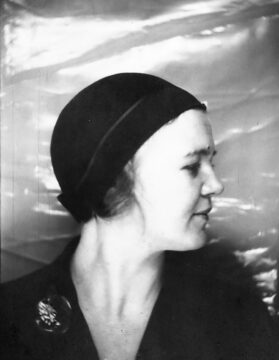
If she hadn’t died in July 1987, at the age of 81, my maternal grandmother would be celebrating her 120th birthday this week. One-hundred-and-twenty is a proverbial age among Ashkenazi Jews, who recite the Yiddish formula Biz hundert un tsvantsik, or “[You should live] to 120,” on the anniversary of a birth. That’s a full 20% markup over their Goyish compatriots in the Old Country, who grant honorees a mere Sto Lat!— “100 years”—in the traditional Polish song of birthday congratulations.
I never once said Biz hundert un tsvantsik to my grandmother, however, on any of her birthdays, although not for want of wishing her well. This was because, despite her birth in the canton of Aargau, the traditional Swiss “Pale of Settlement” for Jewish residents until the late 19th century, and her own eventual close family ties with Jews, my Grossmutti was not herself Jewish. But neither was she in fact a Swiss citizen, despite the place of her birth. She was German.
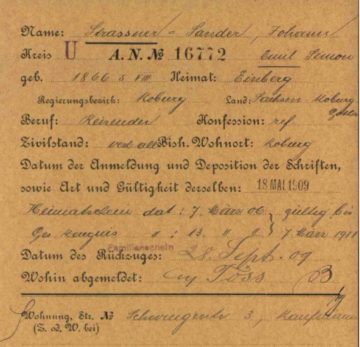
Eva Bertha Strassner was born on February 23, 1906, in Baden, Switzerland, to Johann Simon Emil Strassner and Maria Elisabeth Sander, immigrants from Löbelstein, which was, at the time of their births and until 1918, in the Duchy of Saxe-Coburg-Gotha, and is today a part of Bavaria. Eva Bertha’s father had come with his burgeoning family in search of employment as a handyman, which he found with a variety of enterprises in the industrialized regions of Switzerland at the turn of the 20th century. Over the next decades the family moved, in keeping with Johann Strassner’s fortunes and economic exigencies, from Baden in the canton of Aargau to nearby Wettingen, then to Töss, at the time a village in the canton of Zurich, now a district of Winterthur, the canton’s second city, and from there, in the 1920s, to Schwerzenbach, on the edge of Zurich’s Oberland, within shouting distance of Zurich itself, the cantonal capital and today Switzerland’s largest city.
By that time, however, my grandmother had left Switzerland: initially for Munich, where she studied philology at the university until, she claimed, she saw Hitler swaggering into a beer hall; and from there, by way of a brief stint in England, to Canada.
Eva Bertha Strassner was young when she left Switzerland—in her early twenties—and her letters home suggest a continuing strong and nostalgic attachment, to her mother in particular, as well as to certain of her many siblings. But what she left behind in Switzerland was not only what we would now call a dysfunctional family, afflicted by poverty and a variety of psychological disorders, but also simply the discomfort of living as a German national among Swiss citizens.
My friend Jurczok 1001, a poet and performer and himself the Swiss-born son of German immigrants, is fond of reciting an aphorism: There are three types of people in Switzerland—Swiss people, foreigners, and Germans. To Swiss citizens, in other words, particularly those in the German-speaking cantons, foreign residents may be irritating, exotic, a welcome addition to the cultural landscape, or, depending on their generation, simply an inevitable part of modern Switzerland—but German immigrants are uncanny: both overly familiar and disturbingly strange; marred by their violent national history but bearers of an august cultural tradition; refugees from urban deprivation who may nevertheless seem like arrogant pedants, merely because they are expert speakers of “High German,” the most widely spoken of Switzerland’s three official languages, but a tongue many Germanic Swiss are inhibited about using, preferring instead their own distinctive (and often impenetrable) Alemannic dialects.
So my grandmother left the land of her birth, where, as the child of immigrants, she had never felt quite at home, to produce such children herself in Canada: my mother and aunt, born to Eva Bertha and her husband Franz Kornpointner, a German immigrant to Canada himself. The war years and their aftermath were difficult for Germans in North America as well, of course, where they were at first suspected of being enemy aliens, and then, with the revelations of Nazi atrocities, became susceptible to guilt-by-association in the eyes of their Canadian compatriots. Thus, although their first language and the one spoken by their parents in private was German, my mother and aunt were cautioned against using it outside the home, lest they be identified by others as “dirty Germans.”
Against such opprobrium my grandmother could deploy a defense to which my German-born and bred grandfather had no access. While ostentatiously celebrating the gifts of Teutonic culture—Goethe, Strauss, Thomas Mann—Eva Bertha could also claim to be Swiss, and thus innocent of the mark of Cain. And although she could be as dismissive of the provincial Swiss as she was of the “Canadian turnips” among whom she had chosen to live, and made only occasional reference to Swiss culture, reciting with admiration a story by Gottfried Keller or a Swiss folksong, Eva Bertha used her birth in Switzerland as a shield against association with the Third Reich, and, in the postwar period, with the imperfectly denazified Federal Republic. Her politics intensified this distancing: having identified as a fellow traveler until the Molotov-Ribbentrop Pact in 1939, she transformed her early Communist sympathies into a generalized progressive attitude in Canada, which included an allegiance to social democracy and solidarity with what was then known as the Third World.
Meanwhile, back in Switzerland, as the 20th century progressed, the ethnic makeup of the Swiss population, whether citizens or not, was changing, along with the country’s economic fortunes. Foreigners began to settle in ever greater numbers in Switzerland as its wealth grew and its working-class citizens moved gradually into the middle class, and, as in much of the rest of Europe after the Second World War, labor had to be imported to fill the menial positions being vacated by “native” Swiss. In the case of Switzerland as in its neighbor to the north, these foreign laborers were considered Gastarbeiter or “guest workers,” a euphemism for restrictive permits that tightly controlled length of residence, forbade family unification, and fomented the xenophobia that came to a head in 1970 with a political initiative to cap foreign residence in Switzerland at ten percent.
Another friend of mine here in Switzerland, Samir, a filmmaker who is the son of a Swiss native and an Iraqi immigrant, has recently created a remarkable testament to the period, and a warning against the current resurgence of anti-immigrant sentiment on the Swiss political scene. Die wundersame Verwandlung der Arbeiterklasse in Ausländer (“The Miraculous Transformation of the Working Class Into Foreigners,” 2024) is a documentary feature that uses vintage footage, interviews with witnesses, participants, and experts, and animated recreations to evoke the enormous contributions made by immigrants to Switzerland, in the early postwar era particularly from Italy but increasingly from southern Europe and from other lands of the global majority, and to recount the hardships and resistance such immigrants faced from the Swiss forces of reaction.
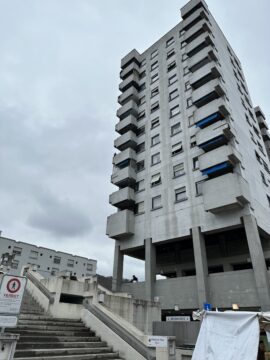
And indeed, my grandmother’s last place of residence in Switzerland, the onetime “white” working-class town of Töss, has since become a suburb of Winterthur populated by immigrants from Turkey and the Balkans—which has earned it the not entirely affectionate sobriquet of “Tösstanbul.” The neighborhood, which had once provided accommodation to itinerant German handymen like my great-grandfather, today boasts kebab restaurants and travel agencies specializing in package tours of Prishtina. Although Zentrum Töss shopping mall, which now serves as the district center, is a brutalist echo of Berlin’s notorious Kottbusser Tor, it cannot compete with the impression of a true Anatolian exclave evoked by the German version: for, given the restrictive realities of Swiss immigration policy, nowhere in Switzerland is there the density of foreign-born population necessary for the formation of a true “ethnic” quarter.
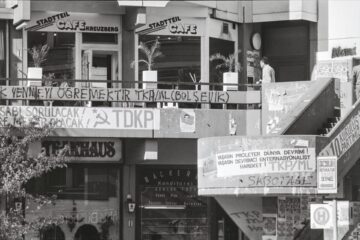
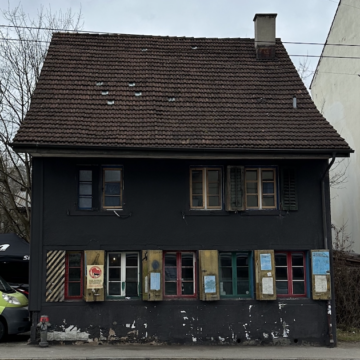
Nevertheless, the immigrant flavor of the area is apparent, along with its typical “first-world” companion, the gradual influx of hipsters that signals a creeping gentrification. I was, however, delighted to see that the house we have identified as the one in which Eva Bertha Strassner lived with her family in the second decade of the 20th century is today a squat, emblazoned with progressive slogans: for improved immigrants’ rights, against the genocide in Gaza, in the name of anarchism. It seemed a fitting memorial to my grandmother’s own early socialization as a rebel and champion of the underclasses: in Töss, on the site of a battle, in 1525, during the Peasants’ War; in a municipality that had voted overwhelmingly for the liberal constitution of 1831, which sponsored the creation of a working man’s association in 1865, and which automatically became Winterthur’s proletarian district when it was incorporated in 1922.
Last week I had the pleasure of conducting an interview with Clare O’Dea, an Irish author and long-time resident of Switzerland, at a reading from her most recent novel. (That marvelous book, Before the Leaves Fall, addresses, among other issues of relevance to contemporary Swiss society, the changing face of the country’s working class, regularly populated as it is these days by immigrants from Kosovo or Sri Lanka.) In our conversation before the event, Clare and I found that we were similarly averse to using the word “expatriate” to describe ourselves, since we agreed that “expat” is merely a prettified term for “immigrant,” one reserved for non-POC foreign residents, or those who have come from industrialized, dominant countries, and are presumed to enjoy the economic wherewithal and political freedom to return to their places of origin, if they choose.
Since we were holding the launch at the James Joyce Foundation in Zurich, I was reminded of that earlier Irish author’s own experience as an immigrant: or, as he himself might have put it, as an exile, long before the euphemistic term “expat” had entered into circulation, or could have made any sense for a citizen of what was at the time a profoundly repressive and low-income country, not yet the emancipated “Celtic Tiger” of recent years. And it occurred to me that, if O’Dea and I were clearly not exiles, neither were we expatriates; but that we could perhaps be termed “ex-patriots”—that is, people who have chosen to live in a country other than that of their birth, who are committed to the political and economic life of that new country, who maintain a connection with their “native” land but are not reflexively patriotic about that identity, and who experience their new home with empathy and interest, as well as with the salutary distance of the settled nomad. People who have made up their elective, affective selves from pieces of various cultures, in other words.
At any rate, I am for my part certainly an immigrant, like my grandmother and great-grandfather before me. In fact I insist on the appellation, in solidarity with all those being defamed by the venomous representatives of a renewed reaction: most recently by the loathsome Marco Rubio, at the 62nd Munich (!) Security Conference.
*
In February 2006 we gathered in Toronto, where my mother now lives and where my grandmother spent the final years of her life, to celebrate the centenary of her birth. All of Eva Bertha’s descendants were there, and when we had eaten a festive meal and reminisced about Grossmutti, we struck up the Internationale, in memory of her commitment to progressive politics and to a world without class, ethnic, or religious hierarchies. As a tribute to her own early experience of ex-patriotism, however, we sang the anthem of proletarian solidarity in a Swiss-German version written for the occasion by my elder daughter, who was born in Seattle, first schooled in Berlin, and raised in Zurich, and who has since lived, worked, or studied in Toronto, Venice, London, Sarajevo, and Basel. A member of the latest of four generations of immigrants—at least, and so far.
With grateful acknowledgment of the City Archives of Baden, Winterthur, and Zurich