
by Daniel Gauss
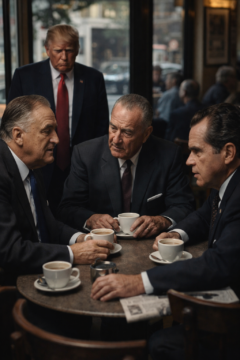
In the twentieth century, there were policy initiatives in the United States that went beyond incremental reform and which could justifiably be called “utopian.” Three of these initiatives stand out: Franklin D. Roosevelt’s proposal of a “Second Bill of Rights,” Lyndon B. Johnson’s “Great Society” and Richard Nixon’s effort to establish a type of Universal Basic Income (UBI).
If we take a close look at these three initiatives, and what happened with each one, we can see why “progressive” utopian programs are no longer being proposed, and why there is now space for conservative “restorative” ideals.
Each of the three initiatives above was calculated to extend political, social and economic rights to previously excluded groups, and sought to shift the government toward greater responsibility for its citizens’ well‑being. Each initiative failed to reach its full potential because of a combination of political resistance, economic pressures, institutional limitations and changes in public attitude.
In the spirit of John Gray’s Black Mass (2007), I would also like to investigate whether MAGA might be considered a utopian movement, but in the opposite direction. FDR, LBJ and Nixon were interested in forward-looking utopian projects calculated to expand social rights and economic benefits. MAGA seems to represent a backward-looking utopian project: the belief that America can be “restored” to an idealized past through governmental action.
Franklin D. Roosevelt and the Dream of a Second Bill of Rights
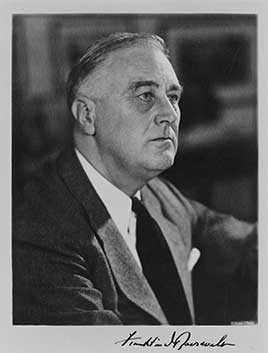
In January 1944, Franklin D. Roosevelt proposed a “Second Bill of Rights” in his State of the Union Address. What he proposed was amazingly far-sighted, humane and optimistic. Two brief excerpts follow:
“We cannot be content, no matter how high that general standard of living may be, if some fraction of our people – whether it be one-third or one-fifth or one-tenth – is ill-fed, ill-clothed, ill-housed and insecure.”
“We have come to a clear realization of the fact that true individual freedom cannot exist without economic security and independence. Necessitous men are not free men. People who are hungry and out of a job are the stuff of which dictatorships are made.”
This new Bill of Rights reflected FDR’s desire for economic security for all of the American people. This was to constitute a newly articulated set of rights premised on the fact that “political democracy” had to be supported by “economic democracy.”
His proposed new rights included: the right to a useful job with pay allowing for adequate food, clothing and leisure; the right to a decent home; the right of every farmer to sell products at a return which would provide a decent living; the right of every businessperson to trade in an atmosphere free from unfair competition at home or abroad; the right to adequate medical care and the opportunity to achieve and enjoy good health; the right to protection from the economic fears of old age, sickness, accident and unemployment and the right to a good education.
This would have changed and enhanced the role of government from a defender of liberty to a guarantor of economic wellbeing. With the wartime economy doing well and national unity riding high, he believed the country had both the economic capacity and the moral obligation to establish a fairer and more equitable future. The time was right to move toward safer, more secure and more meaningful lives…for everyone.
What Happened to the Second Bill of Rights?
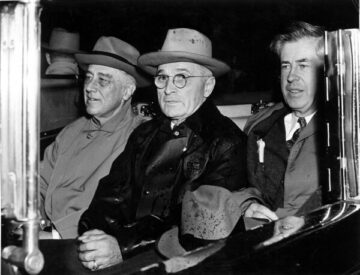
Roosevelt did not live long enough to see the Second Bill of Rights through. Truman, though committed to extending the New Deal through what he called the Fair Deal, initially faced a conservative Congress that blocked most Fair Deal proposals. Only after his 1948 victory did Democrats regain control, producing the more liberal 81st Congress, though even that Congress remained too divided to enact the core of Roosevelt’s Second Bill of Rights.
Yet, things might have been different had Roosevelt kept Henry A. Wallace on the 1944 ticket, as Wallace was far more ideologically aligned with Roosevelt’s expansive social vision.
Wallace was one of the most proactive social‑democratic figures ever to hold national office in the United States. Roosevelt valued him not only for his sweeping reforms as Secretary of Agriculture but also for his broader vision that America’s agricultural abundance could help relieve hunger beyond its borders. FDR fought hard to put him on the 1940 ticket and Eleanor Roosevelt delivered an unusually impassioned speech to the Democratic National Convention to secure Wallace’s nomination.
If Wallace had entered the Oval Office in April 1945, the Second Bill of Rights would not have just faded into history. It would have become the organizing principle of postwar liberalism. Congress might still have resisted, the conservative coalition was real, but Wallace would have framed the struggle not as incremental reform but as the fulfillment of democracy itself. The early Cold War might have unfolded under a president who treated economic rights as central to freedom rather than subordinate to anti-communist containment.
Roosevelt’s decision to drop Wallace reflected the realities of American political coalition-building in the 1940s. Wallace was highly unpopular with Southern Democrats, pro-business party leaders and those who would become Cold War hawks. The hawks viewed him as ideologically unreliable.
As Roosevelt’s health became worse, party elites demanded a “safe” successor. Roosevelt chose party unity over ideological continuity and thus ensured that the Second Bill of Rights would die with him. Postwar America accepted, instead, a private-market vision of the good life and social goals became home ownership, high-volume consumerism and suburban living. Although Roosevelt’s Second Bill of Rights never came to fruition, its spirit did influence later programs such as Medicare and Medicaid, civil-rights-era anti-poverty measures and other goals of the Great Society.
Lyndon B. Johnson’s Great Society: Successes, Failures and the End of an Era
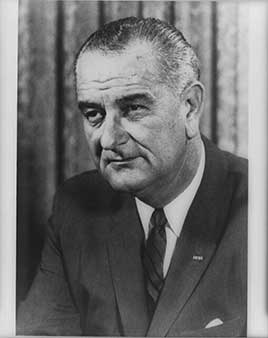
When Lyndon B. Johnson assumed the presidency, the Civil Rights Movement was exposing the depth of America’s racial and economic inequalities. Johnson responded with his Great Society vision – a commitment to develop a country where “no child will go unfed,” where cities would be rebuilt and where entrenched injustice would finally be confronted and overcome.
LBJ’s Civil Rights Act of 1964 and Voting Rights Act of 1965 are among the most significant pieces of legislation in American history. They dismantled legalized segregation and destroyed barriers that prevented millions of Black Americans from voting.
Medicaid and Medicare created federal responsibility for elderly and low-income healthcare, two major steps toward Roosevelt’s idea of economic rights. Other initiatives included Head Start, Job Corps, VISTA (a domestic Peace Corps), community action programs, food assistance expansion and federal aid to education.
The Great Society also produced the Clean Air Act, the Water Quality Act, and the first major federal consumer safety laws. The National Endowment for the Arts, the National Endowment for the Humanities and public broadcasting also emerged from this initiative, reflecting Johnson’s belief that a humane and dynamic society needed a vibrant culture and shared knowledge as well as wealth.
Why Did the Great Society Fall Short?
If the Great Society is judged by the standard of total social transformation, it failed. If it is judged by the more realistic standard of incremental democratic reform, it succeeded. Its programs did not eliminate poverty or injustice, but they reduced suffering and reinforced the principle that economic security is a legitimate goal of democratic governance.
Unfortunately, the Vietnam War destroyed its political momentum and drained the federal budget. Military spending soared while Great Society programs became open to cuts. The mid-to-late 1960s also saw major social disturbances in some American cities. Many White Americans interpreted these events as evidence that reform had gone too far, even though the protests were caused by long-standing structural inequalities meant to be addressed by the Great Society program.
The late 1960s and 1970s saw the rise of inflation, stagnation, oil shocks and job losses. Folks lost faith in government economic management just when Great Society programs needed continued investment. Yet, despite all the obstacles, many Great Society programs survived and remain deeply woven into the fabric of American life. This partial success highlights both the promise and fragility of utopian policymaking in the American political system.
Richard Nixon also helped bury the Great Society by exploiting the anxieties of White middle‑class voters. His “silent majority” strategy redirected public opinion away from expansive social programs and toward a politics of order and resentment. Yet, the irony is real: even as he capitalized on backlash to Johnson’s reforms, Nixon proposed what would have been the most sweeping welfare overhaul in American history.
Richard Nixon and the Near Miss of Universal Basic Income
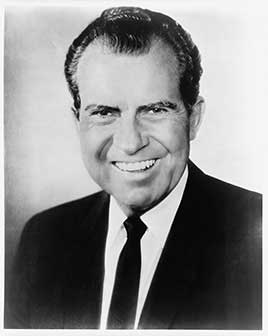
The Family Assistance Plan was not conceived of as an extension of Great Society idealism but more as a technocratic alternative to it: a way to reduce poverty while avoiding cultural and racial flashpoints. By replacing fragmented services and intrusive social supervision with direct cash transfers, Nixon refused to abandon federal responsibility for the poor, and tried to streamline assistance and make it work more effectively.
The plan ultimately failed due to 1) opposition from both left and right, 2) rising inflation, and 3) the end of the brief postwar possibility for consensus that had made such experiments possible.
It may seem surprising that the nation’s most successful attempt to establish a Universal Basic Income came from Richard Nixon, but in the late 1960s U.S. poverty remained widespread despite the Great Society, and economists across ideological lines (including Milton Friedman) argued for a simpler and more efficient system of income support instead of possibly wasteful “social programs.”
In 1969 Nixon introduced the Family Assistance Plan (FAP). Although not pure UBI (it was going to reach low-income families with children and reduced benefits as earnings increased) it contained the core principles of a basic income plan: a guaranteed minimum cash benefit; minimal restrictions on eligibility; centralization of welfare under federal administration and incentives to work by avoiding complete benefit loss as income rose. If enacted, FAP would have been the most ambitious anti-poverty reform in U.S. history.
Why FAP Almost Happened – and Why It Didn’t
The plan drew support from liberals who wanted stronger government intervention and conservatives who recognized the problem of poverty in the USA but preferred providing empowering cash transfers over warm-hearted but often inefficient bureaucracy. Both sides ultimately turned against it: liberals disliked the benefit levels as they were considered too low, while many conservatives ultimately gravitated to opposing guaranteed income as they feared it might destroy the incentive to work.
Although the House passed the FAP twice, the Senate – particularly its more liberal members – blocked it. They believed that rejecting FAP might lead to something better. Instead, the opportunity merely disappeared. In the end, Nixon’s UBI experiment came close but failed, leaving only remnants such as the Earned Income Tax Credit (EITC), which became law in 1975 and remains one of the nation’s most wide-spread, though limited, anti-poverty initiatives.
Why 20th-Century American Utopianism Repeatedly Faltered
The Great Depression and World War II gave Roosevelt the political space for sweeping reform. The Civil Rights Movement, the exposure of entrenched inequality, and a moment of postwar affluence enabled Johnson’s expansive social vision. The deterioration of urban economies and frustration with fragmented welfare bureaucracies in the 1960s pushed Nixon toward an experiment in guaranteed income. Yet these same pressures – economic strain, racial conflict, and a growing sense of social instability – also made sustained reform increasingly difficult.
American politics often oscillates between expansion and retrenchment. Periods of bold progressive reform are often followed by counterreactions. These pendulum swings make deep structural transformation hard to sustain.
Racism has also influenced the fate of social policy. Policies thought of as benefitting racial minorities disproportionately have faced more backlash, even when that perception was inaccurate. This pattern undermined the New Deal’s inclusiveness, fueled resistance to the Great Society and polarized welfare debates in the Nixon era.
In many developed nations, the rights Roosevelt proposed (healthcare, housing, education, income support), became standard aspects of the welfare state. In the U.S., however, there remains ongoing debate about whether such rights are even the government’s responsibility.
In a Nutshell, Where Did Utopia Go?
Politicians began to avoid utopian ideas because inflation made voters risk‑averse, neoliberalism questioned big government and political realignment made broad coalitions for reform nearly impossible to assemble. Add to that a growing resistance to higher taxes and mounting anxiety about the national debt, and impressive, grandiose, transformative projects disappeared.
Even relatively modest reforms became brutal fights. Remember how hard Obama had to push to get the ACA through? After the 1970s, leaders on both sides learned the same lesson: incrementalism was possible, though often hard-fought, while utopianism was dangerous.
Yet, “Utopian” Income Support Seems Essential for Our Survival as a Democracy
History suggests that democracies become most vulnerable when large segments of the population experience chronic insecurity or exclusion. More secure citizens are then more likely to support leaders who promise order, restoration or scapegoats.
Democracy requires that citizens have the time, energy and economic stability to participate meaningfully in public life, voting, organizing, deliberating and holding power to account. When people are overwhelmed with concerns dealing with survival, rent, food, healthcare and child care, their capacity for civic engagement shrinks and those who are more affluent take control of the democratic process.
Income support allows participation for all. In this sense, UBI functions like public education or universal suffrage: it creates the practical conditions under which democratic rights can be exercised.
Did I mention retrenchment?
Each flirtation with utopia may have failed but it left a legacy. Social Security, Medicare, Medicaid, civil rights laws, public broadcasting, environmental protection and the Earned Income Tax Credit are realities that benefit Americans’ lives today. Progress can be cumulative. Yet, there are also political forces that enjoy looking backward and remembering what they perceived as the good old days.
 A movement such as Donald Trump’s “Make America Great Again” can be understood as a type of restorative utopianism: an attempt to fix presently perceived disorder by returning to an idealized past.
MAGA derives from the belief that America once possessed a prosperous and morally unified social order, was supreme militarily in the world and that this condition can be restored through political action. MAGA frames social problems as deviations from a lost norm. Its utopia is not a continuation of progress to a humane goal, but a recovery of imagined stability, hierarchy and national unity.
This backward-looking vision, however, simplifies or whitewashes history, reduces the reality and awareness of social complexity and morphs delusional nostalgia into a political vision. Yet it remains utopian in John Gray’s sense: it posits a new, “corrected” social order achievable through political will, and it promises social redemption through transformation, although it is transformation by going back instead of going forward.
Conclusion
In Black Mass, John Gray argues that the most destructive utopian projects of the twentieth century shared a common goal: they did not seek to redesign institutions but to remake human beings themselves. Revolutionary regimes aimed to create new forms of consciousness or being.
Once utopia depended on transforming human nature, coercion and violence appeared. A glorious social end would justify horrific means. Gray’s critique argues that utopianism becomes dangerous when it demands new kinds of people rather than new and more responsive institutions. Gray argues that the USA showed restraint in regard to this issue, leaving human nature alone to become what it could without government assistance, but supplying government assistance in working toward equal opportunity for all.
Thus, the American utopian experiments considered here are a different category from those that ended in the violence that Gray mentions in Europe and Asia. Roosevelt’s Second Bill of Rights, Johnson’s Great Society and Nixon’s near-adoption of a guaranteed income did not seek to create a new human type or impose a uniform moral vision. They tried to create the conditions for a meaningful human life of responsible, pro-social choices for everyone.
They assumed human beings as they are: imperfect, diverse and self-interested. Our utopian schemes treated poverty, insecurity and social dysfunction as products of institutional failure rather than defective character.
None of these projects demanded ideological purification or personal transformation as a condition of belonging. Our utopianism, such as it is, has been inspired by democratic pluralism and directed at structures rather than souls.
Wait, here’s the big question…
In recent times, visions of social transformation have largely moved to the political right, reframed as projects of restoration rather than progress. Democratic leaders have often relied on utopian rhetoric without advancing ambitious, holistic institutional visions. Barack Obama’s presidency produced some reforms, most notably in healthcare and financial regulation, but these were circumscribed (by his own admission, he was an incrementalist).
They operated as repairs to an inherited system rather than as a reimagining of the social contract, extending elements of the Great Society without articulating a new utopian horizon. The result was caretaker governance without a horizon of social transformation, although people seemed to vote for the implied social transformation inherently promised in a motto like: “Yes, we can!”
Such horizons matter. People want them. We want to believe massive, peaceful, positive social and economic transformation is possible. Yet, the three twentieth-century initiatives looked at here reveal both the possibilities and limits of democratic utopianism: a strong vision can reshape institutions and reduce suffering, but such policies are often expensive, fragile, vulnerable to push-back and hard to sustain.
Whether a future reform movement can combine moral imagination with institutional durability is the big question. What American history shows, however, is that utopian thinking reflects a recurring effort in our country to bring the highest democratic institutional ideals closer to a lived reality for all. Let’s keep looking forward.
Enjoying the content on 3QD? Help keep us going by donating now.