
by Lei Wang
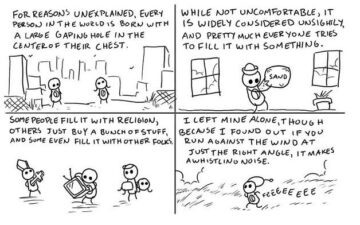
My trick for falling asleep is pretending I actually have to get up to do something else.
I imagine that the alarm has just rung, the obligation must be borne—any moment now, I must leave the cocoon to pack for my early flight or send urgent essay feedback—but I am deliciously malingering in bed.
I fall asleep while distracting myself from feeling the need to fall asleep, instead treating sleep as a rebellious act. This psychology is also how I have experienced the best writing in my life on silent meditation retreats where I snuck in contraband notebooks—writing as a forbidden act—and the best meditation and naps at writing residencies where I’m afraid the secret residency police will catch me not writing.
The only other trick I have for falling asleep is fully accepting the awakeness. But they are actually just one trick, the trick of not trying to do the thing I think I am supposed to be doing. This is also the secret to meditation, by the way, and sex. One of my favorite meditations, via Adyashanti, is the No Idea meditation: how would you meditate, how would you write or love or charm someone, if you had no idea what you were supposed to be doing? And thus couldn’t fail?
Once, forgetting my own tricks and trying very hard to be sexy to someone, I was accidentally funny in a way I have always wanted to be, but maybe only to myself. I made witticism after witticism, nervous joke after joke. Puns leapt into my head one after the other, while I completely left my body. I did not seduce the intended.
Emily Dickinson writes:
Tell all the truth but tell it slant—
Success in Circuit lies
Too bright for our infirm Delight
The Truth’s superb surprise
As Lightning to the Children eased
With explanation kind
The Truth must dazzle gradually
Or every man be blind—
These circuitous truths apply to ourselves as well as to others—we must sometimes hide our own truths from ourselves, in order to live them. As every Joan Didion fan knows, this applies to writing.
I had the best writing of my life—not objectively, but subjectively, the experience of it—on a silent meditation retreat where writing was forbidden because for once, it was something I wasn’t supposed to do. It was the opposite of dutifulness. This is what Elizabeth Gilbert meant when she said you should treat your creative work as you would treat an affair: take advantage even of fifteen minutes in the stairwell. It is the innate human subversiveness to not want to do what is supposed to be good for us, but instead of trying to transcend it, use it.
*
Someone told me recently that my writing is a little cheesy (granted, I asked: “what’s something you haven’t been telling me?”), and now I want to be a little rebellious: how cheesy can I be?
Not trying to fall asleep when it’s not happening—and yet continuing to place myself in the circumstances in which it could happen—reminds me of a definition of unconditional love I heard recently, via the neuroscientist Julia Mossbridge: “feeling loved and loving without the need for anything to change.” Mossbridge says everyone can train to access unconditional love by simply intending to feel it, for two minutes. If you believe in God, she says, pray to feel it. Don’t have any expectations for what it’s supposed to be like. Is anything cheesier than unconditional love and God, earnestly presented?
I am afraid I really am very cheesy, for a writer, though I try to hide it. I am tired of trying to hide it, though it breaks the contract of art. Cheesiness is not coy. Clichés are often true, but so true our brains have glossed over them, thinking we know what they mean. Once upon a time, when the world was new, philosophers only had to think; now, we have to think upon their thinking.
I am tired of being coy with God, about God. “Every book should be a coming out book,” said the writer Diana Goetsch, but coming out about God who is supposed to be dead, as an intellectual, seems worse than anything else. (Of course, I’ve already been coming out, but to say so directly!) And of course, God is just a cliche, a substitute syllable for something I have no real idea how to communicate. My healing teacher says God is just a face we humans give to Mystery, to make Mystery more intimate to us. God is still relatable, while Mystery is ungraspable. He asked us to meditate on Mystery, which I definitely felt as colder than meditating on Divinity, which was warm.
And still, in the tampon aisle in CVS, under the fluorescent lights, I met God. God was in every aisle, in every roll of toilet paper, every tube of mascara. God was in the air, which felt dense and viscous, like walking in water: a presence, a hug from the inside out, interpenetrating. (I really wasn’t on drugs.) And yet it wasn’t a Big revelatory kind of feeling; it was almost subtle, like, “oh, of course.” It did not feel like faith; reality was just reality, not something that needed to be believed in. It was a perception that conceivably could have been there all along.
“Am I making this up?” I asked my therapist, wary of interpretations and my own brain. “Do I just want everything to be divine?” She is a therapist who surely must have her own biases, but said: “Instead of needing something big and bold enough to convince you without a shadow of a doubt that it’s God, why don’t you do the opposite? Ask the world: prove to me that something isn’t divine.”
I thought of the Billy Jonas song that goes, “God is in your strangest pleasure; some say God is into leather / God is into body piercing; in your nipple, lip, and nose ring… God is in the ozone layer; holier and holier.”
Still hard to apply it to the world at large, but starting with my personal world, I have been attempting no exceptions, which means I am not exempt either, with my divine procrastination, divine shrimp crackers, divine Netflix, divine insomnia. I didn’t realize how many things I didn’t really accept before, were outside of my window of unconditional love. There were too many conditions I wanted to change.
Sheila Heti recently wrote about her LSD-infused experience of God:
“God — (my god? a god?) — was this huge, corpulent woman in the sky with lots of flowing, lemon-glazed hair, and her hair spread wide out in every direction, it was curly and wavy, like the clouds and the sea, and at other moments she looked like a 1940s pinup star; and she was gathering into herself all the pleasures of the earth, which she absorbed into herself, in order to also feel it, whenever we experienced pleasure, even just the sun on your face, and she could never be satiated, or too filled up with pleasures. I saw her floating above me, and all these éclairs and lollipops and sweets were hovering in the air around her, and her legs were outstretched, or she had no legs, and her arms were like a pendulum almost, alternately swinging out and gathering in, just scooping and gathering up all the world’s pleasures and pushing them inside her vagina. And she did this calmly, methodically, and she never stopped gathering; in went the desserts, and she was coolly insatiable.
And as I watched her, I noticed she didn’t gather in pleasures that – in their pursuit – had hurt other people. So hurting other people in pursuit of your own pleasure was a sin. And anything that spoiled your own pleasure, like for instance guilt that helped no one when you were trying on clothes, or impatience to be done watching a movie when you had work to get back to – the potential pleasure of those experiences never reached her, and so could be considered neighbors of sin. All this corrected something I’d believed: that pleasure was self-indulgent. Now I realized no, it was holy. That ‘pleasure is prayer’.”
*
I never understood the whole Christian thing of starting as a sinner, but I think I’m starting to get it. If you begin wholly good, then you have to be perfect or else everything is a blemish, like poor words in a new journal. But as a sinner, the only way to go is redemption.
“It is no reassurance to be loved by someone ignorant of those traits and features we feel might make us unlovable,” the philosopher Robert Nozick said.
Maybe all evildoers are testing God: can you love me, really? Can you love me even now? Every act a test of boundaries, like a child acting out. Maybe one can only have unconditional love if there are conditions. Maybe every kink is a form of unconditional love.
I once dated someone who had not had sugar since 2004, who had meditated and done yoga every day without fail for 40 years. He didn’t understand how anyone could consider dessert a “treat” for being good when it was bad for your body. What I loved about him was his secret love for pizza, even though he couldn’t and didn’t eat it (being allergic to both dariy and gluten). I like when people have high ideals but admit they don’t live up to them, like when monks fall in love or are attached to ice cream.
Recently, I found out some disturbing things about a spiritual mentor of mine, someone who saved my life 15 years ago. The series of events that led to encountering him were so uncanny it is not hard at all to think it could be divine, but it is difficult to see his badness now as divine. This secret badness is not an uncommon thing, unfortunately, for spiritual teachers, who must pretend to always be so Good. When you don’t acknowledge your badness, when you hide it and hide it, even from yourself, you build a wall around it, a wall that eventually cracks.
Which is why I think the best religion in the world, while innately very all-accepting, very unconditionally loving, should also keep some minor taboos, for the pleasure of breaking them: perhaps radishes are banned, or sighs, and secret breaths amongst forbidden root vegetables would become the very height of pleasure.
***
Enjoying the content on 3QD? Help keep us going by donating now.