
by Derek Neal
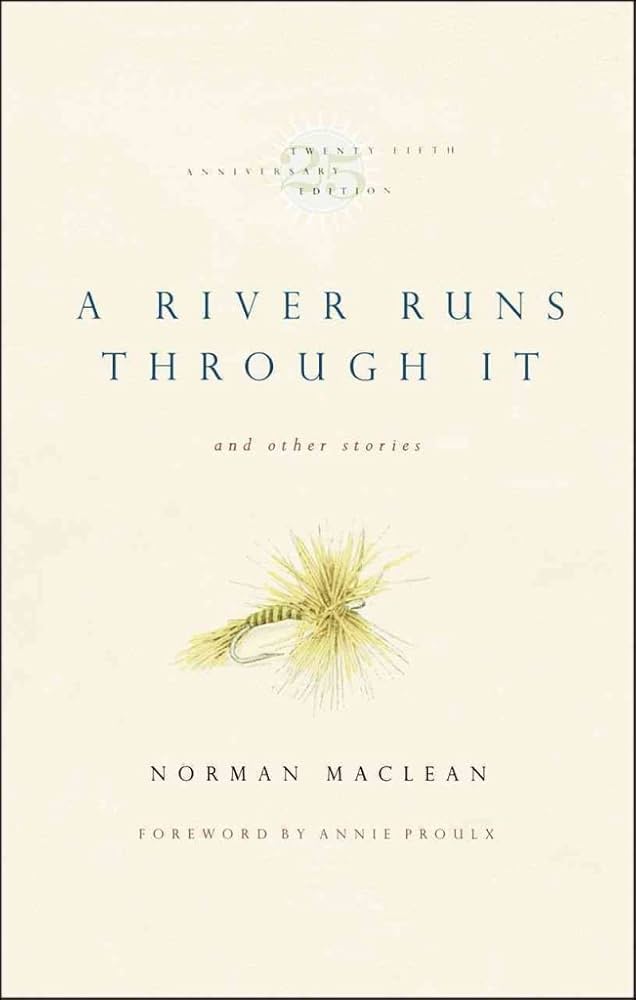 Three weeks later and I’m almost fully healed. My ribs still hurt when I lie down to sleep and when I rise in the morning, but sitting and walking are fine. In another week I’ll be able to return to the gym and attempt some light weightlifting, a welcome resumption of my weekly routine. There was, however, a silver lining to my accident. In the days immediately following it, I could do little else but read. Sitting down in a chair, I was stuck there. So it was that I took A River Runs Through It (1976) by Norman Maclean off the bookshelf in my father’s office and began to turn its pages.
At one time, I’d referred to this book as “my favorite,” but that had been over 10 years ago, and since I no longer owned a copy, I’d forgotten why the book had made such an impression on me. I would soon remember, sitting in the chair and reading the 100-page autobiographical novella over a period of two or three sittings, interspersed with short breaks for more Advil and Tylenol, and to return the ice pack around my side to the freezer. The snow was falling softly on the other side of the large windows in the office, the same snow that I’d been cutting through the day before, turning this way and that on my skis, marveling at my own ability after not having been on the mountain for many years. It really is just like riding a bike, I thought to myself.
Maclean’s book is about the physical, too, about how the body can transcend itself through movement, and it seemed somehow appropriate that I would be reading it in my incapacitated state, allowing me to live vicariously through the two brothers in the story, both excellent fly fishers. The story, in fact, simply consists of a few set pieces built around fly fishing in Montana: the author fishing the “Big Blackfoot” river with his brother, Paul; their fishing the Elkhorn and the Blackfoot with the author’s brother-in-law; a final fishing trip with their father.
These fishing excursions allow Maclean to philosophize about life and to convince us that fly fishing is a spiritual act and the highest end a to which a person can aspire. Much of this comes from Maclean’s father, a Presbyterian minister who raises him to believe that “there was no clear line between religion and fly fishing,” “Christ’s disciples [were] fishermen,” and fly fishing is a “spiritual matter.”
Maclean, as is often the case in these sorts of stories, is the weaker fisherman but the keener observer, whereas Paul is a magnificent fisherman (“he was beautiful,” the father says) but not the writer of his own story. While Maclean never mentions his own career directly, the story is understood to be autobiographical and in real life, he was an English professor. Paul is a reporter (so still a writer, but one focused on facts rather than poetry); he’s also a drinker, a gambler, and a fighter. The body and the mind, the actor and the observer, the spirit and the letter—these dichotomies characterize the relationship between Paul and Maclean (Norman), although we also have to admit that Norman is a capable fisherman and can hold his own in a fight. Still, he’s the brother with fewer natural gifts, meaning he must be the writer of Paul’s story. Maclean never comments on his role as “the writer” (as has become fashionable in contemporary autobiographical literature) because it’s implied that all he has to do is translate Paul’s fly fishing into words and the result will be true, effacing the distance between word and act.
One of the most memorable passages is when Maclean is satisfied with his own fishing and says, referring to his brother, “I sat down to watch a fisherman.” Maclean has just gone through a torturous internal process of overthinking, considering all the best ways to catch and land a difficult fish, before stopping himself when he has “thought too much.” He concludes by writing, “I thought all these thoughts and some besides that proved of no value, and then I cast and I caught him.” To act, one must stop thinking, suggests Maclean.
Then he describes Paul climbing to the top of a rock in the river, which is apparently an ideal fishing spot. It’s understood that this is physically challenging and there is the possibility that Paul could be “swept into the blue below,” but Paul doesn’t plan his actions in advance (“If he studied the situation he didn’t take any separate time to do it”). Maclean writes that Paul, who is now soaked with water, “shook himself duck-dog fashion,” indicating something about Paul’s primal nature—more of an animal than a human.
Next, Maclean describes Paul in a way that will merge human and nature, a key spiritual motif and a way to express transcendence in literature. First, “his clothes looked hydraulic, as if they were running off him.” Then Maclean describes the river: “Below him was the multitudinous river, and, where the rock had parted it around him, big-grained vapor rose,” before describing an effect of Paul’s casting: “The spray emanating from him was finer-grained still.” The river creates vapor, but so does Paul. Slowly, “the whole world turned to water.” Not just the river, but Paul, too.
Maclean continues to describe Paul’s casting, which, because he’s casting his line in a circle, causes the vapor to “enclose him in a halo of himself.” So, not an animal or a human now, but something spiritual: an angel. Through the act of fly fishing, Paul has transcended his finite nature as a physical body, which allows him to merge with his surroundings:
The images of himself and his line kept disappearing into the rising vapors of the river, which continually circled to the tops of the cliffs where, after becoming a wreath in the wind, they became rays of the sun.
If this is all getting too abstract, Maclean also describes Paul’s casting in more concrete detail:
He would cast hard and low upstream, skimming the water with his fly but never letting it touch. Then he would pivot, reverse his line in a great oval above his head, and drive his line low and hard downstream, again skimming the water with his fly. He would complete this grand circle four or five times…
Maclean writes that this technique is called “shadow casting” and is one of Paul’s specialties. For such a great performance, there needs to be an audience. A husband and wife out for a picnic walk by and join Maclean as a spectator. They are transfixed by Paul, but also rendered speechless. The wife says, “My, my!” and the husband, “Every now and then he said, ‘Jesus.’ Each time his wife nodded.” Maclean has done a valiant job in poetically rendering Paul’s fly casting, but sometimes, to properly appreciate beauty, silence is appropriate.
Of course, there is no place for beauty in the modern world, or there is, but it’s continually diminished, which is why Maclean must write the story of his brother, Paul, before it’s too late (Maclean wrote A River Runs Through It at 73 years old, his first published story). In the background of the fishing trips, running like a current, is Paul’s other life: his bar fights, poker games, and overnight stays in the local jail. And encroaching on their way of life is progress, represented by the brother-in-law, a man who bait fishes (no greater sin in Maclean’s world), steals their beer, and lives on the “West Coast,” clearly understood to be a soulless place for those divorced from roots and tradition. In this way, A River Runs Through It comes to resemble a prose elegy, both for Paul and the way of life he represents.
I’ve never been fly fishing. In college, I attended the first meeting of the fly fishing club, but I soon realized that it was not a group for beginners. I joined the inline hockey team instead, more in accordance with my past as an ice hockey player, and I occasionally went skiing on the weekends. I am a good but not exceptional skier—more Norman than Paul—but it’s easy to get carried away when one is on the slopes, especially when there’s fresh powder and a blue bird sky. There is a desire to challenge oneself, to test one’s limits, to go bigger and descend faster. Unless you’re a Paul, this is how you end up hitting a tree on your last run (never say it’s your last run), nursing your ribs on Christmas day at your childhood home, reading about the glorious exploits of someone you thought you could be.
Enjoying the content on 3QD? Help keep us going by donating now.