
by David J. Lobina
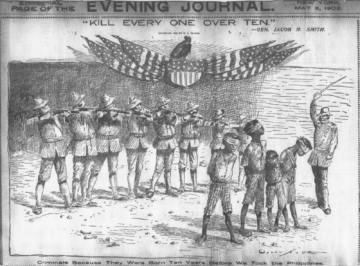
In a previous post, I joked that one of the most annoying things about living in an American world is the cultural hegemony that US soft power sort-of imposes everywhere. In that piece, I was concerned with the connotations that political concepts such as liberalism and libertarianism receive in US commentary, as these meanings vary to how these terms have been traditionally understood in Europe, where they originated, and some shifting of meaning has taken place in European discourse recently because of American influence, especially, as ever, in the UK (similarly for fascism, and even worse, sadly; see here). In the event, I did note in the article (endnote 1) that I was joking: the worst thing about living in an American world is US imperialism, with all the violence that derives therefrom.
More recently, in a series of posts on the legacy of Francisco Franco (last here), the Spanish dictator who provoked a civil war and then ruled Spain for close to 40 years, I argued that Franco’s actual legacy is the staggering number of dead people he left behind, many of whom were executed and buried in mass graves, their remains unlocated to this day.
Putting these two strands together, and in the context of the recent, blatant violation of Venezuelan sovereignty and the kidnapping of its head of state by US forces, I couldn’t help but feel that the human cost of the raid was not being discussed enough in most commentary. Yes, there are many important ramifications and some interesting discussions out there regarding previous US interventions in the region (here and here), the mostly meek response of US media (here), or the role of Venezuelan oil in all this (here), but one issue is usually mentioned only in passing: more than 50 people lost their lives in the raid, many of whom were simply doing their job, and some were in fact just bystanders (here and here).
And so I thought that instead of adding to contemporary commentary and write about this or that political aspect of the raid, I would this time post a list of conflicts the US has been involved with since the second world war, along with the number of people killed in these conflicts.
I do not offer much commentary and I do not intend to explain anyone’s actions in this list. My aim, instead, is to highlight that the vast majority of these people lost their lives because of explicit US actions; in some cases the US was directly responsible for the deaths, whilst in other cases the deaths were caused by actors who were being actively supported by the US and more often than not the US was fully aware of the human cost. As a matter of fact, most of these deaths were perfectly preventable, but alas they were accepted by the main actors. At the very least, I hope to convey how overwhelming the number of dead people in these conflicts actually is.
The following list is rather selective and thus not exhaustive in any way, and I’m sure some details are controversial and moreover disputed, but here it is:[i]
– In the 1940s and 50s, the US was heavily involved in Asia. This included support for Chiang Kai-shek in China, with American troops stationed there until 1947, where they carried out actual military operations. Further assistance was provided to Chiang in order to relocate to Taiwan when he started losing the Chinese civil war, and by 1949 US aid to Chiang’s Nationalist movement had amounted to 2 billion dollars in cash in addition to military hardware and training. As a case in point, in 1947 Chiang faced a political uprising by the Taiwanese, which was put down forcefully, the dead numbering between 18,000 and 28,000 in total (see, for instance, here).
– In the Korean War, the US was a direct belligerent, and though responsibility must be shared with China and the Soviet Union, total deaths in the war come up to at least 3 million people. Nevertheless, the bombing of North Korea by the US Air Force in the 1950-53 period may have cost over 200,000 deaths alone (here), and to this day North Korea remains one of the most heavily bombed countries in history (see infra).
– In 1953, the US and the UK orchestrated a coup d’état in Iran to depose the government of Mohammad Mosaddegh. At least 200 people were killed.
– In 1954, the US engineered the overthrow of the Árbenz government in Guatemala and the imposition of a military dictatorship headed by Carlos Castillo Armas (Operation PBSuccess). The rule of the latter included the execution and forced disappearance of unknown numbers, estimates ranging from a few hundred to the thousands. There were no free elections until the mid-1990s in Guatemala, one dictator followed by another, with the US keeping its support to military rule throughout. The subsequent civil war resulted in hundreds of thousands of people killed; the mass killing of Maya people alone, a particularly cruel policy of the military regimes, cost up to 150,000 lives (here).
– In the 1950s, the US carried out a number of coups in Indonesia to depose Sukarno, with no success. When Suharto rose to power in the mid-1960s, he received US support in terms of military training and aid, and this lasted well into the 1990s. During the purges of 1965-66, at least 500,000 were killed in Indonesia (here), whilst the invasion of East Timor in 1975 and the subsequent mass killings there added up to 170,000 dead (here). It is worth adding that during the 1965-66 period Suharto was supported by both the US and the UK, whilst during the invasion of East Timor he received diplomatic and military support from both the US and Australia (see here for more background on the latter).
– In Europe in the 1960s, the US was involved in Operation Gladio, a set of clandestine operations, mostly directed against left-wing parties. In Italy alone this translated in support for terrorist attacks by neo-fascist groups as part of a so-called strategy of tension. Some 400 people were killed in various attacks, including at busy train stations. (This wide-ranging conspiracy deserves an entry of its own at 3QD; come back anon.)
– In the Vietnam War, the US conduced the heaviest bombing campaigns in history, and this included Cambodia and Laos too, who were not initially involved in the war (some operations were covert). Apart from the close to 60,000 US dead, the war claimed the lives of perhaps more than 3,000,000 people in Vietnam, Cambodia, and Laos combined (see here).
– In 1964, the US supported a coup in Brazil, and so then a military dictatorship lasting until 1984. The regime conducted extensive torture, extrajudicial killings, and disappearances, with over 400 political deaths and disappearances on record (see here).
– Ever since the Cuban Revolution, the US has consistently conspired against Cuba. One tactic has been the series of embargos the US has imposed since 1960, affecting every facet of life in the island (economic, financial, health, food, and medicine), though its overall impact, especially in terms of lives lost, is difficult to quantify (but there can be no doubt that the human cost must have been great). This was compounded by an actual invasion attempt and the setting up of a programme of terrorist campaigns and assassination attempts (Operation Mongoose) immediately set up after the failed invasion. Hundreds died during the Bay of Pigs invasion, whilst acts of terrorism may have claimed up to 3,000 dead, these acts often backed by the US explicitly.
– In 1973, the US was instrumental in not only supporting a coup in Chile, but also in consolidating and supporting the dictatorship of General Pinochet that was soon imposed in the country. Over 50 people died in the coup itself, and over 3,000 people were eventually executed and disappeared by the regime. More generally, Operation Condor, a campaign of repression against left-wing politicians and sympathisers in South America, was set up in 1975 with the participation of Argentina, Chile, Brazil and a few other countries, supported and financed by the US. Up to 60,000 people may have been killed in covert operations during this time (here), the programme coming to an end when military rule in Argentina ended in 1983 (see here for a general background).
– In 1979, the US did not oppose the Salvadoran coup d’état – one military dictatorship replaced with another, at the end of the day – and in fact promptly supported the junta that was to rule the country until 1982. The coup also initiated a civil war, with the US providing the usual economic aid and advice, and of course military training and equipment. By the time the war came to an end in 1992, over 60,000 civilians had been killed and over 5,000 were disappeared, with estimates that 85% of the atrocities were committed by government security forces.
– Ever since the Sandinista Revolution, the US has consistently conspired against Nicaragua, to the point that the it provided military assistance and financial aid to the Contras, right-wing paramilitary squadrons, even clandestinely so. The Contras committed numerous atrocities and acts of terrorism, including targeted attacks against civilians. Estimates are hard to come by, but this study from 1988 alleges over 2,500 deaths were due to the Contras, though the real number is likely to be higher, with the total killed during the overall conflict (1978-1990) reaching at least 40,000 people.
– In the 1980s and all the way to the 2000s, US involvement in the Middle East has concentrated the greater number of deaths. First up there was the Soviet-Afghan War in 1979-89, where the US funded and trained some of the Islamist militant groups that would later morph into al-Qaeda and the Taliban, though at this time they were allies in a war against the Soviet Union and their proxy regime in Afghanistan, the result at least 10,000 Soviet deaths, over 60,000 deaths for the Afghani military forces, and possibly a million civilian deaths. Then there was the Gulf War in 1990-91, with the US a direct belligerent, this war claiming the lives of at least 150,000 people (this includes various internal conflicts). Then there was the War in Afghanistan (2001-2021), with the US after both al-Qaeda and the Taliban this time around (the latter are of course now back in power), a war that cost the lives of more than 150,000 deaths. And finally there is the Iraq War (2003-2011), which may well have resulted in over 600,000 people being killed.
Not an exhaustive list, as I said, though these are the most lethal conflicts the US has been involved with since the second world war, and the numbers are certainly staggering.
[i] My main source here is William Blum’s Killing Hope book (the CIA amusingly offers a pdf version of it here), with the addition of other sources (the Encyclopaedia Britannica, Wikipedia, and again, the CIA website) to cross-check numbers and dates through other sources.
Enjoying the content on 3QD? Help keep us going by donating now.