
by Ashutosh Jogalekar
We shall not cease from exploration.
And the end of all our exploring
Will be to arrive where we started
And know the place for the first time. —T. S. Eliot
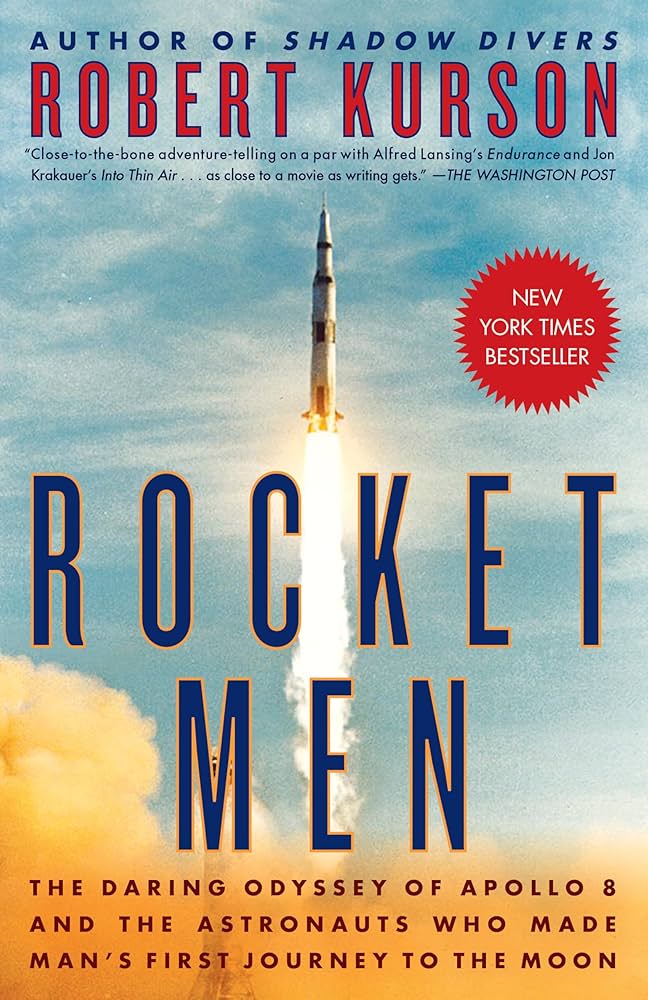
Robert Kurson closes Rocket Men: The Daring Odyssey of Apollo 8 with a deceptively simple scene. Decades into the twenty-first century, he takes his teenage son, armed with an iPhone, an Xbox, and all the distractions of modern technology, to see a Saturn V laid on its side, bursting out of its building. The boy doesn’t check his phone. He doesn’t take a picture. He just stands there, staring at the five enormous F-1 engine nozzles, each taller than a person, and after several silent minutes asks if they can stay longer. The Saturn V guarantees turning every person, no matter how young or old, into that boy.
I had just returned from a visit to NASA myself, standing beneath the behemoth and feeling something close to vertigo. You can know the numbers – 363 feet long, millions of pounds of thrust, nearly a million gallons of propellant – and still be unprepared for the physical reality of it. The rocket overwhelms abstraction. Like Kurson’s son, I found myself wordless, pulled into a long stare, asking the same unspoken question: how did anyone dare build this thing? Rocket Men provides part of the answer.
What the book does better than almost any account of Apollo is make the case that Apollo 8, usually treated as a dress rehearsal for Apollo 11, may have been the most consequential spaceflight of them all. Apollo 11 was about arriving. Apollo 8 was about leaving, about the first time human beings severed the umbilical cord to Earth and committed themselves to a quarter-million-mile journey with no rescue, no precedent, and no margin for error. Apollo 11 astronaut Michael Collins’s later remark, quoted near the end of the book – that a century from now Apollo 8 might be judged more significant than Apollo 11 – sounds provocative until Kurson patiently shows why it may simply be accurate.
He begins by placing Apollo inside a nation that had lost its sense of technological inevitability. The United States, fresh from ending World War II with the atomic bomb, should have been first into orbit. Instead, Sputnik rose into the sky on the same night Americans tuned in to the debut of Leave It to Beaver. Kurson’s juxtaposition is devastating: while the Soviets leapt forward, America appeared comfortable, suburban, complacent, fat and happy. The Space Race becomes not spectacle but self-diagnosis.
From there, Kurson shows how the response quickly became structural. Eisenhower’s National Defense Education Act poured billions into science education, reshaping classrooms as much as launchpads. He humanizes the Soviet side through Yuri Gagarin’s flight – nearly ending in disaster, resolved by an emergency ejection and a landing far off course – and that almost mythic moment when a woman and child encounter him, an alien materializing from outer space, in a field and he reassures them, “I’m one of yours… don’t be afraid.” Spaceflight, Kurson reminds us, was messy long before it was heroic.
The emotional hinge comes with Kennedy’s visit to Cape Canaveral in November 1963, when he stands in wonder beside von Braun as men in shirtsleeves and ties explain the Saturn V. Six days later Kennedy is dead. Apollo, from that moment on, carries the weight of unfinished national promises.
The core of the book—and its sustained tension—lies in the decision to send Apollo 8 to lunar orbit in December 1968. Kurson makes clear just how close this decision was to institutional heresy. No human had ever traveled more than 853 miles from Earth. Now George Low was proposing to send three men a quarter-million miles away, months ahead of schedule, skipping two missions and violating NASA’s incremental philosophy. Frank Borman’s answer—“Yes, Deke. Let’s go to the Moon”—lands with almost frightening calm.
Borman is not portrayed as a romantic explorer. He has little interest in glamour or adventure. He joined NASA to fight the Soviet Union on the Cold War’s newest battlefield. Kurson doesn’t soften that motivation; he uses it to give Apollo 8 moral sharpness. This was exploration driven by geopolitical necessity as much as curiosity.
Kurson returns again and again to the central terror of the mission: the Saturn V had never flown humans. It had been tested only twice, and the second test nearly ended in catastrophe. If Apollo 8 flew in December, there would be no third test. The next Saturn V flight would carry Borman, Lovell, and Anders atop nearly a million gallons of propellant with the explosive potential of a small nuclear bomb.
The urgency infects everything. Meetings are called with hours’ notice – pack a sandwich, find a plane, be in Huntsville by mid-afternoon – and everyone arrives. For a brief moment, a vast bureaucracy behaves like a single organism under pressure.
Kurson excels at turning technical demands into images that linger. Orbiting just 69 miles above the Moon requires precision equivalent to throwing a dart at the fuzz of a peach from 28 feet away—while the peach hurtles through space at 2,300 miles per hour. Trans-lunar injection doesn’t “escape Earth” so much as stretch an orbit into a long ellipse that intersects the Moon at exactly the right moment. The spacecraft must rotate slowly in “barbecue mode” to avoid frying one side and freezing the other. Subtle mass concentrations – mascons – beneath the lunar surface tug invisibly at the spacecraft, threatening to warp its orbit into a fatal descent.
These details aren’t indulgence. They serve Kurson’s deeper point: Apollo 8 worked because the universe turned out to be predictable, and because human beings had learned to read that predictability to the split second. When Mission Control realizes orbital mechanics have behaved exactly as calculated, the response isn’t triumph, it’s relief tinged with awe.
The astronauts emerge as fully dimensional people. Borman’s defining ethic—“do not quit, stay in there and pitch”—is matched by contradiction: disturbed by nuclear imagery in political ads, yet ready to deploy the same weapon if ordered. Susan Borman’s parallel story is one of the book’s quiet triumphs. She refuses the stoic astronaut-wife role, admits fear publicly, and later prepares Frank’s eulogy in advance so that, if he dies, she and not the government will decide how his life is honored.
Jim Lovell is framed through lineage. Kurson recalls the ridicule Robert Goddard endured for imagining rockets in vacuum, and Goddard’s reply that every vision is a joke until it becomes commonplace. Lovell navigates to the Moon using a sextant and stars—ancient tools guiding the most modern vessel ever built—linking centuries of human exploration in a single cockpit.
Bill Anders is steel tempered by responsibility. Kurson recounts a wartime moment when shrapnel pierced Anders’s throat and he wrote orders in his own blood, and later describes his Cold War service flying interceptors armed with nuclear-tipped missiles. Two switches, thrown by two men, could have started World War III. “That’s the Cold War,” Anders says. “It’s up to us not to screw up.” After orbiting the Moon, no corporate crisis would ever feel existential again.
The book refuses to sanitize the body. Zero gravity amplifies discomfort. Illness becomes dangerous. Bathroom breaks are hour-long ordeals involving adhesive collars, fingertip scoops, and germicide packets kneaded into waste to prevent gas buildup and explosion. When Borman becomes violently ill in lunar orbit and blobs of diarrhea float free in the cabin, Lovell and Anders chase them down like butterflies. The scene is grotesque, funny, and essential. Heroism here is not clean.
All of this unfolds against the wreckage of 1968—assassinations, riots, Vietnam, Chicago, Columbia, a country unsure it can be put back together. Then comes Christmas Eve. From lunar orbit, Apollo 8 reads from Genesis. Earth rises—blue, radiant, boundaryless—over the Moon’s gray horizon. Anders sees the planet as a Christmas ornament and realizes that without borders, without familiar reference points, what stands out is not division but proximity. From that distance, it is no longer possible to see nations or ideologies—only a small, fragile world suspended in darkness.
It is one of history’s great ironies, and Kurson captures it beautifully: the mission was conceived to explore the Moon, yet its most enduring revelation was not lunar at all. By leaving Earth for the first time, humanity finally saw it—whole, finite, and shared. They went to discover the Moon and ended up discovering the Earth.
The response on the ground is one of stunned unity. Mission Control weeps. A party falls silent. So does a renowned composer who has always believed the whole thing to be a gigantic waste of taxpayer money. A single anonymous telegram captures the moment better than any speech: THANKS. YOU SAVED 1968.
Kurson closes the circle by returning us to aftermath and scale. Earthrise becomes an icon. Lawsuits are filed and dismissed. Astronauts return to ordinary lives: Borman pumping gas for access to a garage lift; Anders rescuing a major corporation with the calm of someone who has already stared into infinity. Humanity, having gone so far, has never returned.
Standing beneath a Saturn V, you feel small. Reading Rocket Men, you feel steadied. Kurson shows how a handful of people—armed with slide rules, judgment, courage, and an unflinching acceptance of risk—proved that the universe could be navigated, not just admired. Apollo 11 showed us we could arrive somewhere new. Apollo 8 showed us we could leave home, look back and, in the spirit of T. S. Eliot’s quote, understand what home really is.