
by Mike Bendzela
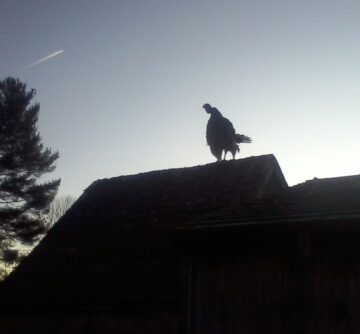
The recently passed American holidays of Thanksgiving and Christmas are decidedly irreligious affairs in our starkly secular, two-person household. The tall tales and deeply rutted customs reduplicated and reenacted by the general population barely register with my spouse and me — except for the notion of ritual sacrifice. Every year we enact one sacrifice for each holiday, of our own free will (if such exists), even though it disturbs me a little. It feels at times as if I’m harrying myself rather than satisfying my curiosity for hands-on experience procuring food, but in the end there is something cleansing about it. I’m able to look squarely at the central fact of our existence as heterotrophs on Planet Earth: Life consumes life. Not just that, sentient lives must consume other sentient lives. The rest are just algae of one sort or another (not that there’s anything wrong with that).
Ritual sacrifice. Nobody escapes this essential detail of life on the planet, but most simply farm out the detail out to someone else. They have to, for it is impossible for the N-and-a-half million citizens of a large eastern city to have poultry houses or pig pens in their backyards, just as it is impossible they should have neighbors who raise cattle from whom they can buy half a side of grass-fed beef. Because of the sheer magnitude of the human enterprise, we must have feedlots, which have become modern necessities. It follows that antibiotics are necessities as well (to stem mass animal plagues in addition to fortifying growth), and pesticides are necessities (to keep square miles of feed grain unmolested by arthropods), and genetically modified organisms are necessities (to outpace natural selection, which produces antagonists that happily exploit every weak spot in our domesticated stock, given the chance).
One reason why I engage in a hands-on sacrifice of a couple of turkeys every year is that it forces me to think about these issues, as overwhelming as they are. And after the holidays, when the mass slaughter of 46 million turkeys in the US is over, it looks less like thanks being given than appetites being indulged. But there is no way out of this feeding frenzy, not for any of us. . . . And so I rub my own face in it every fall.
Instead of honoring them, we recite outrageous lies about the star animals of our holiday feasts, like that they are so stupid they gaze up at falling rain with their beaks agape until they drown. Perhaps such myths help us justify these creatures’ extermination. How can something so dumb be permitted to live? Let’s do the miserable beasts some good by slow-roasting them in a 275-degree oven.
Now, the modern, domesticated turkey is indeed a grotesque, even pathetic thing, but it’s not their fault. They have had thousands of years of human tampering to make them what they are today, starting with the indigenous peoples of Mexico and Mesoamerica, who first corralled and groomed wild birds for consumption. By the time the conquistadors arrived, turkeys were already fairly altered by artificial selection. These birds were then spirited back across the Atlantic, where they soon became brokered through the country after which they were (absurdly) named, Turkey, a place known for its trade in gallinaceous comestibles. (I like the Northeastern Abenaki name much better, nahamak.)
The wild forebears of the birds on our dinner plates are anything but grotesque and pathetic. Study a wild flock of Meleagris gallopavo and you will discover a collection of bright, wily animals. I’m happy to see them touring in flocks through our fields here in Maine in the spring. Several females stroll along the perimeter of a bustling crowd of poults, keeping their eye out for wild and human interference, while their chicks feed on insects in the tall grass. The hens’ black snakey heads stick up from the field like periscopes; if they see anything approaching they will hustle the crowd of chicks off toward the woods. And if startled outright, they will do something spectacular: All birds, hens and poults alike, burst into noisy flight all at once, soaring for several hundred feet until they come to rest high in the boughs of some White Pine trees. A domesticated turkey couldn’t fly like that if you launched it in a trebuchet.
I have wondered, in fable form, what a dinner turkey such as the Broad Breasted Bronze would think upon discovering its heritage, comparing itself now to what it was way back when:
The Bronze
A young, domesticated turkey despaired upon learning the truth of his species’ pedigree. Meleagris gallopavo was not historically sedentary, nor so broad-breasted as to be anchored to the earth, nor totally reliant on the flat-faced ape to propagate their kind. They used to be agile, wild animals, but no more.
The youngster voiced his anguish to his mother: “You never told me we are descended from birds that could fly! We ate nuts, berries and insects instead of just corn, and we even raised our own families! What happened to us?”
“Success, child!” the hen said. “Sometimes you have to cater to the tastes of your benefactor.”
If proliferation is the sign of evolutionary “success,” then the domesticated turkey is a runaway champion. It has produced variants that have caused it to benefit greatly from the forces of artificial selection. Why, in a single year over a quarter of a billion birds come under the knife in the US alone.
*
When I first moved to Maine in the mid-80s, my partner and I used to raise six to eight Broad Breasted Bronze turkeys every year, kill and clean them ourselves, and sell a few to friends and neighbors. We earned some pocket change in addition to two free, full roasting pans, one at Thanksgiving and the second on either Christmas Day or New Year’s Eve. At our peak, we raised around a dozen birds, but instead of processing them ourselves we began hauling them in a trailer to a local butcher shop, as our low-tech backyard operation began to seem more like an ordeal than a hobby.
Over time, the total cost of chicks, grain, and processing became ridiculous, and it got embarrassing to mumble to customers that the price of their 20-pound bird was now close to one hundred dollars. It was worse when we raised heritage breeds — Bourbon Red, Royal Palm, Narragansett — which are lovely birds, but small (even scrawny). The hatchlings were wicked expensive to buy, so the finished birds provided woefully low bang for the buck. We tried holding back two Bourbon Red hens and a tom for breeding stock. Don built a cute little nesting box for the hens, and together they incubated a batch of about twenty-four speckled, fertile eggs. Thirteen hatched and nine chicks survived. We sold some of the mature birds and ate the rest, but the work was a bit much.
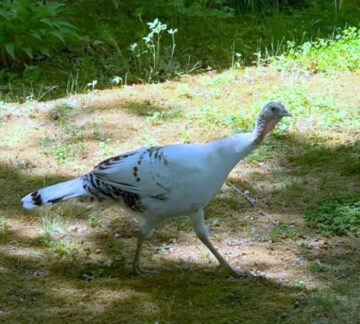
So we settled on raising a few White Hollands for a while, which are at least large enough to look picturesque on a platter. Today, all we can find for chicks in grain stores is its hyper-inflated descendant, Broad Breasted White, a quick-growing breed that is almost literally the workhorse of meat birds. The cost to customers is still ridiculous (though in the past few people have complained; farm-raised birds occupy a special place in people’s imaginations, including my own). So we have stopped raising birds to sell, and we just raise two or three for ourselves (one is almost guaranteed to die).
It has become a seasonal ritual for us to slaughter these birds, one-by-one, from November through December, for the holidays and as freezer stock. My husband and I share the work: I kill, pick, and wash them; he puts them on a board in the kitchen and cleans them. I cannot bring myself to handle offal, and Don is meticulous and pretty adept at bird cleaning, having gotten his start back in the 1970s when his cat, Tom, hauled a fat partridge into the dooryard. Like him, I’m self-taught at this, using a terrific old book called Starting Right With Turkeys, first published in 1946. By raising and processing a few birds ourselves, we save a little money and have plenty of poultry in our freezer. It seems well worth the effort — until learning that a friend of ours who has bought birds from us in the past got a free Thanksgiving bird from a store after buying 150 dollars worth of groceries. So much for the monetary benefits of raising birds at home. At least with a knife in hand I get to experience directly the actual costs of being a creature who eats other creatures.
*
“Thanks for the wild turkey and Passenger Pigeons destined to be shit out through wholesome American guts.” William Burroughs is not my favorite writer (or person) in the world, but his prayer for “Thanksgiving Day, November 28, 1986” does capture for me the horrors enacted by a bloated civilization that seems eager to push vast sections of the planet toward extinction. I last partook directly in this bloodletting this past solstice, when I captured the year’s last turkey in the poultry house, tied her claws together with baling twine, and placed her into the bed of my little pickup truck.
It is important (for me, anyway) to make sure she goes quietly, without being startled. By mid-December, she has grown far too large and can barely walk, so it takes little effort to grab a naked leg (which feels thick and cold as a tree branch) and pin her to the floor. Quietly, slowly, I get the twine looped around her claws, and soon we are coasting down the hill in my pickup toward the orchard. I back up close to the nearest mature tree and carefully lift the bird off the tailgate. I get the twine looped and secured around a sturdy limb and let the bird hang. Back in mid-October, I had to kill a tom early as it had grown so huge it lay almost continually on its breast and the feathers had worn off completely to the skin. That’s what happens when you raise Broad Breasted Whites and keep them longer than four months. Domesticated birds are not bred for longevity, to say the least. This tom was so huge I couldn’t lift it into the tree myself and had to have Don come out and help me tie it off on a tree limb. My guess is that it weighed over thirty pounds.
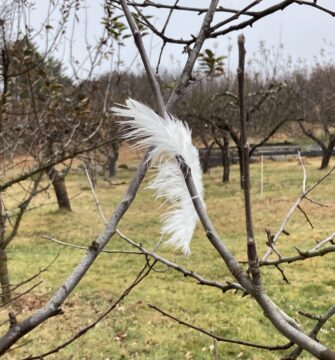
Today’s hen, thankfully, is not so hefty and seems unaware that anything is amiss, at least as far as I am able to determine from her placid demeanor, as she hangs there twisting slowly by the twine. What happens next goes according to the directions in Starting Right With Turkeys:
There are two distinct operations in proper killing.
First: If you are right-handed, hold the turkey’s head in your left hand — the palm cupped around the back of the bird’s head, the throat facing you. Then, by means of the razor-sharp knife in your right hand, slash the bird’s throat deep enough to cut the blood vessels in the neck and get free bleeding.
Second: Follow quickly by sticking the knife in through the mouth and slicing into the back portion of the brain, which instantly loosens the feathers.
It figures that in the middle of stripping feathers off the bird, a sharp, ugly wind rises directly out of the north and strikes me in the face. You cannot pick a bird while wearing gloves, and the picking has to go fast or the feathers will tighten again, making them difficult to pull, so I work bare-handedly in the chill, trying to stuff the feathers into a plastic-bag-lined trash can, all the while smaller feathers and down get scooped up by the wind and blown throughout the orchard like snow. This “dry picking” is slow (with larger flocks we would use a scalding water dip to loosen feathers), and after several minutes of yanking out the large primaries and secondaries from the wings, the retrices of the tail, and the smaller body feathers, I begin the tedious work on pin feathers and down. When I have the majority of the feathers removed and bagged, I’m struck by the bird’s pitiful reptilian appearance.
It cut the twine and let the bird down from the tree. I chop off its head with an ax and haul the carcass into the yard to be sprayed off with a hose. Eventually, the bird ends up in the woodshed, lying on its back, claws still attached, awaiting Don’s ministrations with the gutting knife once it has cooled down.
This turkey is at the nadir of its humiliation: Not yet food, hardly bird; a naked, headless thing with theropod stompers still attached, grasping at nothing. Poor dinosaur, I can’t help thinking. You survived the Chicxulub impact for this?
Sources
“Bronze,” from Metazoan Variations: Evolutionary Fables and Other Emblematic Tales. Ellicott, MD: UnCollected Press, 2020.
Starting Right With Turkeys, written by G. T. Klein for The “Have-More” Plan Reference Library. Charlotte, VT: Garden Way Publishing Co., 1972, significant portions of which were published in 1946.
Thanksgiving Day, November 28, 1986, William Burroughs. https://realitystudio.org/texts/thanksgiving-prayer/
Images
Photographs by the author.
Enjoying the content on 3QD? Help keep us going by donating now.