
by Barbara Fischkin
Another eight weeks have passed since I wrote about my Cousin Bernie—and how, posthumously, he adds to my understanding of him. To review: Earlier this year I wrote two chapters about Cousin Bernie completely from memory. Then his widow, Joan Hamilton Morris, sent me more material—pages she’d found of an incomplete memoir her late husband pecked out on a vintage typewriter in an adult education class he took after retiring as a university professor of psychology and mathematics.
If Cousin Bernie were alive today he would be 102, 32 years older than I am now. Each time I take a deeper dive into the pages Joan sent me, I realize I have only skimmed the surface. And so, here is my fifth take on my cousin, who fascinates me despite his evergreen persona as a nerdy, chubby, lost boy from Brooklyn. This, in part, is the saddest offering from my cousin’s own memoir. It may—or may not—be the final one. A chapter about his interest in radios, as a child—and in being a ham radio operator in his retirement— might appear one of these days.
Again, I will let Cousin Bernie tell most of his story, this time about how having a schizophrenic mother affected him, in ways both obvious and veiled. His memories also offer a look inside an earlier time when mental illness in a family was far more shameful and misunderstood than it is even today. To review more: When I was a child my mother told me that Cousin Bernie’s mother was dead. She was my father’s mysterious, absent sister, that is all I was told at first. I now wonder if my mother wanted to put as much distance between herself and this sister as she could. It was bad enough that they sort of shared the same name. Cousin Bernie’s mother’s maiden name was Ida Fishkin. My mother’s married name was Ida Fischkin. I believe my mother also wanted to protect me from fear. She apparently believed that a dead aunt was not as scary as a living ghost, locked up in an institution for years, as Bernie’s mother was at the time.
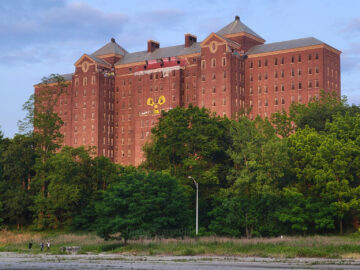
I was not told the truth about my long-lost aunt’s institutionalization until I overheard a conversation my mother had with Cousin Bernie about whether he was going to visit his mother. She may have been at Kings Park Psychiatric Center, as shown in the image above. Or at Hudson Valley Psychiatric Center in Poughkeepsie, where she was moved, later. Although New York began to deinstitutionalize mental patients in the 1970s, with the goal of moving them to community-based facilities, that reform did nothing for Cousin Bernie’s mother. She may have been too far-gone. Or, perhaps, as in many cases, the state had no appropriate place to move her, no place where she could receive the care she needed. I doubt I will ever know. There are records that show she spent an unclear amount of time at Kings Park. It seems she was moved around a lot without any consideration for the distances her family had to travel to visit her. During the years I worked as a young reporter for Newsday, the large Long Island-based daily newspaper, I covered the town of Smithtown, which included Kings Park and its then still-open psychiatric center. My Aunt Ida was probably long gone from there by then. I only found out that this was one of her “placements,” after I went to her graveside funeral and then called a state public relations officer who, in a cursory manner, checked the records for me.
The second part of this chapter focuses on Cousin Bernie’s own view of his paternal grandmother. Bernie and his younger sister, Gertie, schoolchildren at the time, went to live with their Bubbeh Rachel a year after their mother was “put away.” Family stories portray this grandmother as a stringent Orthodox Jewish woman, who was also mean to these two motherless children she was asked to nurture and protect.
Bernie wrote some different, kinder tales about his grandmother.
Here, much of it in his own words is Cousin Bernie, first on his mother and then on his grandmother.
“My Hidden Emotions’
“There are two images that have had a great tug at my adult emotional life. The first concerns a sculpture of a bush full of brambles. Just jagged branches. It is in a church in Florence with the Giotto bell-tower outside. It was the summer of 1960 and I was doing my post-degree European tour. I had attained my PhD and a secure job at Drake University, Des Moines, Iowa.
“I was tired of so many churches. As I walked around this bush of brambles, it suddenly became a pieta. There was a mother holding her dead son in her lap. This I could understand. I have often wondered since, if there was a similar prickly sculpture of a son holding the slight body of his mother.
“The second image came to me when a colleague who lives on a farm outside of Indianapolis started to tell me of the dog problem. It seems that folks drive out to rural areas, let their pets out to play and quickly drive off. I can see the doggie tired after chasing the family car, with a daunting, bewildering shock of abandonment.
“These images are part of my emotional make-up having to do with my mother. We lived on Prospect Place, Brooklyn, above a barber shop and a half block from a pushcart street market. We had moved back from Bridgeport, Connecticut so that my mother could care for our [maternal] grandmother who was paralyzed because she refused to take her insulin. There were, in addition to bedridden grandma Toby, my alcoholic grandfather, my father, my sister, myself and my three uncles. [n.b. One uncle was Barbara’s father, David Fischkin].
“One evening. my mother asked my sister and me to accompany her to my cousin’s apartment a few blocks away. She was dressed for the occasion, but she seemed to be mumbling as she walked. At the apartment she continued to mumble and asked us all some strange embarrassing questions.
“The next morning the family doctor was in my parents’ bedroom. My mother had had a ‘nervous breakdown.’ My father spent the next year dressing my mother, walking with her around a deserted city block, and giving her showers. After a year or so she was admitted to a fancy mental institution in New Jersey. There she became violent, ripped up a few dresses, and was transferred to a [New York] state institution.
“ We moved into an apartment at 311 Hopkinson Avenue where my paternal grandmother Rachel lived. She had offered to take in my father and and his two children. Our savings had been pretty well depleted in the first year of my mother’s illness. But my father was able to get work. My sister and I attended school and attempted to clean house. I must have been eleven at the time and my sister nine.
“On Sundays we packed lunches and set out with my father to visit my mother at the King’s County Hospital Complex. This was at least not too far away. My mother might have recognized us at this time, but she was busy mumbling and speaking to persons who simply were not there. Then she was transferred to Creedmoor State Hospital, [in the New York City borough of Queens] which for us seemed to be pretty far out on Long Island. We visited her there.
“As the years went by I completed high school and went on to Brooklyn College. My sister completed high school and became an advertising department clerk and messenger for the New York Post. My father began seeing a widow who had a young son. World War II came and went. My mother had a number of experimental treatments and nothing helped. She was now in a state hospital in upstate New York which meant a weekend trip to visit her. The frequency of the visits dropped off. And my father died. He had developed painter’s colic.
“As the years mounted further, I chose to major in psychology. Out of the blue my sister was married to a solid, stable gentleman. I was having trouble entertaining women on dates. I lectured too much. And the medical profession did not help, with its noting that my mother was schizophrenic, a diagnosis I may have revealed too often. Somehow, at the age of 47, I met the lady I thought was right for me. There were problems but things have worked out wondrously in our relationship.
“In 1984 my wife Joan and I made a trip back east and into Canada. My sister and her husband met us in upstate New York and we visited my mother. She was maybe 90 pounds and I doubt that she recognized either my sister or me. She died two years later in 1986.
“Her funeral was very simple. There was my sister and her husband, my favorite aunt and uncle [Barbara Fischkin’s parents Ida and David Fischkin. Barbara attended, as well] and myself. At the burial site I told my mother some of the things that had happened in the last 50-plus years. I told her that both my sister and I had made it without becoming gangsters or drug addicts. It was a whole new world since the middle thirties.
“On the plane flying home, I was sad and felt no more alone than I had been for the most of my life before finding my devoted wife. Somehow, over the past 50 years my grief had been seeping out. Does anyone ever get over motherlessness and the feeling of abandonment?
On Cousin Bernie’s Paternal Grandmother, Rachel
People from the same family have been known to remember their childhoods differently. I think of the way my father had little good to say about his own father, as depicted in an earlier chapter. Yet Bernie’s memories of this same man, his maternal grandfather, are happy ones.
I was told by both my parents, that after Cousin Bernie’s mother was institutionalized, he and his sister Gertie had a miserable life with their grandmother, “Bubbeh” Rachel. She was strict about behavior and did not know how to raise children with joy. My parents told me that as an Orthodox Jewish woman, she was bewildered by Bernie and Gertie, two kids whose religious upbringing was, in her opinion, lacking.
Bernie again—and in contrast to what I was told— packaged these memories with joy and humor. Rachel was a grandmother who took them in when their mother was institutionalized. Bernie also depicted Bubbeh Rachel as charitable despite hardships of her own. He writes lovingly about his Bubbeh’s idiosyncrasies and her confusion about a world she lived in, as an unassimilated immigrant. One example: Bernie loved a collection of porcelain piggy banks he had painstaking assembled. Upon discovering them Bubbeh Rachel smashed them to pieces with a hammer, because “pigs are not kosher.” She did this despite Bernie’s playful protests that he did not “eat them or even lick them.” Years later, as a young adult in graduate school, Cousin Bernie regularly, and with great mischief, sent his grandmother piggy banks filled with coins for her own charitable boxes. She smashed those too—but kept the money to give to others,
Here are more random samples from Cousin Bernie’s memoir writings about his Bubbeh Rachel, with whom he spoke Yiddish.
“My earliest memory of my father’s mother, Bubbeh Rachel, had to be when I was six or seven. She had come for the Sabbath dinner at our home near Betsy-Head Park. She was formally dressed in a black dress with a fairly large white collar, with at least three strings of white pearls hanging from her neck. She wore this lovely brunette wig. She was smiling and happy, despite her own history, Years earlier her husband had been conscripted into the Czar’s army, caught pneumonia and died in a camp. She ran a general store in Moscow and managed to raise three children, my father and his two sisters. My father, after a prank at school, ran off to the Black Sea and became a cabin boy at the age of thirteen.
“In 1932, my mother had taken sick with mental illness and my father had used up his savings trying to treat her at home. My mother was now in an institution. My father, sister and I moved in with my Bubbeh — and another family of three in a three room apartment. [Within a year the other family moved out.] Bubbeh had a small bedroom all to herself where she had her burial clothes, wigs and charity “pushkes,”— boxes for collection money for various institutions. She also had boxes of donated old clothes to help the needy. One evening after I had eaten supper she shushed me into silence and ushered a woman with a youngster in her arms and a crew of four more children holding each other’s hands into the apartment. And then, into her bedroom. The woman and her entourage left with each of the older children carrying a box or two of clothes…
“One of the real problems for Bubbeh Rachel was keeping a kosher home for her son and two somewhat worldly youngsters. Forbidden lard products lurked in the local groceries. And bacon was not unknown to us…if Bubbeh went on a trip longer than a day or two the ice-box had to be cleansed. There was no telling what my sister and I might have stored there…
“On Sunday mornings a number of Jewish language broadcasts took place. The Daily Forward was a famous Jewish paper which helped create an American Jewish Culture. It’s Sunday morning radio hour was superb. One Sunday my sister and I put it on, stopped Bubbeh on a trip to the kitchen and asked her to listen. She was amazed, mostly because she could not imagine Jewish people on the radio. She spun around towards us and said: ‘Which one of you hoodlums taught the Gentiles Yiddish?’
There is more about Bubbeh Rachel, with a flourish—or perhaps better said a flush—of an ending. While cousin Bernie was earning his PhD in psychology he came back to New York to explain to his grandmother that he was going to be a doctor. That people would call him “doctor.” Bubbeh Rachel questioned him vigorously about what kind of doctor he would be. He told her he would be a “doctor of learning,” and to that end was studying the brains of cats. She did not buy this.
These are his words: “Finally disgusted with me, she said smelling a fraud: ‘Listen kiddo, when they call you doctor and you’re not a real doctor will you at least be able to give a cat an enema?’ There was something ego deflating about this. However: Yetz ken ich
“Now, I can.” wrote Cousin Bernie, in Yiddish and English.