
by Ashutosh Jogalekar
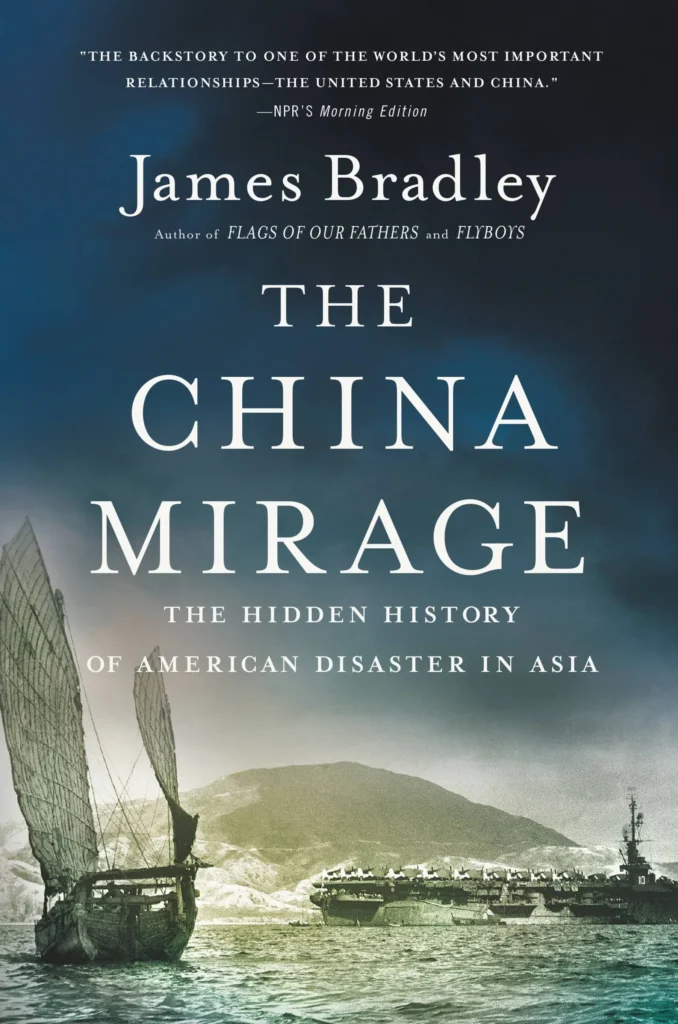
The China Mirage: The Hidden History of American Disaster in Asia. By James Bradley
By the time Henry Luce’s LIFE magazine was churning out colorized visions of a democratic, Christian China under the steady hand of Chiang Kai-shek, the die had already been cast. Not in Beijing or Nanjing but in Washington and New Haven, where a potent combination of missionary fantasy, elite delusion, and diplomatic theater spun the most expensive fiction in American foreign policy. It might well turn out to be the most expensive misunderstanding in American history. James Bradley’s fascinating The China Mirage tells that story in a way few books have. It’s less a cautionary tale and more a generational hallucination, one whose ghosts are still rattling around the White House Situation Room today.
This is not a subtle book, and that’s its strength. Bradley writes with the fervor and sardonic tone of a man watching a slow-motion car crash that everyone else mistook for a victory parade. The narrative he unspools is less about China itself and more about the American invention of China, an invention powered by an astonishingly small handful of men: Henry Stimson, Henry Morgenthau, and above all Henry Luce, whose boyhood in China as a missionary’s son formed a kind of mythic cradle for the 20th-century China Lobby. Their China was a Christian China, a Westernized China, a China that never really existed.
This is the mirage of the book’s title, and Bradley makes clear that it has cost America dearly.
At the heart of The China Mirage is a claim that would sound like conspiracy if it weren’t so well-sourced: that Chiang Kai-shek, Madame Chiang, and her brother T. V. Soong orchestrated the most successful foreign public relations campaign in American history. Under the pretext of fighting Japan, they extracted huge sums of money and military hardware from FDR, which either went into their own pockets or flowed toward Chiang’s guerilla war with Mao. With the Soongs’ impeccable English, Wellesley diplomas, and Methodist polish, they seduced a generation of American policymakers into believing that Chiang’s faltering, corrupt regime spoke for China. Luce, with his vast media empire, did the rest, featuring Chiang and Madame Chiang on LIFE’s cover more often than most American celebrities, opening women’s clubs and Manhattan drawing rooms to China donations, and making millions of Americans believe they were elevating the noble Chinese peasant.
The result: billions in aid, doctored diplomatic cables, falsified briefings to the president, and a country misled into war.
Bradley reminds us that America’s misunderstanding of China didn’t start in the 1930s. It goes back to the Opium Wars, where a shocking number of American fortunes were built not just adjacent to, but on the opium trade. One of the most successful American opium traders was Warren Delano, the grandfather of Franklin Delano Roosevelt. That tainted legacy – Warren Delano never publicly acknowledged that particular source of his great wealth – financed FDR’s entry into elite American politics, and haunted his presidency in more ways than he may have realized.
This misunderstanding took root in the “civilizing mission” America inherited from Europe. It was missionary zeal, not geopolitical realism, that shaped early U.S. policy toward China. Americans who studied or traveled there did so in a cocoon of privilege, surrounded by English-speaking Chinese like Charlie Soong – Madame Chiang’s father – educated in American seminaries and bearing a gospel of compatibility between East and West. But, living in pockets of little America where the Chinese spoke in Bostonian accents and ate with forks, they never saw the real China. They didn’t try.
Meanwhile, if China was an object of fantasy, Japan was an object of admiration, at least to Theodore Roosevelt. His affinity for Japan was strategic, but also philosophical. Baron Kaneko, the Japanese emissary and Harvard Law School graduate, served as Roosevelt’s pipeline to Tokyo. Teddy did more than support Japan’s war with Russia; he envisioned a Japanese Monroe Doctrine for Asia. His words are as startling today as they were sincere then:
“Japan is the only nation in Asia that understands the principles and methods of Western civilization… A ‘Japanese Monroe Doctrine’ in Asia will remove the temptation to European encroachment…”
Here was an American president openly encouraging Japanese imperialism as a civilizing force. In his eyes, Japan was what he hoped China could never be: Western in function, Eastern in soul. While hindsight is fraught with pitfalls, it is tempting to draw a direct, bright line between Teddy’s words and Pearl Harbor.
With Teddy’s cousin Franklin it was the opposite. That FDR was enthralled by China is not surprising given his family’s financial and cultural entanglement with the East. What is surprising and maddening is how thoroughly he was manipulated by his advisors. While FDR often bypassed his own State Department, Treasury Secretary Henry Morgenthau and Undersecretary of State Sumner Welles routinely bypassed FDR by altering presidential language in diplomatic dispatches to send money to Chiang Kai-shek. They even altered minute details of FDR’s instructions for selling aviation fuel to Japan, changing language about limiting the fuel to above a certain octane number to restrictions on all aviation fuel. A billion dollars, an astonishing sum at the time, flowed in the 1930s from American coffers into the pockets of a government more interested in suppressing Mao than resisting Japan.
FDR knew denying oil to Japan was dangerous. He feared it would drive them to attack the Dutch East Indies. He was right. But the China Lobby, seduced by Madame Chiang’s charm and Soong’s cunning, overrode him. Their obsession with propping up Chiang at all costs set the stage for Pearl Harbor.
The tragedy, as Bradley sees it, was that there were Americans who saw through the mirage. Men like John Service and John Paton Davies, so-called “China Hands”, recognized that Mao, brutal though he was, represented the real face of China. Chiang was for warlords, the moneyed elite, and above all for himself. Mao had his finger on the pulse of the peasants and the masses. His forces had popularity and mass mobilization. Service urged FDR to treat Mao as a legitimate partner in fighting Japan. But history took the other fork. Chiang stole the gold, fled to Taiwan, and left Americans ignorant of the history wondering why on earth successive Chinese premiers all the way to Xi Jinping would have designs on the little island. By the time Harry Truman became president, Chiang’s subterfuge had become clear. Truman immediately halted all aid and had harsh words for the small cabal of Chinese charmers who had been hoodwinking his predecessor for more than a decade.
Mao, for his part, won – without American help – and built a China fundamentally alienated from the West. Those who had tried to tell the truth were later purged from government in the McCarthyite hysteria of “Who lost China?”.
Bradley’s answer is stark: America never had China. You cannot lose what you never understood.
If the book has a flaw, it lies in its idealization of Mao as a missed opportunity. Bradley occasionally veers toward the wistful, suggesting a fruitful U.S.–Mao alliance that might have changed the Cold War. Perhaps. But the Soviet experience reminds us that wartime alliances with authoritarian revolutionaries rarely age well. A brief collaboration, yes. A lasting friendship? Unlikely. Bradley also drips with condescension toward the China Lobby. This is understandable given their appeasement of Chiang and instigation of conflict with Japan, but he uses the Chinese term “barbarian” to refer to Americans so many times that the reader starts suspecting whether he himself thinks of his countrymen that way.
Still, the power of Bradley’s argument stands. The China Mirage is less about diplomacy and more about epistemology. It is a chronicle of how wishful thinking, cultural arrogance, and elite illusion can build a foreign policy more dangerous than simple ignorance.
Reading The China Mirage in 2025 feels like reading a classified memo too late. The names have changed: Chiang is Xi, Luce is the think tank circuit, and we have our own China hawks and Joe McCarthys, but the mirage persists. We are still searching for the China we want, not the China that is. We cycle between naïve engagement and paranoid confrontation, still guided more by emotion than expertise. Bradley closes a century-long loop, showing how each misunderstanding builds atop the last. Vietnam, Iraq, Afghanistan – each time we believe we’ve found a reliable, pliable partner or client state, only to discover we never understood the ground we were standing on. These are not foreign policy failures. They are failures of imagination, of empathy, of study.
We cannot afford another mirage. What we need now is not a doctrine but depth. A new generation of China hands, fluent not just in Mandarin, but in history, philosophy, bureaucracy, and myth need to be at the helm. People who’ve lived the language, traced the dynastic cycles, and can tell a court eunuch from a Red Guard. Not because we should flatter China, but because we should understand it. Robert McNamara who was one of the chief architects of the Vietnam War realized – much too late for his own and the country’s good – that our primary lacuna in fighting Vietnam was that, unlike Soviet experts such as George Kennan, George Ball and Llewelyn (Tommy) Thompson, we never had any experts on Vietnamese history, culture and language.
It is not dovish to appreciate your adversary. It is not hawkish to know their history. It is prudent. It is strategic. And it is, at this late hour, essential. The next crisis will not wait for us to figure it out. Either we invest in that understanding now, or we will, once again, pay for it later. In treasure. In credibility. In American lives. In The China Mirage, Bradley has handed us a mirror. What remains is whether we choose to look into it, or whether we look away.