
by Scott Samuelson

Studying in Leipzig back in 1993, I took the train down to Dresden and visited the Old Masters Picture Gallery. As I meandered among the masterpieces, I was stopped in my tracks by Johannes Vermeer’s Young Woman Reading a Letter by an Open Window. The droplets of light on her braids. Her ringlets of loose hair. The almost-touchable texture of the tapestry. The almost-smellable bowl of fruit. The mysterious green curtain. Her face engrossed in the end of the letter. Her blurred reflection on the windowpane. I ended up gawking at the painting so long I missed my train back.
Right now, at the Frick Collection in New York, people the world over are crowding into an exhibit called “Vermeer’s Love Letters,” featuring three exquisite portraits by the master on his favorite theme (I first wrote “only three”—but that’s nearly ten percent of his work!). Vermeer shows are always a sensation. I still remember the excitement I shared in early 1996 with the line of museumgoers waiting in the cold to see the once-in-a-lifetime exhibit at the National Gallery in Washington D.C., which gathered twenty-one of his thirty-five paintings.
How have Vermeer’s paintings come to entrance the world? Why is that painting in Dresden—alas, not in the Frick show—still my absolute favorite over thirty years later? What are Vermeer’s love letters trying to tell us?
A couple of years ago, I had an experience that revealed to me the secret of our fascination with his paintings. It took place at Terminal One in O’Hare—at Stefani’s Tuscany Café. But before I unveil the mystery (at least as far as I’ve been given to understand it), let me say a quick word about light.
It’s been argued that Vermeer relied on a camera obscura to achieve his precision—a device that utilizes light falling on a sensitized plate. Whether or not he used one, his intense realism isn’t simply that his works are visually accurate. Each painting is a document of light, a way of preserving in oils the precise flow of a moment’s illumination, much like how a camera obscura’s plate or photographic film is—remarkably—the recorded imprint of the exact light of the moment it captures.
You could imagine a painter, steeped in the optics and natural philosophy of the seventeenth century, for whom capturing the realities of light would be the be-all and end-all. For what are the visual particularities of textures, colors, and shapes except the interaction of light with our eyes? But Vermeer took his quest for reality to another level.
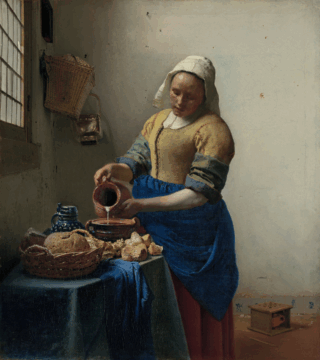
Think of how his compositions are populated with maps, paintings, patterns, reflections. As first glance, it’s like he’s trying to remind us how much we rely on concepts refracted from the visual. Maybe he’s even trying to show us just how close to the workings of light his brushstrokes are by comparison.
But the more he insists on material reality, the more obvious it becomes that something exceeds the dance of light on objects. A woman reading a letter is a perfect example. Her inner life is hidden, even as it shines through into the visible.
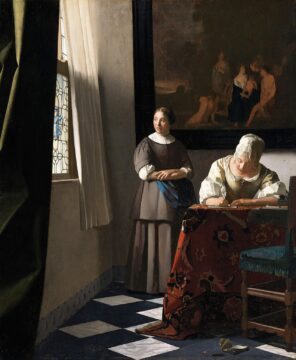
In one of Emily Dickinson’s poems, she exhorts us to “Deal with the soul/ as with Algebra.” Part of why I think Vermeer’s paintings are so fascinating is that they deal with the soul as with algebra. By being so visually precise about their subjects, they isolate the x that can’t be visually revealed. They remind us of the stubborn presence of the soul in an age inclined to think that reality is no more than what can be directly observed. In this sense, they’re religious, regardless of any symbolism. Vermeer is telling us that when we look as closely as we can at reality, we come face to face with the secret that reality is keeping.
Discussions of Vermeer’s paintings of women often concern issues like if their love letters bespeak illicit affairs, or if they’re even love letters, or what the symbolism of the fruit in the bowl or the painting on the wall can tell us about how we’re supposed to interpret the work. There are few painters about whom such discussions strike me as more pointless. When I consult what I see and love in Vermeer’s paintings, I don’t care what the apple or Cupid’s bow is supposed to tell me about their subjects. I experience no trace of judgment or moralizing in his work.
Don’t get me wrong. Vermeer is obviously interested in allegory. Not only do mythological paintings hang inside his compositions, whole works of his are organized around allegory, like The Allegory of Painting and The Allegory of Faith. But his most engrossing paintings, like those of the women with their letters, aren’t allegories, nor should they be read as such. They’re not object lessons. They’re not codes to be cracked. Their faces contain what can only be hinted at by the images surrounding them. In Vermeer’s interiors, the painted reality is a way of reading the allegories, not the other way around.
Now we can return to Stefani’s Tuscany Café in O’Hare. On the table in front of me is an almost-finished pizza funghi and a half-drunk six-ounce pour of Chianti. I’m looking around the restaurant and getting grumpy about how every attention span but mine is being hoovered up by a device. Then I catch sight of a woman in her twenties nibbling at a slice of pizza, sipping on a six-ounce pour of Pinot Grigio, sometimes daydreaming, sometimes people-watching. No phone!
By conventional standards, her looks are quite plain. But she’s beautiful to me. Here’s a face, a youthful face, still open to being shaped by the interaction of her thoughts with the real world. I almost walk over to talk to her—to congratulate her, to thank her. We’re comrades in things of the spirit.
Just then, a phone bleeps from her purse. She digs the damn thing out and starts texting. I give up all hope in the world and return to my Chianti.
When I finally look up again at her face, just to confirm how unbeautiful she’s become, something in the message she’s reading makes her lips flicker with a profound half-smile. She gathers her thoughts. Her face concentrates everything it has into texting back. She’s in love, or so it powerfully seems. She’s probably waiting to catch a flight to see the lover she’s texting with. Suddenly, nobody else in O’Hare exists. Just her in her white V-neck t-shirt and long navy skirt with a slit up to the knee. Just her and the washed sunbeam flowing through a tic-tac-toe-patterned window and twinkling against her wineglass.
An hour or so later, as I’m waiting to take off, it dawns on me that the young woman looked remarkably like a Vermeer painting.
It wasn’t simply that she was reading our era’s equivalent of a love letter. In that instant, I’d been graced with the ability not just to look at her but to see her. Somehow, I stopped judging her on whether she fulfilled or frustrated my sense of how people should behave. All my moralism and allegorizing faded into the background. I basked in the presence of a soul—a fellow suffering, loving, waiting human being.
Simultaneously, I was hyper-aware of the late afternoon sun streaming through the electric lights. It took on a liquid quality. It soaked into things. The sparkles sat like dewdrops on her wineglass.
Just as we’ll never know what the letters say that Vermeer’s young women are reading and writing, I’ll never know the exact nature of the text that made the young woman’s face in O’Hare so luminous. But I think I know the gist of it: “Remember that one time we both happened to be eating pizza and drinking wine and people-watching in O’Hare? Can you ever forgive me? IMS. ILY4EVA. XOXO.”
***
Scott Samuelson holds a joint appointment at Iowa State University in Philosophy & Religious Studies and Extension & Outreach. He’s the author of three books: Rome as a Guide to the Good Life, Seven Ways of Looking at Pointless Suffering, and The Deepest Human Life—all published by the University of Chicago Press.
Enjoying the content on 3QD? Help keep us going by donating now.