
Olga Litvak at The Hedgehog Review:
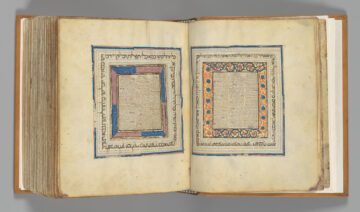 From the Christian perspective, the hyphen is a sign of Jewish translatability; but the same sign, read, we might say, from right to left, also points to a more confrontational reality, that of Jewish resistance to being translated (elevated) into a (higher) Christian register. The Jewish insistence on reading “the Bible” in Hebrew every week, in synagogue, to congregations whose first language was (and is) probably not the language of the patriarchs but the language of their non-Jewish neighbors, is a performance of otherness. We can see what is at stake in this attachment to the original when we appreciate the difference between reading Hebrew texts in Greek—from right to left—and reading the Bible as a Greek text, from left to right. From the perspective of the former, the Alexandrian translation of ’almah as parthenos provides a Jewish textual source for the Christian myth of the virgin birth. From the perspective of the latter, the same translation turns the Tanakh (a set of texts) into the Bible (a book).
Christian readers who read ’almah as parthenos locate in this translation a proof text for the argument that the Bible constitutes a single narrative with a sad Jewish beginning and a happy Christian ending, a form imitated by countless European and American novels and turned into a near-universal cultural staple by Hollywood; Jewish film moguls propagated it among the gentiles no less zealously than the early Christians who were, of course, all Jews.
more here.
Enjoying the content on 3QD? Help keep us going by donating now.