
by Barry Goldman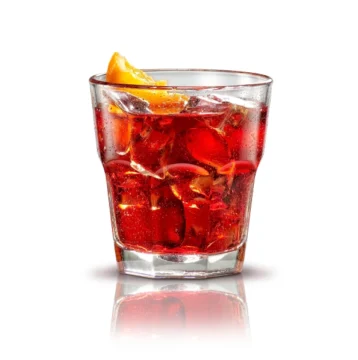
I am not a cocktail guy. The whole craft cocktail thing strikes me as precious, pretentious and silly. You want to have a drink? Fine, let’s have a drink. I’ll have an IPA or a scotch. Maybe a gin and tonic if it’s a particularly hot day. But stay away from me with your oregano tincture and elderflower liqueur. If I’m drinking wine with one of my wino friends, I like to pay attention to the first few sips. We can talk about the character of the wine for a minute or two. But then I want to talk about something else. I quickly run out of patience with conversation about artisanal anything. Look, I’m a crotchety old Midwesterner. Guys like me just don’t go for that stuff.
On the other hand, I am a big fan of the physicist, author and “natural philosopher” Sean Carroll and his Mindscape Podcast. So when Carroll interviewed Kevin Peterson, author of Cocktail Theory: A Sensory Approach to Transcendent Drinks, I listened. And it was fascinating.
Peterson has an undergraduate background in physics and a PhD in mechanical engineering. He approaches the world of cocktails as a scientist. In Peterson’s view, a statement that one drink is better than another is not a matter of opinion. It can be objectively confirmed. Partly, this is based on his knowledge of the biology of the human sensory apparatus, and partly it is based on his extensive, painstaking accumulation of data. Peterson has digital thermometers and gram scales that allow previously unavailable precision measurement. And he has the kind of obsessive personality that will systematically test a thousand daiquiris. He proceeded methodically, varying only one element at a time and only by tiny increments. Testing ingredient ratios was only the beginning. He also tested small changes in temperature, dilution, and aeration. In the end, he says, he can draw quantitative, objective conclusions.
Peterson claims to have established, for example, that the proper distance to shake a cocktail shaker is 18 inches, and proper length of time to shake it is 12 seconds. His claim is that this is not just his opinion. He says it’s in the data.
Petersen has an “experimental craft cocktail bar” called Castalia in a Victorian mansion in midtown Detroit. The bar offers reservations for a 90-minute “cocktail tasting menu experience.” My wife and I signed up. I brought my copy of his book. We met Petersen – a thoroughly charming fellow – and he signed the book with, “Let the data be your guide.”
I’d love to say the experience was transformative, but it was not. It was precious, pretentious, and silly. The drinks were, to use the Yiddish term, óngepatshket (אָנגעפּאַטשקעט).
But that’s not the end of the story. There are really two questions here. You could build the perfect daiquiri, given everything Peterson has learned about what that means. But if you serve it to someone who doesn’t like daiquiris, he won’t like it. There is the question of building the perfect drink, and there is the separate question of matching that drink to the right drinker. To address the second question, Peterson has undertaken the Cocktail Genome Project. The idea is to construct an algorithm that will reveal a person’s cocktail preference from a series of questions about their flavor profile. There are questions, for example, about the person’s “feelings toward bitterness.” Here are some of mine:
Do I like black coffee? Definitely.
Hoppy beers? Devotedly.
Brussels sprouts? My favorite vegetable.
My answers suggested I would like a negroni: equal parts gin, sweet vermouth, and Campari, over ice, garnished with an orange peel.
I had never had a negroni. But the next time I was in a bar that could make one I ordered a negroni, and it changed my life. I mean it. The closest analogy I can come up with is love at first sight. It was a where-have-you-been-all-my-life moment. I can’t remember the last time I had one of those. I went out the next day and bought my first bottle of Campari and my first bottle of sweet vermouth. My wife and I have started having a drink before dinner, and it’s my favorite part of the day. I can’t stop talking about how perfectly delicious my negroni is.
All of which takes me to the subject of Denis Dutton and his book The Art Instinct: Beauty, Pleasure, and Human Evolution. Dutton was the genius founder of Arts & Letters Daily and the perpetrator of the delicious Bad Writing Contest. In The Art Instinct, Dutton argued that humans are wired by natural selection to find certain things beautiful. All over the world, for instance, people have landscape paintings on their walls. And all over the world, those paintings include the same elements:
Open spaces of low (or mown) grasses interspersed with thickets of bushes and groupings of trees;
The presence of water directly in view, or evidence of water nearby or in the distance;
An opening up in at least one direction to an unimpeded vantage on the horizon;
Evidence of animal and bird life; and
A diversity of greenery, including flowering and fruiting plants.
What is it about this particular type of landscape that makes it the subject of countless paintings all over the world and throughout history? According to Dutton, evolution built the preference for this kind of landscape into our psychology because it would have been the ideal setting for 80,000 generations of our hunter-gatherer ancestors. Though we no longer live in hunter-gatherer bands, if you look at the calendar on the wall in houses all over the world you will see the same scene. It is not the power of the calendar art-industrial complex that produces this result. The preference is there because evolution put it there.
Is it the case that the preference for negronis is built in to the structure of the perceptual apparatus? Clearly not. Some people find them undrinkable. But for people with the right predisposition, they are marvelous. This is not merely circular. There are reliable predictors. One day, either from the brute force of Peterson’s data gathering or from a deeper understanding of the mechanism of taste buds, olfactory receptors, and whatever cultural influences may be at work, we may have the algorithm.
And that takes us to the subject of the Human Genome Project, pharmacogenomics, and personalized medicine. Not so very long ago the story was that sequencing the human genome would lead in a straight line to personalized drug therapy. In theory, scientists who have your DNA profile and a drug laboratory can cook up just exactly the chemical you need to cure what ails you. It hasn’t worked out quite that way, at least not yet. But that was the idea.
You can see how the Cocktail Genome Project got its name. And you can see its promise. In theory, a scientist like Peterson, or a team of scientists like Peterson, should be able to construct an algorithm that will produce personalized cocktails perfectly matched to the flavor receptors in any drinker. Like a key in a lock.
You load in the answers to a series of questions, and the algorithm produces the recipe for a cocktail that perfectly matches your flavor profile. The payoff is that where-have-you-been-all-my-life moment.
Is Peterson right? Is Dutton right?
I don’t know. But I have had a lovely time recently drinking negronis and thinking about it.
***
Enjoying the content on 3QD? Help keep us going by donating now.