
Michael Marshall in Nature:
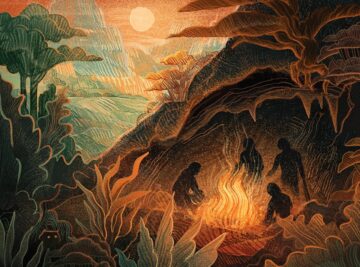 It was the finger seen around the world. In 2008, archaeologists working in Denisova Cave in southern Siberia, Russia, uncovered a tiny bone: the tip of the little finger of an ancient human that lived there tens of thousands of years ago. The fragment didn’t seem remarkable, but it was well preserved, giving researchers hope that it harboured intact DNA. A team of geneticists led by Johannes Krause at the Max Planck Institute for Evolutionary Anthropology in Leipzig, Germany, removed 30 milligrams of bone and managed to extract enough intact DNA to analyse it. They were able to sequence the entire mitochondrial genome — and were shocked by what they found. The DNA did not match that of modern humans, or of Neanderthals, the other likely candidate1. It was a new population, which they dubbed the Denisovans, after the cave.
When the team announced this result in March 2010, it caused a sensation. Up to that point, researchers had used preserved bones to identify every species or population of hominin — the group that includes modern and ancient humans and their immediate ancestors. “Denisovans were created from DNA work,” says palaeoanthropologist Chris Stringer at the Natural History Museum in London. Nine months later came the second bombshell. Krause and his colleagues had obtained the entire nuclear genome from the finger bone, which yielded much more information. It showed that the Denisovans were a sister group to the Neanderthals, which lived in Europe and western Asia for hundreds of thousands of years.
More here.
Enjoying the content on 3QD? Help keep us going by donating now.