
by Paul Braterman
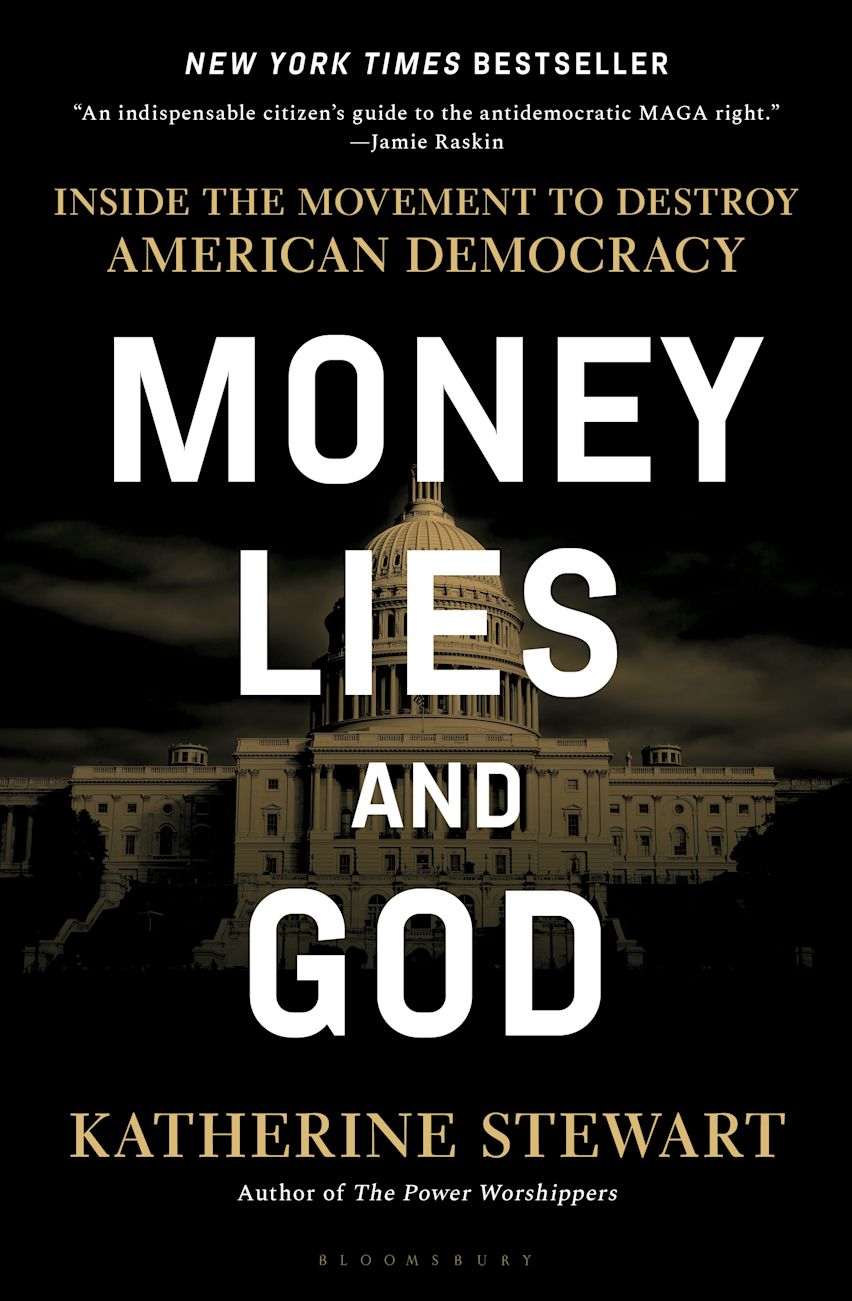 This book is essential reading or anyone who is trying to make sense of what is happening in America (and, alas, in much of the rest of the world) today. It traces the intellectual roots of Trumpism back to its fascist (or perhaps more accurately Nazi) roots. It anatomizes the extraordinary coalition of the superrich and the disaffected that has made the Republican Party what it is today, explores the contribution of apocalyptic religion to the cult of Trump, and details the organizational networks that hold this coalition together. Most disturbingly, it shows that Trumpism is a symptom of a much larger and more deeply rooted phenomenon that will not disappear with Trump. More encouragingly, it points to inherent contradictions within the coalition that may yet prove its downfall. Finally, it urges those who value democracy to be active and organize at all levels. To which I would add, join a Union. It is the Faculty Union, not the University Administration with its $52 billion endowment, that is fighting Trump’s attempt to seize control of Harvard. [Update: the University has now rejected Trump’s demands.]
The author has been studying the phenomenon she describes here for over 15 years, and has written two earlier related books. This one manages to cover an enormous territory, from which I can here only present a few impressions, with a large cast of actors, combining together detailed discussion of organizations and arguments with firsthand accounts of political and religious gatherings, and the sometimes colorful biographies of many of the leading characters. It is as close to being an enjoyable read as the subject matter permits, skillfully navigating its complex narratives through some 250 pages of text, backed up by over 700 references, most of them with web links.
The book appears to have gone to press after Trump’s 2024 electoral victory, but before he took office. Its analysis helps make sense of the Trump regime’s most extraordinary behavior, such as its fondness for spreading measles, its assault on the academic and governmental research base that has served the US economy so well, its betrayal of Ukraine, and the Orwellian rewriting of American history that un-persons or sidesteps people as diverse as Colin Powell and Harriet Tubman. In each case, we can with the aid of the book understand what is going on. Simply put, Trump is an accomplished mafioso, and rewards his power base. The book does not however prepare us (how could it?) for the full impact of Trump’s own megalomania and erratic policy-making.
I have only one slight criticism, which may perhaps merely reflect my own interests. There is little discussion of the connections, dating back to before 1980, between biblical creationist organizations and the doctrinaire illiberal Right of which Trumpism is the latest aspect, or of the links that have been forged between these organizations, with their theological and pseudoscientific denial of climate change, and leading right-wing political think tanks.
The author starts off her Introduction by stating what I think should by now be obvious, though some Democratic Members of Congress still do not seem to realize it:
The movement described in this book isn’t looking for a seat at the noisy table of American democracy; it wants to burn down the house. It isn’t the product of misunderstanding; it advances its antidemocratic agenda by actively promoting division and disinformation.
Moreover, this movement did not start when in 2015 Trump announced his candidacy for President, and will continue to feast on what Stewart calls “the carcass of the Republican Party” after he is gone.
The process is driven by increasing economic inequality. In the middle of the 20th-century, America had a secure and prosperous middle-class. But over past decades, the top 0.1% of the population has doubled its share of the national income, at the expense of the bottom 90%, and some strata of society have even seen a reduction in life expectancy. Growing disparities have created a very small class with the means to impose their own vision, and increased the vulnerability of much of the rest of the population to directed disinformation. Much of the professional class has abdicated its own responsibility (and in support of the book’s thesis, I would point to the current capitulation of law firms and university administrations), while the anger and resentment of those who feel themselves falling behind has undermined their confidence in the democratic system that has failed to meet their needs. The entire antidemocratic movement draws strength from the same us versus them mentality as racism, except that its followers, of any race, can buy into the privileged ingroup by adopting the approved beliefs, paraphernalia, and political loyalties. The residual racism, however, surfaces repeatedly, and is now blatantly on display in the Trump regime’s actions. The approved beliefs, for reasons discussed in the book, have come to include, in the name of freedom, restrictions on individual sexual behavior, and an inferior role for women. The most destructive part of the movement is its negation of reason itself, in the pursuit of doctrinal orthodoxy.
The book divides the antidemocratic coalition into five groups, the Funders, the Thinkers, the Sergeants, the Infantry, and the Power Players. These different groups have different motivations and interests, but are united in their campaign to impose their own will, even at the cost, as becomes clear later, of denying reality.
The Funders have chosen to invest part of their massive wealth in strategies that undermine democracy, in the belief that those strategies will make their wealth even more massive. Among other things, they fund the Thinkers, in institutions that provide rationalizations for the chosen policies. They embrace an anti-woke ideology, and their quarrel with what they represent as an intellectual Leftist elite is in reality an internal dispute between one group of intellectuals and another. They may describe themselves as the New Right, but as the book shows their thinking goes back to the 1930s, and is far more radical than any traditional right-wing agenda. The Infantry are a diverse middle- and lower-middle-class group, intent on censoring school libraries and promoting nationalist religion. And within the Infantry are the Sergeants, whose links include the networks of pastors who present the antidemocratic agenda as in some way biblical. Finally, there are the Power Players, dominant figures promoting their own self-contradictory doctrines of libertarian theocracy. Such doctrines, which make up what is known as Christian Nationalism, are far from Christian, but are driven by fear of catastrophe, feelings of being left behind and persecuted, the embracement of an increasingly specific political identity, and admiration of authoritarianism.
We see these different groups coming together early in the book, at a meeting organized in a Baptist Church Hall by Chad Connelly, one of the large number of key figures that we meet throughout the book, and a member of the Council for National Policy (CNP). This organization goes back to the early days of the Reagan Administration, and I was repeatedly struck as I read the book of the strong similarities between the present Christian Nationalism agenda and tactics, and those spelt out, as I described here earlier, in LaHaye’s The Battle for the Mind. The recurrent themes of alleged liberal and therefore anti-Christian control of the media and the political machinery, and of persecution of those who stand up for God’s truth, are already there in LaHaye, as are direct organizational links, with Trump having addressed the 2023 conference of Concerned Women for America, founded in 1979 by Beverley LaHaye, Tim LaHaye’s wife.
One thing that is new, however, is a focus on “election integrity,” i.e. voter suppression, and the linking of this agenda to the myth that the 2020 election was stolen, and that the fundamental institutions of American democracy are therefore illegitimate (as I write, a brutal voter suppression act is making its way through Congress). The stolen election narrative is essential to any movement that supports Trump, since otherwise the January 6, 2021 insurrection would be inexcusable. A corollary is the ease with which the movement blends in with other forms of reality denial, such as Covid conspiracy theories.
Another relative novelty is the frantic sense of urgency. This resonates with the Last Days theology never far beneath the surface in much of American Christianity, as well as with the anxieties raised by social dislocation and the Covid pandemic.
To these we must add the sophistication with which groups like CNP connect wealthy donors (the Funders), the pastors and community organizations (Sergeants) and their congregations (Infantry), under the direction of interacting Power Players like Connelly, with the sending out of detailed materials, usable as the outline for sermons, complete with selected Bible verses. (One example I have come across myself is the Biblical Foundations Project of the America First Policy Institute, which invokes verses from Deuteronomy about just scales in support of purging the voter rolls.)
There is an interesting discussion of American Catholicism, which is strangely split. There is a liberal wing, concerned with social justice, which is typified by Pope Francis. However, there is an extreme conservative wing, with roots going back to Franco’s Spain, typified by the secretive organization Opus Dei. Scandals in the Church have weakened the authority of the hierarchy, and the conservative wing has set up its own independent organizations, including a Fox-like broadcasting network (EWTN). Catholics have been prominent in the rise of what is now Christian Nationalism from its Reaganite beginnings, with Paul Weyrich in alliance with Tim LaHaye. (As Stewart reminds us in an earlier book, Weyrich actually moved to the Melkite Greek Catholic Church from the Roman Catholic Church, which he considered too liberal after Vatican II, and it was the coalition that Weyrich assembled the that gave birth to anti-abortion politics.) Five of the six conservative judges on the current US Supreme Court are Catholics. And the book describes the emergence of a conservative Catholic theology, with representatives at Notre Dame and Harvard.
The conservative assault on public education is typified by Moms for Liberty, whose 2023 conference Stewart attended. The gateway issue is opposition to transgenderism, out of all proportion to its numerical importance, and this is blended with opposition to DEI initiatives and critical scrutiny of America’s history, and to the alleged broad influence of what is referred to as cultural Marxism. Moms for Liberty is connected to wealthy funders, and Donald Trump, Ron DeSantis, Nikki Haley, and Vivek Ramaswamy, at that time rivals for the 2024 Republican Presidential nomination, all addressed the 2023 conference.
There is a lot of money to be made in the private education industry, both by using vouchers to provide private schooling at taxpayers’ expense, and by supplying suitable educational materials. (I am a little surprised at Stewart does not mention organizations such as Abeka, Bob Jones University, and Accelerated Christian Education, who market these.)
The Heritage Foundation serves as bridge between Christian Nationalism and the New Right. Its Project 2025 is being translated into policy, in a way beyond what Stewart could have foreseen. We have the reversal of DEI (with massive rewriting of official information documents to minimize the role of non-whites and women), and a witchhunt on whatever might be described as “Critical Race Theory training.” The Heritage Foundation agenda claims that Health and Social Services should protect conscience (code for the right of religious conservatives to impose their own views on others), the right to life, and what it calls bodily integrity. The anti-trans agenda is linked to traditional marriage, the ending no-fault divorce, and opposition not only to abortion but to contraception. Project 2025 is against what it calls elite rule and woke culture, with Russell Vought (reinstalled since the book was written in the Office of Management and Budget) saying “America cannot be saved unless the current grip of woke and weaponized government is broken.” This ties in with attacks (see below) on the “administrative State.”
The Claremont Institute, founded 1979, is one of the organizations that connects the New Right to the old religious right, as the latter abandons social conscience and embraces fascism. Stewart traces Claremont’s intellectual roots traced back all the way to intellectual justifications of Nazism, and the explicit Nazism of Carl Schmitt, with anti-woke taking the place of anti-Jew. Claremont is the publisher of American Mind, which provides a platform for pizzagate conspirators and aspiring leaders of armed militias. John Eastman, who is on the Board of Claremont, is a former clerk to Clarence Thomas. He has been indicted for his role in attempting to overthrow the 2020 election result, and argues that America faces an overriding emergency from the Democratic party, justifying insurrection.
Feminism is another evil manifestation of wokeism. (Here I would point out that Tim LaHaye singled out feminism as humanist and evil, and that the fundamentalist churches in the US insist on so-called complementary roles for men and women, while denying that they are advocating inequality.) The doctrine of male domination is evident in consent laws, which would require the father to agree to an abortion, and with opposition to equal rights for women in the workplace. Stewart reminds us that the Southern Baptist Convention, in 2023, reversed its policy of allowing women to preach. She gives examples of writing that shows extreme contempt for women, and praise for manliness. The word “virtue,” after all, does derive from the Latin vir, man.
Patriarchy spills over into pronatalism, the demand that the right kind of women have lots of children (I seen this as another direct echo of Nazism, also met with among the creationists), so that the US can cut down on immigration, and open regret that women have the right to vote differently from their husbands.
Claremont and the Federalist Society have long talked about dismantling the administrative state, which according to Russell Vought, has woke ideology embedded in its very DNA, and which they see as an undemocratic instrument imposing the will of the knowledge class.
The attack on the administrative state also comes from extremely wealthy people, who may not fully understand that they owe something to the society that made their wealth accumulation possible, and see the destruction of the tax-collecting state as in their own financial interests. Thus the Claremont Institute gets its largest single contribution from Thomas Klingenstein, a financial executive. Other donors, such as the De Vos Foundation, also fund climate change denialism and the attack on public schooling. Stewart presciently notes that these donors may not fully understand the full implications of what they are funding.
Stewart did not foresee the chainsaw that the Trump/Musk regime would bring to the administrative state. She mentions the National Park Service and the FDA as examples of institutions that would presumably be allowed to continue to operate. She also reviews Michael Pack’s record at the organization running Voice of America, and his attempts to fire staff members opposed to Trump, only to see them reinstated by the Inspector General of the State Department. Now of course, we have seen the mass sacking of Inspectors General, and the silencing of the Voice of America.
Moreover, if you attack reasonableness, you risk attracting the unreasonable, as shown by the next section of the book, Demons. Here we meet the apocalyptic religious base of Trumpism, with its own prophets and at times strange theology, and claims that Trump is anointed by God, as was Cyrus, or even David. The New Apostolic Reformation, typified by Lance Wallnau (who has over 2 million followers), preaches the Dominionist mandate, according to which the Church should aim to seize control of the “Seven Mountains” of government, business, media, education, entertainment and arts, family, and religion. This is a theocratic and antidemocratic creed, with no place for the separation between Church and State. NAR declares that
“we have been given legal power from heaven and now exercise our authority… We declare that we stand against wokeness, the occult, and every evil attempt against our nation … We declare that we take back and permanently control positions of influence and leadership in each of the Seven Mountains”
and goes on to say that judicial rulings will be biblical, the one true God will be honored, and
“AMERICA SHALL BE SAVED!”
Wallnau is preoccupied with demons, and sees evil at work in scientists who described vaccines as life-saving, people who derive their morality from reason and empathy rather than the Bible, and professors who advocate theories he doesn’t like:
“Satan has taken over the academic mountain, he’s taking over government and the FBI, he’s taking over Hollywood and Netflix.”
And of course most demonic of all is deviation from heterosexual norms. Hence preoccupation with bathrooms.
Pentecostals are among the fastest-growing group of Christians, and the most reliable supporters of Far Right ideology. Thus Stewart plausibly suggests that increasing support for Trump among Hispanic voters may be due to many of them switching from Catholicism to Pentecostalism.
One chapter is devoted to a ReAwaken America meeting in Las Vegas, which I will describe in some detail, since it is so remote from the normal political discourse with which readers here will be familiar. The meeting happened to be covered by a German film group, whom Stewart befriended, and who were shocked by what they saw. This is no minor fringe group. The President’s son Eric Trump has addressed it several times. So has Mike Flynn, the disgraced national security adviser with proven links to Moscow, who said that Trump should have used the military after November 2020 to force a re-run of the election. The conspiracy theorist Alex Jones was a speaker at Las Vegas, as were other Covid deniers. The group had earlier raised money for JFK Jr, who spoke at one of its meetings during his presidential campaign.
ReAwaken America is run by Clay Clark, a life coach and businessman from Tulsa. He is opposed to mask mandates, and also to anti-Covid vaccines, which he says contain a compound called luciferase, made using Jeffrey Epstein’s DNA. (There really is a compound called luciferase, which fireflies use when signalling.) The evil plot here was hatched at Davos, and involves Bill Gates, Black Lives Matter, the World Economic Forum, and climate activists. Clark quotes the book of Revelation, and relates the number 666 to the World Economic Forum and the World Cup health Organization. Jackson Lahmeyer, founder of Pastors for Trump, which claims 7000 members, is also part of the organization. Stew Peters, another antivaxx conspiracist, predicts the death penalty for Anthony Fauci and Hunter Biden, tells the audience that “liberals, democrats, communists, lizard things” are running the country as Satan’s minions, “the restoration of the rightful President of America” (remember that the rightful President of America that time was Joe Biden), and promises the use of rope, water, and millstones, to bring accountability. Roseanne Barr is one of the speakers, and wants to rescue “our children” from the hell that they have created. Who are they? They are “the people who own every cent in this world and also keep track of it.” (Presumably, she means the Jews. At this point, the German filmmakers are feeling decidedly uncomfortable, and it does not help when another speaker promises blitzkrieg against their opponents.) Much more about conspiracies, in the leaflets available. They are coming after your children, the pandemic was only an exercise, there will be a nuclear attack, you need to stock up on provisions, the electric grid will collapse, and everyone will be microchipped and have their guns days away, as part of the total enslavement of humanity. There is only one way of averting such catastrophe, and that, of course, is Trump.
This is what the Far Right has turned into. There is no point trying to reason with it because its principal method is the destruction of reason. There is no point in using rational arguments against it, because doing so merely identifies you as a member of the liberal conspiracy. This explains why Trump emerged electorally triumphant (sort of, just about) despite, or indeed because of, his unprincipled lawlessness, and how he manages to present himself as the One True Defender of America, while destroying all of America’s institutions.
The body of the text concludes with two chapters regarding the overseas operations of the Christian Nationalism network, and the links between various Far Right groups round the world. I was surprised to learn here that Weyrich, mentioned above, was an influence on Putinism, which prides itself on its intolerance towards trans people. However, the connections between the US and Russia run both ways, with Russian troll farms working to discredit Black Lives Matter and the trans rights movement using inflammatory false flag postings. Anti-trans material originating in Russia was used as a weapon against Harris in 2024, which for me raises awkward questions as to why the Democratic party was so vulnerable on this issue (more on this below).
Opposition to abortion also serves to bring together Far Right international etworks, with large sums of money flowing, anti-abortion movements being planted in much the same way that churches are planted, and the U.S.-based Alliance for the Defense of Freedom providing legal assistance to groups breaking European laws by harassment at the entrances to abortion clinics. Such networks also support the institutionalized illiberalism of Viktor Orban’s Hungary, and of the Law and Justice Party in Poland.
Stewart concludes with some suggestions for those who wish to save democracy. She highlights six points: We are (still) in the majority; they are divided; the separation of church and state is a good idea—and we should try it; extreme levels of material inequality are eroding democracy; knowledge is power; and (as her entire narrative shows) organization matters:
Support your school community. Get involved in local governance. If you belong to a church or house of worship, work to bring your fellows to the side of justice and voter engagement and education campaigns. Reach out to those who feel politically disenfranchised. Tell them democracy matters. Tell them the republic is theirs—if they can keep it.
There are, as I mentioned, two topics that would I think have repaid more discussion here, though they are touched on in the author’s earlier book, The Power Worshippers. The first of these is the deep connection between Trumpism and biblical literalist creationism. Readers would have been interested in the fact that Speaker Johnson is himself a Young Earth biblical literalist, and has done pro bono legal work for Answers in Genesis, the world’s most prominent creationist organization. LaHaye, whose program so strongly resembles today’s Christian Nationalism, was a close associate of the Henry Morris, whose Genesis Flood is the foundational document of present-day creationism, was part of the original group that helped set up Morris’ Institute for Creation Research, and was given a laudatory obituary by Answers in Genesis.
I would also have liked to hear more about the role of the climate change denial industry in Trump’s coalition. Climate change denial is itself embraced by the major creationist organizations, for doctrinal as well as political reasons, with Calvin Beisner’s Cornwall Alliance, itself biblical literalist, providing a direct link via its opposition to environmental policy to the Heritage Foundation and the Heartland Institute. John MacArthur, mentioned in the book for his views on the submission of women and opposition to Covid regulation, is a further link between the biblical literalist creationism that he preaches in his 2001 book The Battle for the Beginning , Answers in Genesis (again), which promotes his study Bible, End Times theology, and the denial of climate science, which he has attacked in a sermon as a hundred billion (!) dollar scam.
Two final uncomfortable thoughts of my own. The first is that the theocrats have a natural advantage. They are already organized (in churches) with a leadership (pastors and ministers) that can be, and is, readily linked through carefully constructed networks to the Thinkers and Funders, and their Infantry is emotionally bonded to the cause through the shared experience of worship.
The other one regards the transgender issue. The numbers affected by this issue may be small, as this book reminds us, but unfortunately that is not the point. The book repeatedly shows us how attacks on trans rights are used strategically as a gateway to wider attacks on personal freedom, ranging from opposition to gay marriage to criminalizing birth control to the subjugation of women. It tells us that, as I have long suspected, the issue is being deliberately inflamed by trolls and provocative false flags. It was also notoriously used by the Trump campaign with its slogan, “She is what they/them. He is for you,” directly linking the matter to his populist pretensions. And there really is much contention in the medical community (see e.g. this British Medical Journal editorial) about the causes and best treatment for gender dysphorias, I have seen school teaching materials emanating from Stonewall-like charities that would deeply worry me as a parent, and the political costs of ignoring such concerns are enormous.
***
Enjoying the content on 3QD? Help keep us going by donating now.