
Francesco Perono Cacciafoco in Aeon:
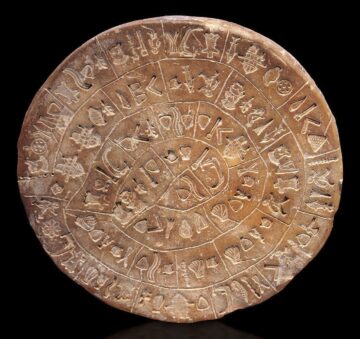 I am a glyph-breaker. I confess. Guilty as charged. A glyph-breaker who didn’t break anything, and that is quite paradoxical, because, to be a true glyph-breaker, you should have deciphered an undeciphered script, like Jean-François Champollion (the founder of Egyptology, who decoded the Ancient Egyptian hieroglyphs), Henry Rawlinson (who gave us the key to cuneiform) or Michael Ventris (who deciphered Linear B). Well, I didn’t. But I tried. I still try, in a way. And, in our times of devolution, that probably qualifies a guy to be called a glyph-breaker. The age of the great decipherments is, in all likelihood, over. What remains: a considerable amount of poorly documented, extremely elusive writing systems and ‘inscribed relics’, like Linear A, the Indus Valley Script, Rongorongo, and the Singapore Stone. Puzzles. Possibly unsolvable. Headache-generators. Nasty stuff.
Despite this, a glyph-breaker cannot be scared. A glyph-breaker doesn’t surrender. Theoretically. I started a quarter of century ago, in 1999, when I was at the University of Pisa in Italy, with Linear A, the undeciphered writing system from Bronze Age Crete, ‘hiding’ the so-called (unknown) Minoan language. I probably studied everything there was to study on that script, I reproduced many of the previous (and unsuccessful) decipherment attempts, and I tried to decipher the writing system by myself. I failed.
More here.
Enjoying the content on 3QD? Help keep us going by donating now.