
by Lei Wang
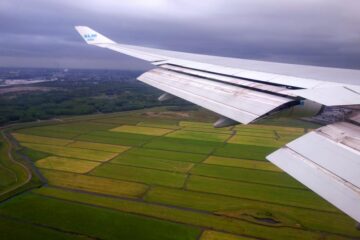 “In bardo again,” I text a friend, meaning I’m at the Dallas airport, en route to JFK. I can’t remember now who came up with it first, but it fits. Neither of us are even Buddhist, yet we are Buddhist-adjacent, that in-between place. Though purgatories are not just in-between places, but also places in themselves.
In The Global Soul: Jet Lag, Shopping Malls, and the Search for Home, a book by travel writer Pico Iyer on, among other things, the charm of airports, he quotes Geoff Dyer, who quotes the architect Vincenzo Volentieri:
“Birds in flight… are not between places, they carry their places with them. We never wonder where they live: they are at home in the sky, in flight. Flight is their way of being in the world.”
For a homing pigeon, home is a verb. I try to remember this as my flight is delayed, with bardo extended until 2am. The planes keep malfunctioning: two so far, with need for another. “We’re waiting as fast as we can,” I overhear. But bardo is better than dying.
My best friend loved bus rides as a child, because en route from one destination to another, one could do frivolous things, like listen to music or read a book that wasn’t necessary for school. It was a little bit like being sick: a time of respite from ordinary demands, as you and your paused ambitions travel to the kingdom of wellness.
During travel, you are “off the hook” in a way: you have a reasonable excuse for not getting back to people, a kind of natural digital detox. Internet is opt-in, not opt-out. You are already doing something everyone seems to agree is difficult and uncomfortable, and so distractions are socially sanctioned: juicy novels, non-arthouse movies, guilt-free fast food.
An airport is a free pass for ShakeShack, or for those early morning flights, a sweet and savory McGriddle. Of course, there are those who partake of salads and yogurt and honey crisp apples from home even en route, probably the kind of people who use the word partake.
But while traveling, I feel I don’t have to pretend to be better than I am. I don’t have to resist hundreds of thousands of years of evolution, which is exhausting. Instead of a hundred things to do, there is really only one thing to do, and just by waiting, by existing as a body in a seat, I am already doing it.
It’s why people like to be in the wilderness, when the only thing you have to do—hopefully—is stay on the trail. Maybe set up a tent, find water, build a fire, all concrete, doable things.
My best friend and I are both very invested in finding more ways of feeling less guilty and more “off the hook,” because we are guilt-prone, recovering overachievers. We are both writing books that in some ways are about the delusions of success. Because success doesn’t have a concrete benchmark, an actual location, it’s hard to know when you’ve done it. When you’ve reached the destination. More of it still doesn’t mean it’s enough; you can always keep going. We are trying to figure out what is enough.
We picked up our best friend lexicon, “off the hook,” from a New York Times Magazine piece by Merritt Tierce, a fellow recovering overachiever. The essay is actually about the abortion the author didn’t have, but as she writes about getting the positive pregnancy test, she quotes this poem by Marge Piercy:
In nightmares she suddenly recalls
a class she signed up for
but forgot to attend.
Now it is too late.
Now it is time for finals:
losers will be shot.
Later in the essay, Tierce describes the best feeling she has ever felt in her life, after she had finally given birth and someone had put a heavy blanket on top of her:
“I fell asleep almost immediately after the blanket was placed on top of me, and I felt what I can only describe as a moment of immense, complete, unforeseen pleasure, because I realized I was physically maxed out, could do absolutely nothing more no matter what was asked of me, and this resulted in a relief I have only otherwise experienced under the effects of clinically administered ketamine. This particular relief arises from being able to momentarily let go of guilt and effort because you understand you are incapacitated and therefore off the hook.”
Difficult and uncomfortable? Check, check: what overachievers think is the prerequisite for relaxing.
This was definitely not the main point of the article, but this was the point my best friend and I took from it. “You’re off the hook now,” we say to each other, as ultimate comfort: when one or the other of us is sick, when we’re in the midst of shuttling from one place to another, when a social event we would have otherwise frittered away our time at is canceled and suddenly we feel we’ve gotten some bonus life hours to spend however we wish.
But even then, we doubt ourselves: are we really that sick, or do we just want an excuse to lounge? If we’re not going to that movie, should we be writing instead? If we’re not mentally and physically maxed out, how can we possibly deserve to rest?
Not that my best friend and I, being artists, are productivity machines, quite the opposite. But unless we really watch ourselves, we are haunted by the thought of what we could be doing, the shame of what we are not. It’s hard to let ourselves off the hook.
It’s hard now that some flights even offer free Wi-Fi; one has the option of productivity after all! I’m glad I’m the kind of person who gets dizzy in cars, so I still get to be just a body then.
Travelling, I get to play hooky from life, as bardo is playing hooky from death.
But maybe I am still doing it wrong.
The spiritual teacher Douglas Harding, who traveled extensively into his 80s and seemingly never felt tired said his secret was that he never actually went anywhere. “I’m not moving through the world,” he said. “The world is moving through me.”
He was the creator of a series of meditation experiments called the Headless Way, and what he meant was that the typical way we think we see the world is a hallucination. We think of ourselves as heads on bodies, moving through the world as these avatars of ourselves. When really, if you think about it, if you actually look, you are really more like a headless video game character.
From your own perspective, moving through the world, you don’t see your own head: you see, at most, a giant space in which the world appears, perhaps a smudge in the center of your vision that is your nose. But it is not the size of the nose you are familiar with: no, this nose seemingly begins at the ceiling and ends near the floor. To everyone else, your nose is sticking out from your face, but to you yourself, your nose is huge and sticking out from a void, a void in which the world appears.
If you pay attention to the void, to the space itself instead of the things that are populating the space, it can feel that even as you move, you—not you the body, but you who is looking, you who are the space—are not moving.
What if, indeed, you are still and the world is moving through you?
Try this next time on a walk, or even while driving: pretend, for a moment, that you are not moving. You are only a screen, a transparency, you are completely still, and the whole world is moving through you. (I’ve been told not to try this sitting sideways on a subway if you have even a hint of OCD; you might feel unbalanced at the world rushing through you only one way and have to immediately go back the other way.)
It is one thing to see this, and another to live it. But living it is another way of playing hooky. Wherever you go, there you are, the spiritual adage goes. But what if you never go anywhere?