
by Priya Malhotra
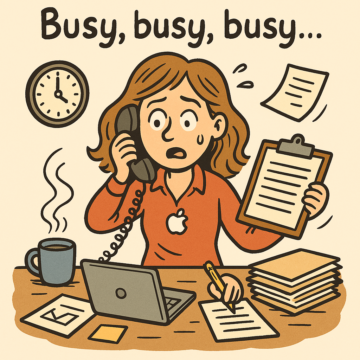
“How are you?” asked my aunt about a year ago in my living room in New Delhi, her tone languorous and inquisitive, her gaze perched on my face. Having recently moved back to India after about 28 years in the U.S., this deceptively simple question both thrilled and discomfited me. I was used to being in the U.S. where people routinely asked, “How’re you doin’?”—a greeting that always put me on the defensive. I’d always try to justify my existence by magnifying whatever I was doing with my life at that moment and try to make it sound important. That day, just as I’d grown accustomed to doing in the U.S., I rattled off the things I was doing to my aunt, which, at the time, weren’t a whole lot. I was visiting my ailing mother in the hospital, reorganizing things in the house, and getting in touch with friends. There was a great deal of leisure at that time, I must admit. (I can feel my stomach muscles contract as I write this—I feel guilty confessing to indulging in leisure. I feel I must legitimize my leisure time, make it sound somehow “earned.” See how conditioned I am?)
My aunt furrowed her eyebrows, confusion washing over her face as she said, “Priya, I didn’t ask you what you were doing. I wanted to know how you are.” And then I spilled out all my feelings about my mother’s illness, my move to India, and my various conundrums. At that time, I also began thinking about how much language reveals about a culture, and how everyday expressions in American English signify America’s devout veneration of action, motion, and productivity.
Besides “how’re you doing?,” there are numerous expressions in American English that reflect this obsession with action and ceaseless motion, this deeply ingrained notion that the value of doing vastly supersedes the value of being. “What’s happening?” “What are you doing this weekend?” “What are your plans for the summer?” The underlying implication is always the same—are you active enough to matter? Are you doing enough to validate your existence? (When I lived in the U.S., the pressure to do sometimes became so overwhelming for me that I started conjuring up grand plans for the weekend. Instead of admitting that I intended simply to veg out in bed and watch some Netflix, I’d say things like I was planning to see an exhibition at the Metropolitan Museum of Art on Friday, listen to a fabulous new jazz sensation in the West Village on Saturday, followed by dinner at a cozy Peruvian restaurant.)
Now back to language. What’s one of the first questions people ask each other when they first meet in America? “What do you do?” Not what your interests or beliefs are, but what you do. The emphasis on your profession—what you do, in other words—is so deeply woven into the fabric of American identity that your sense of self derives primarily from external actions. American culture tells you that just being fully present with yourself, without any goals or plans, is an inadequate, loser-like state; only striving and achieving make you valuable and worthwhile. Being “on the go,” as they say in America, is the default state, so deeply embedded in the culture that stillness is like a stranger—something that one deliberately cultivates by attending meditation and mindfulness classes.
Psychologist and author Jim Taylor wonderfully elaborates upon this concept in a Psychology Today article on human beings and human doings. “We live in an achievement culture that worships at the altar of accomplishment,” writes Taylor. “Growing up or living in today’s world means being bombarded by messages telling us that we must ‘do’ things (really well!) to be valued in our society (and to value ourselves). However it’s measured, whether with grades, sports victories, admission into the best schools, accumulation of wealth, status, or power, just to name a few, it can become the basis for our self-identity and self-esteem.”
I suppose it makes sense that American English would center action and productivity, considering the foundational Protestant ethic of the country as well as its capitalist ethos. Sometimes, I also wonder if this excessive emphasis on activity is a defense mechanism against an existential sense of emptiness, a means to keep our fears and our most gnawing emotions at bay.
But are we really just what we do? Should that be the sole basis of our identity? I don’t mean to suggest our actions shouldn’t account for any part of our selfhood—they definitely play a role in defining us—but I believe it’s detrimental to let our doings completely colonize our identity. Now that I’ve been away from the U.S. for almost a year, immersed in a culture where individuals don’t derive their sense of self solely from action and motion, I see more clearly the downsides of the American approach to self-definition.
When your sense of self is deeply intertwined with your accomplishments, you create a ruthless hustle culture where you must relentlessly struggle to achieve more and more in a hypercompetitive world to feel good about yourself. As Taylor explains in Psychology Today: “Human doings live in a constant state of discomfort that causes them to feel as if they must achieve and be successful or they are worthless people undeserving of love. This relationship between achievement and self-esteem becomes the basis for their own self-love.”
I know this first-hand. When my children were very young and my primary role was caring for them, I dreaded the inevitable “what do you do?” question. I’d feel shame crawling up my skin as I admitted I wasn’t a woman who could do it all. What I never disclosed—because it made me feel even more ashamed—was that I didn’t particularly want to do it all, either. I feared I’d be swallowed up by all that doing, burned down to the ashes of nobeingness, as in losing myself entirely.
I can’t help but think this whirlwind of constant busyness defiles our souls, minds, and humanity. And, as a result of it, we become estranged from ourselves and others. We circumvent plunging into the swamp of our grimy emotions. We don’t have to shudder at the mortifying sight of our inner demons. We don’t have to contemplate dark issues like our own mortality. We don’t have to feel that soul-shaking sorrow for those dying in wars or famine, that wellspring of empathy s for a mother too poor to buy Christmas gifts for her children, or the tug of joy watching stars twinkle in the sky. We avoid the hard work of forging profound relationships and creating bonds that make our souls sing. Without these experiences, are we leading fully human lives, or merely mechanistic ones?
If we wish to lead lives rich in humanity, we sometimes need to stop, walk in a peaceful garden, smell the flower-scented air, and do nothing. Then we allow ourselves the opportunity to dive into our essence, tuning into our unique rhythm and the quiet symphony of the universe. In that stillness, we’re free to be present, and experience the ceaseless expanse within us without validating our existence through a flurry of activity. As American writer Walt Whitman once wrote, “I exist as I am, that is enough.”
Maybe the next time you’re tempted to say “how’re you doin’?,” pause, reflect on the implication of those words, and consider changing them to that simple question my aunt asked—”how are you?”—and quietly observe the shift.
***
Enjoying the content on 3QD? Help keep us going by donating now.