The Immensity Of Killing Bin Laden vs. The Banality Of Language

By Evert Cilliers aka Adam Ash

Obl-nypost

There are events so shocking, untoward or thrilling, they are bigger than language. Beyond words.

In my lifetime, such events have included the assassinations of JFK, MLK, and Bobby Kennedy, as well as 9/11 and the killing of Osama bin Laden. Being a South African-American, I'd add the 1976 Soweto Uprising and Mandela's release from jail.

What sets these events apart from all others? They scorch the collective cerebellum. They rip away the veil we construct between us and reality to such a degree that, for at least a minute, and sometimes for days, we look straight into the heart of the raw what-is. The realness of the Real upends our world and blows our minds. We find ourselves staring into an approximation of Kant's Ding an sich. Language becomes inadequate. Eloquence cannot meet the moment. The event is too original for any rhetoric to be appropriate. As Adorno famously observed about the greatest crime in history, “Poetry isn't possible after the Holocaust.”

Listen to a mother talking about what happened when she and her husband heard the news that Osama bin Laden was dead. Maureen and Alexander Santora lost their firefighter son on 9/11, and this is from an interview on May 5th at Ground Zero. Mrs. Santora is talking.

“Well, Al was out watching TV and I was on the computer and he yelled out, come out right away, and I came out to the TV and on the bottom was, you know, Osama bin Laden is dead. And then they kept, you know, delaying the President coming out to speak. And we thought initially the President would say, we thought it was him, but it was a mistake. And when he came out and he said he's actually dead, we just sat there for 20 minutes and didn't move. We were just motionless. And then we were just filled with joy. We just were filled with joy. We were just elated at the realization that this had actually happened.”

Zapped by reality for 20 minutes. As if there were too much reality to absorb. And then filled with a wordless joy.

But that's not where it ends. After the merciless intrusion of the real, something happens that robs us of that moment, that wrenches us away from the unmediated experience of the raw what-is, the actual Actual.

That something is language. Inevitably, a consensus language emerges. An official narrative spins the event out of our original grasp — or nongrasp — into the pastiche of consolation or celebration.

It's like a couple ready to claw each other's clothes off, but trapped in a wedding that goes on forever. The wedding is beautiful, but it allows no room for the raw, wet desire that drew them together in the first place.

Read more »

Monday, March 14, 2011

Passion Play: Local history, poor governance and divisive politics

by Gautam Pemmaraju

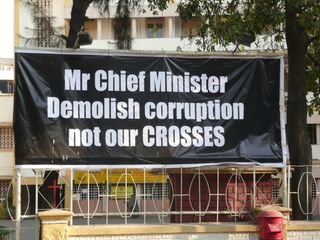
MtCarmelProtest As the picture here suggests, the local parish of Mt Carmel’s on Chapel Road in the western suburb of Bandra in Mumbai, is exhorting upon the Chief Minister of Maharashtra State to exert his efforts elsewhere. Recently, in a most controversial and aggressively conducted manner, the BMC (Brihanmumbai Municipal Corporation), the city’s main civic authority, went on a drive of demolishing ‘illegal’ religious structures, mostly ‘plague crosses’, around Mumbai – from the centre of the city in Mazagaon and Byculla, to the historic Portuguese Catholic suburb of Bandra. The local community, caught off guard and distraught by this unilateral action, has mobilized itself and is vigorously protesting the civic authority’s drive. Various newspapers as well as a few television channels have reported the events, speculating on a variety of issues – the legality of the structures, the timing of the civic body’s actions, official stances, the historical issues and community sentiments. The archbishop of Mumbai, Msgr Oswald Gracias has termed the action ‘unjust’ and ‘illegal’ and in contravention of existing policy wherein structures before 1964 are deemed to be of legal status. In 2009, a Supreme Court bench, while hearing a petition against a Gujarat High Court order instructing state municipalities to take action against illegal religious structures, issued an interim order to all states of the union, to review the status of existing structures that are constructed along roadsides and which obstruct traffic. In compliance of this Supreme Court order, the state government issued a regulation last October to all municipal bodies to take action against ‘illegal structures’. Following this government regulation, various municipal officials of the different wards began to post notices on numerous crosses and other structures (two temples) over the last two weeks to meet a February 28th deadline – there are 749 illegal structures in the city according to official figures. In the central district of Byculla, the officials posted a notice on a Saturday afternoon informing the residents of an impending demolition on Monday, leaving them no time to appeal the action. Subsequently, a cross in Hathi Baug, Love Lane, in the central district of Mazagaon, was removed and its plaque, dated 1936, was damaged. 1

In 2003 this matter had come before the state High Court and the civic body had then been instructed to take action against illegal structures. Members of the Catholic community had then submitted documentation to the civic body regarding individual structures in support of their historical value and legality. Now community members are accusing the municipality of disregarding this documentation and acting illegally.

Read more »

Monday, November 1, 2010

To Spend or Not To Spend: The Austerity vs. Stimulus Debate

Greek unions protest

Public sector austerity has come back to the West in a big way. Governments throughout the European Union are wrestling against striking civil servants, a stagnant private sector, and an entrenched public welfare system to drastically reduce spending. The budget cuts are broad, and they run deep. Under pressure from global financial markets and the European Central Bank to reduce public deficits, Spain, Italy, Portugal, and Greece have issued “austere” budgets for the coming year that simultaneously raise taxes and slash government spending. David Cameron’s new Conservative government has violated its campaign pledge to spare Britain’s generous middle class subsidies in an attempt to close a budget gap that is among the world’s largest, at 11 percent of GDP. Supposedly confirming the wisdom of austerity, the financial press has trumpeted the re-election of Latvia’s center-right government, which passed an IMF-endorsed budget with austerity reductions equal to 6.2 percent of GDP. Prime Minister Valdis Dombrovskis won his “increased mandate” – “an inspiration for his colleagues in the EU” – against a backdrop of 20 percent unemployment and a cumulative economic contraction of 25 percent in 2008 and 2009, the most severe collapse in the world.

Latvian electoral politics notwithstanding, austerity has been a tough sell worldwide. Both the protests that broke out across Europe at the end of September and the general strikes mounted against Socialist governments in Portugal, Spain, and Greece attest to the resistance all governments face in cutting public spending. And opposition has not been confined to the streets. At a G20 summit in Washington DC on April 23, the finance ministers and central bank governors of the world’s 20 largest economies agreed that extraordinary levels of public spending should be maintained until “the recovery is firmly driven by the private sector and becomes more entrenched.” Indeed, Larry Summers, the departing Director of the White House National Economic Council, still argues that the United States must continue its policy of economic stimulus in the form of deficit spending on infrastructure rather than pull back public resources, lest it cede the small gains of the nascent recovery.

Read more »